Opinion: Growth without equity — India’s inequality challenge
Even as poverty declines, widening income inequality is making India’s economic growth story increasingly uneven


By Dr Aishwarya Harichandan, Akamsha Krishnan
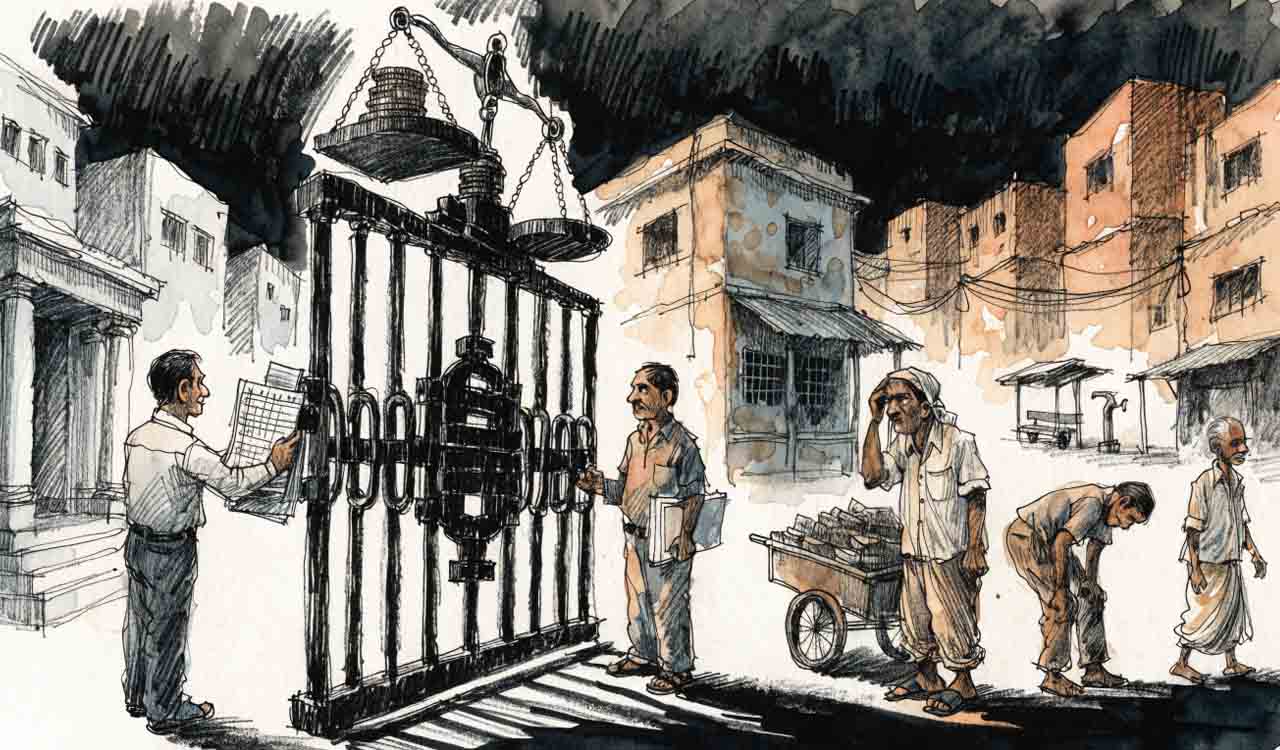
India’s growth story is often celebrated for lifting millions out of poverty. Yet beneath this success lies a more complex and less comforting reality: inequality, especially at the top, has been rising even as poverty declines. This duality raises a critical question for policymakers and markets alike — can rapid growth alone ensure broadly shared prosperity?
Also Read
The relationship between economic growth and inequality has long been framed through the Kuznets Curve, which predicts that inequality first rises and then falls as economies develop. However, India’s experience presents a striking departure from this pattern.
Kuznets Curve
An examination of the relationship between per capita income and inequality in India reveals no clear inverted U-shaped pattern. Using data from the World Bank’s World Development Indicators (GDP per capita) and the Poverty and Inequality Platform (Gini Index), the evidence suggests a weak and erratic relationship between income levels and inequality.
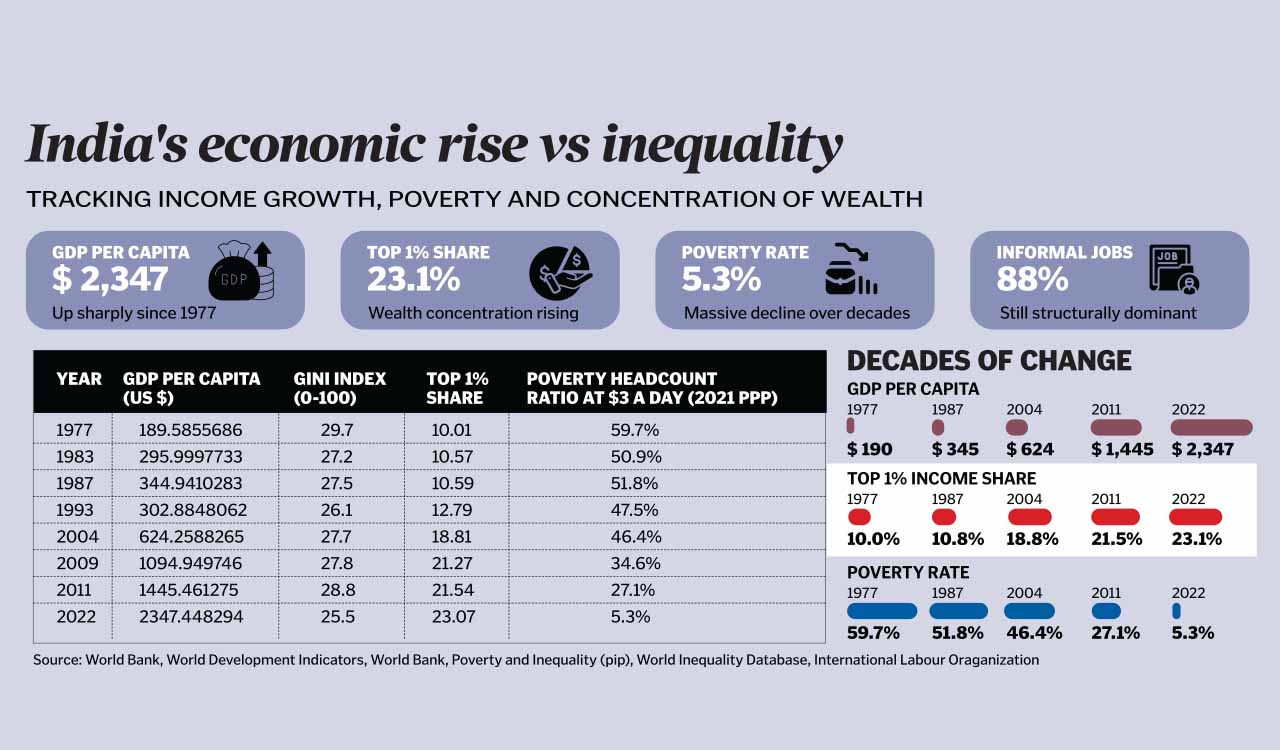
Between 1977 and 2022, the Gini Index based on consumption expenditure declined modestly — from around 29.7 to 25.5. However, plotting this against rising GDP per capita does not reveal any clear turning point where inequality systematically begins to decline. Instead, inequality appears to fluctuate without a consistent trend relative to income growth, calling into question the empirical validity of the Kuznets hypothesis in the Indian context.
Measurement or Structural Reality?
The apparent stability in inequality depends crucially on how it is measured. Consumption-based indicators such as the Gini Index suggest that inequality in India has remained moderate and relatively stable over time.
However, income-based measures present a starkly different picture. Data from the World Inequality Database show the share of income accruing to top 1% increased sharply — from about 10% in the late 1970s to over 23% by 2022. The more than doubling of top income shares indicates a significant concentration of economic gains at the upper end of the distribution.
Without deliberate policy action—through better jobs, stronger human capital, and more progressive fiscal frameworks—the gap between prosperity and inequality will continue to widen
This divergence arises because consumption surveys often fail to capture top incomes, wealth accumulation, and capital gains adequately. As a result, they may underestimate the true extent of inequality, particularly among the richest segments of society. Taken together, these findings point to the presence of “hidden inequality”—a situation where aggregate measures suggest stability, even as disparities widen at the top.
A Diverging Story
India’s growth has been highly effective in reducing poverty. According to World Bank estimates, the poverty headcount ratio at $3 per day (2021 PPP) declined dramatically—from nearly 60 per cent in the late 1970s to about 5 per cent in 2022.
This represents a substantial improvement in living standards and reflects the positive impact of sustained economic expansion. However, when viewed alongside rising top income shares, a more nuanced picture emerges.
While growth has been inclusive in reducing poverty, it has not been equalising across the income distribution. A large segment of the population has experienced improved living conditions, but a disproportionate share of income gains has accrued to those at the top. This coexistence of falling poverty and rising inequality highlights the limitations of relying on a single metric to assess distributional outcomes.
Labour Market Structure
The structural features of the Indian economy play a critical role in shaping these outcomes. Unlike the traditional development path envisaged by Kuznets, India’s growth has been driven primarily by the services sector rather than manufacturing.
At the same time, the labour market remains highly informal. According to estimates by the International Labour Organization, over 88 per cent of workers in India are engaged in informal employment. In such a setting, economic growth does not automatically translate into broad-based income gains. High-growth sectors tend to benefit skilled labour and capital owners disproportionately, while a large share of the workforce remains concentrated in low-productivity, low-wage activities.
The persistence of informality weakens the transmission mechanism from growth to equitable income distribution and constrains the creation of stable, well-paying jobs.
Implications for Policy
These patterns carry significant implications for economic policy. While India’s success in reducing poverty is undeniable, addressing inequality—particularly at the top—requires a distinct and targeted policy approach.
Expanding access to quality education and skills is essential to enable wider participation in high-productivity sectors. Strengthening social protection systems can help mitigate vulnerabilities associated with informal employment. At the same time, fostering the creation of formal, high-quality jobs—especially in labour-intensive industries—must become a central policy priority.
Fiscal policy also has a crucial role to play. Greater progressivity in taxation, particularly on high incomes and wealth, alongside improved regulation of capital and asset markets, may be necessary to address the growing concentration of economic power.
Equally important is the need to improve the quality and availability of data on income and wealth distribution. Better measurement is essential for accurately diagnosing the problem and designing effective policy responses.
Distributing Gains
India’s experience makes one thing clear: inequality does not automatically correct itself with growth. The absence of a clear Kuznets-type pattern reflects deeper structural realities—an economy driven by services, persistent informality, and unequal access to high-productivity opportunities.
The policy challenge, therefore, is not just to sustain high growth, but to reshape how its gains are distributed. While growth has delivered remarkable progress in reducing poverty, the rising concentration at the top highlights the limits of a growth-first approach.
As India enters its next phase of development, the focus must shift from the pace of growth to its quality. Without deliberate policy action—through better jobs, stronger human capital, and more progressive fiscal frameworks—the gap between prosperity and inequality will continue to widen.
Ultimately, the real test of India’s growth story will not be how fast the economy expands, but how broadly the benefits of that growth are shared.
(Dr Aishwarya Harichandan is Assistant Professor, IIM Sirmaur. Akamsha Krishnan is second year Masters in Economics and Analytics student at Christ (Deemed to be University) Delhi NCR Campus)

Related News