James Webb telescope captures alien asteroid belt outside our solar system
Overall, there are three nested belts extending out to 23 billion km from the Fomalhaut; that's 150 times the distance of Earth from the Sun
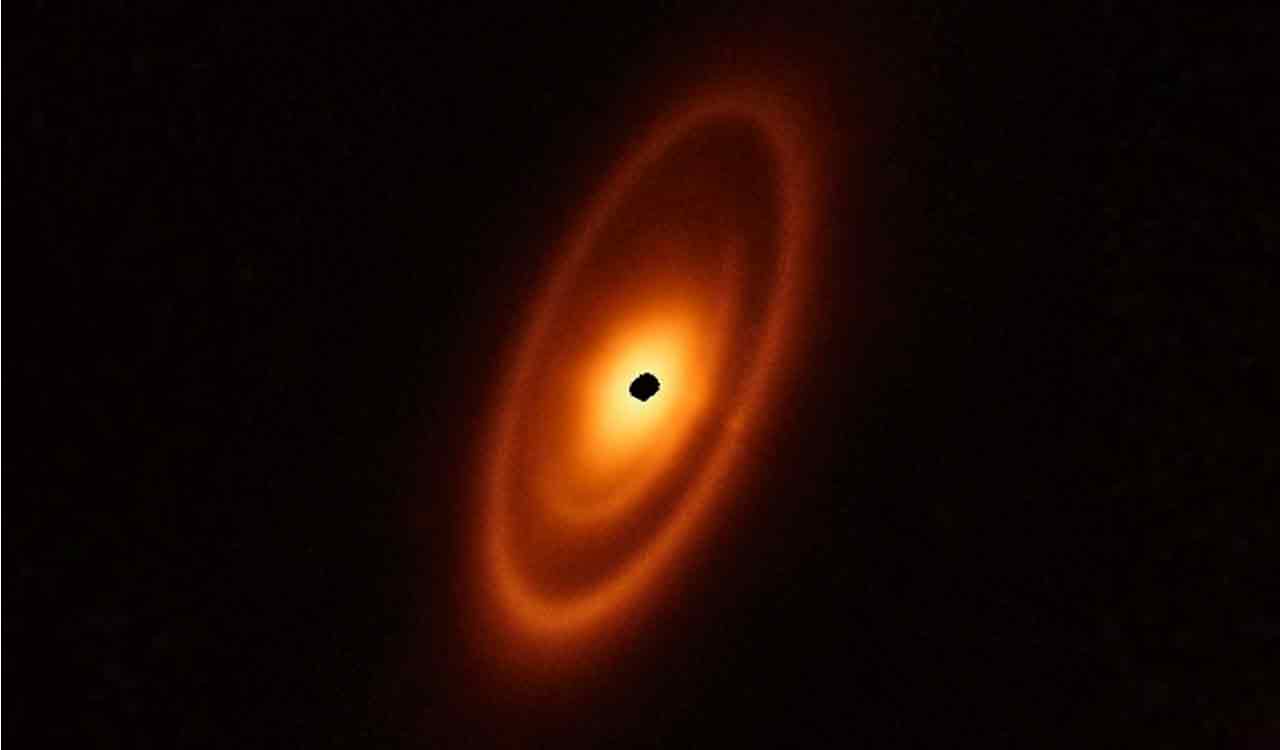


Washington: Astronomers used the powerful James Webb Space Telescope to study Fomalhaut — the first asteroid belt ever seen outside of our solar system in infrared light.
Webb’ Mid-Infrared Instrument (MIRI) captured the warm dust around the young star Fomalhaut, and found that the dusty structures are much more complex than the asteroid and Kuiper dust belts of our solar system.
Overall, there are three nested belts extending out to 23 billion km from the Fomalhaut; that’s 150 times the distance of Earth from the Sun.
The scale of the outermost belt is roughly twice the scale of our solar system’s Kuiper Belt of small bodies and cold dust beyond Neptune. The inner belts — which had never been seen before — were revealed by Webb for the first time.
The belts encircle the young hot star, which can be seen with the naked eye as the brightest star in the southern constellation, Piscis Austrinus. The dusty belts are the debris from collisions of larger bodies, analogous to asteroids and comets, and are frequently described as ‘debris disks’.
“I would describe Fomalhaut as the archetype of debris disks found elsewhere in our galaxy, because it has components similar to those we have in our own planetary system,” said Andras Gaspar of the University of Arizona in Tucson, the lead author of a new paper describing these results.
“By looking at the patterns in these rings, we can actually start to make a little sketch of what a planetary system ought to look like – if we could actually take a deep enough picture to see the suspected planets,” he added.
The Hubble Space Telescope and Herschel Space Observatory, as well as the Atacama Large Millimetre/submillimetre Array (ALMA), have previously taken sharp images of the outermost belt. However, none of them found any structural interior to it.
The inner belts have been resolved for the first time by Webb in infrared light.
Fomalhaut’s dust ring was discovered in 1983 in observations made by NASA’s Infrared Astronomical Satellite (IRAS). The existence of the ring has also been inferred from previous and longer-wavelength observations using submillimeter telescopes on Mauna Kea, Hawaii, NASA’s Spitzer Space Telescope, and Caltech’s Submillimeter Observatory.
“The belts around Fomalhaut are kind of a mystery novel: Where are the planets?” said George Rieke, another team member and US science lead for Webb’s MIRI.
“I think it’s not a very big leap to say there’s probably a really interesting planetary system around the star.”
In the paper published in the journal ‘Nature Astronomy’, the astronomers said they didn’t expect “the more complex structure with the second intermediate belt and then the broader asteroid belt”.
The James Webb Space Telescope is the world’s premier space science observatory. It is an international programme led by NASA with its partners, ESA and the Canadian Space Agency.

Related News
-

Incredible to watch capability ISRO is developing in science missions: Indian-American NASA senior official
-
Explainer: Why the universe is full of strange ‘little red dots’?
-
Astronauts remove faulty ISS antenna during spacewalk; out of time to install spare
-
NASA invites ISRO to join Moon Base programme for lunar South Pole outpost