Jamiat calls Centre’s Vande Mataram order arbitrary and unilateral
Jamiat Ulama-i-Hind has criticised the Centre’s directive mandating the singing of all six stanzas of Vande Mataram at official functions, calling it arbitrary and an attack on religious freedom. It urged respect for constitutional rights
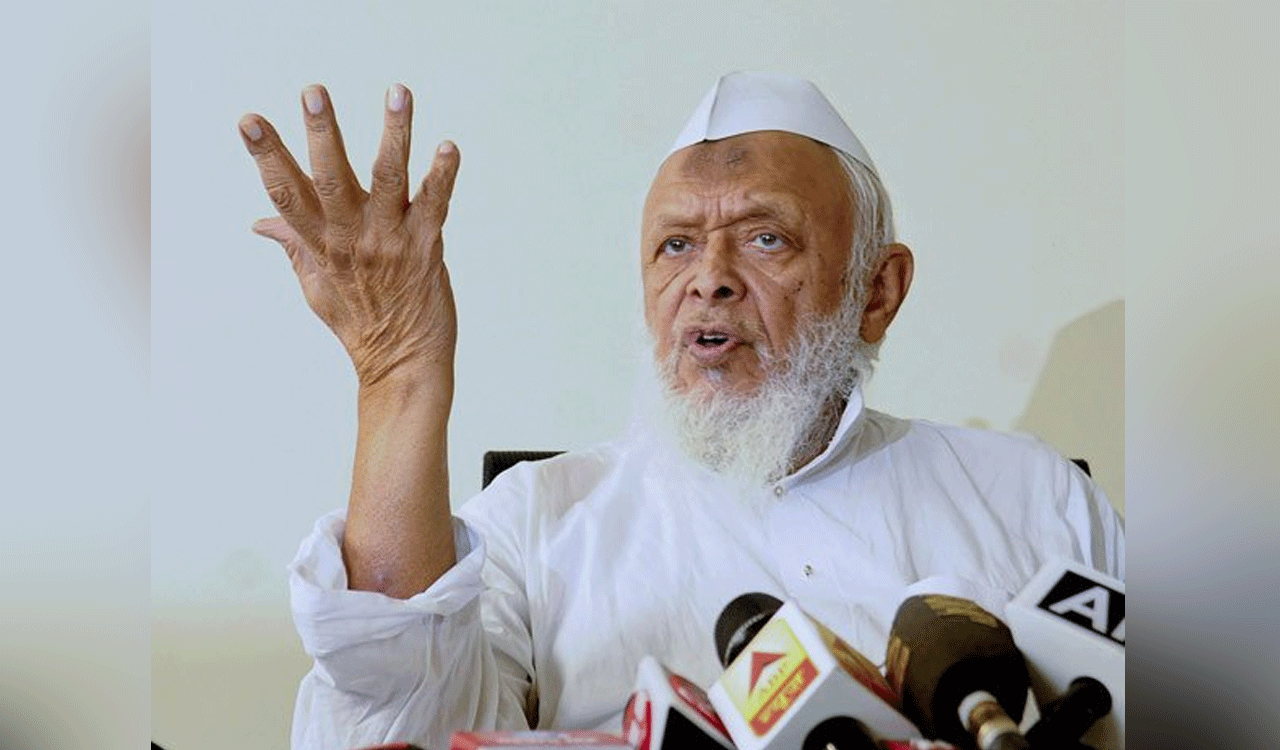


New Delhi: Prominent Muslim organisation Jamiat Ulama-i-Hind on Thursday described as “unilateral” and “arbitrary” the Centre’s directive mandating the singing of all six stanzas of the national song Vande Mataram at official functions, and alleged that it is a “blatant attack” on the freedom of religion guaranteed by the Constitution.
Jamiat president Maulana Arshad Madani said Muslims do not prevent anyone from singing or playing Vande Mataram, but some verses of the song are based on beliefs that portray the homeland as a deity, which contradict the fundamental belief of monotheistic religions.
The Central government’s “unilateral and coercive decision” to mandate all stanzas of Vande Mataram to be sung in all government programmes, schools, colleges and functions is not only a “blatant attack on the freedom of religion guaranteed by the Constitution of India but also a systematic attempt to curtail the constitutional rights of minorities”, he said in a post on X.
“Since a Muslim worships only one Allah, forcing him to sing this song is a clear violation of Article 25 of the Constitution and several judgments of the Supreme Court,” he claimed.
Making this song mandatory and attempting to impose it on citizens is not an expression of patriotism. Rather, it reflects electoral politics, a sectarian agenda and a deliberate effort to divert public attention from fundamental issues, Madani said.
“The true measure of love for one’s country lies not in slogans but in character and sacrifice. The shining examples of which can be seen prominently in the historic struggle of Muslims and the Jamiat Ulama-i-Hind. Such decisions weaken the country’s peace, unity and democratic values and undermine the spirit of the Constitution,” Madani said.
Making Vande Mataram compulsory is a clear assault on the Constitution, religious freedom and democratic principles, he claimed.
His remarks came after the Union Home Ministry directed that all six stanzas of the national song Vande Mataram, written by Bankim Chandra Chattopadhyay, shall be sung first when the national song and national anthem Jan Gana Man are to be played together.
In an order dated January 28, the Home Ministry gave the first set of protocols for singing the national song, directing that six stanzas of it, having a duration of 3 minutes 10 seconds, shall be sung at official functions such as the arrival of the President, unfurling of the tricolour and speeches of governors.
“When the national song and the national anthem are sung or played, the national song will be sung or played first,” the order read.
The assembly where the national song is sung shall stand in attention, it said.
“Whenever the official version of the national song is sung or played, the audience shall stand to attention. However, when in the course of a newsreel or documentary the national song is played as a part of the film, it is not expected of the audience to stand, as standing is bound to interrupt the exhibition of the film and would create disorder and confusion rather than add to the dignity of the national song,” it said.
The work in schools shall begin with the playing of the national song.
The Centre is observing the 150th year of Vande Mataram.

Related News
-

SC seeks Centre’s response on plea against law mandating singing of six stanzas of Vande Mataram
-
Vande Mataram: Karnataka govt limits singing to first two stanzas
-
Congress, CPI react as Omar and Farooq Abdullah stand for all six stanzas of Vande Mataram
-
Nagaland Vande Mataram row: NSF protest enters second day as Assembly debates issue