KCR exposes legal violations, double standards in SIT notice, agrees to appear for questioning
BRS chief and former CM K Chandrashekhar Rao termed the SIT notice in the alleged phone tapping case illegal and without jurisdiction, citing constitutional and Supreme Court violations, but said he would cooperate and appear for questioning on Sunday
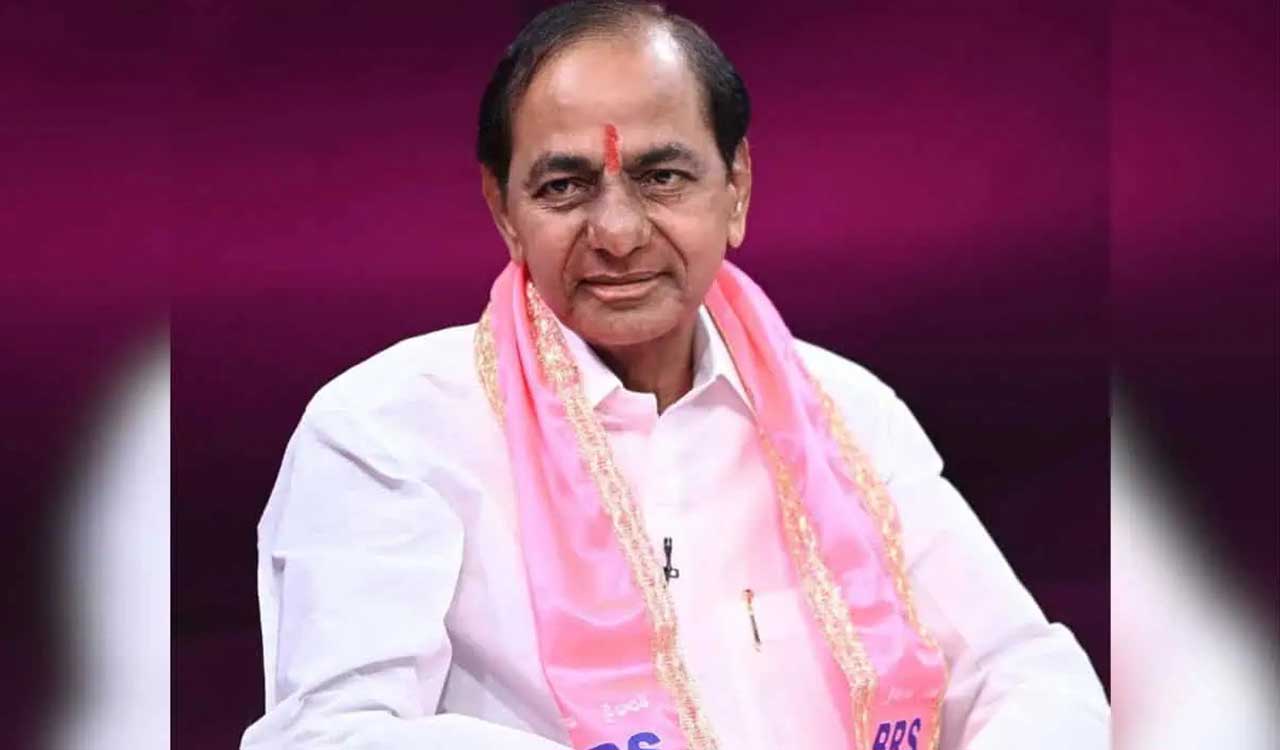


Hyderabad: BRS president and former Chief Minister K Chandrashekhar Rao on Saturday exposed the double standards of the Special Investigation Team (SIT) probing the alleged phone tapping case, established that the notice served on him was illegal and without jurisdiction, and yet displayed statesmanship by agreeing to appear for questioning on Sunday.
In a detailed six-page letter here, addressed to Assistant Commissioner of Police (Jubilee Hills) P Venkatagiri, Chandrashekhar Rao raised objections to both the authority of the officer and the manner in which the notice was served.
He stated that through the notice dated January 29, he was asked to make himself available for examination on January 30 at any place within Hyderabad city. He had responded on January 29 itself, requesting that the examination be deferred to another date owing to his preoccupation with issuing authorisations to party representatives for the municipal elections. In the same letter, he said, he had drawn the officer’s attention to the provisions of Section 160 of the Code of Criminal Procedure, which mandate that persons above the age of 65 years should be examined only at the place where they are residing. He had also made it clear that all future notices should be sent to his residential address at Erravalli.
Despite this, Chandrashekhar Rao pointed out that an ‘alleged letter dated January 30, purportedly under the ACP’s signature’, was pasted on the compound wall of his Nandi Nagar residence around 9 pm by unidentified persons on Friday. If the letter was indeed issued on the instructions of the ACP, such an act showed complete disregard for the Constitution, the law and binding Supreme Court judgments, he noted.
Referring to the Supreme Court judgment in Satender Kumar Antil versus Central Bureau of Investigation and another, reported in 2025 SCC Online SC 1322, Chandrashekhar Rao elaborated on the law governing service of notices. He cited the directions issued by the apex court relating to Sections 41A and 160 of the CrPC and corresponding provisions of the Bharatiya Nagarik Suraksha Sanhita, 2023. As per the judgment, he noted, all States and Union Territories are required to issue standing orders to ensure that notices are served strictly in the manner prescribed under law, and that notices through WhatsApp or other electronic modes cannot be considered or recognised as valid alternatives.
Chandrashekhar Rao further pointed out that the Supreme Court had reiterated that notices must comply with guidelines laid down by the Delhi High Court in Rakesh Kumar versus Vijayanata Arya and Amandeep Singh Johar versus State (NCT of Delhi), both of which were upheld by the apex court. He said the judgment also required States to issue additional standing orders specifically governing notices under Section 160 of the CrPC.
Drawing attention to Chapter VI of the CrPC, the former Chief Minister stated that service of summons or notices was governed strictly by statutory provisions. Citing Section 62(2), he noted that summons must, wherever practicable, be served personally by delivering or tendering a duplicate to the person summoned. He said the police was deliberately and intentionally ignoring both statutory mandates and Supreme Court directions, adding that such conduct could amount to contempt, as Supreme Court directions are law under Article 141 of the Constitution.
Rao asserted that despite having clearly informed the police that all future notices should be sent to his Erravalli residence, the same was ignored. The letter pasted on the wall on Friday night was not served as required by law, rendering it illegal and liable to be ignored, he said, adding that such a mode of service violated his dignity guaranteed under Articles 14 and 21 of the Constitution.
He also questioned the very jurisdiction of the ACP, Jubilee Hills division, to issue a notice to him under Section 160 of the CrPC. As per Section 160(1), the power to issue such a notice is restricted to persons residing within the limits of the officer’s police station or adjoining stations. As he was not residing within Jubilee Hills or adjoining police station limits, the notice, he said, was without jurisdiction, illegal and ultra vires.
To substantiate this, Chandrashekhar Rao referred to the judgment of the Andhra Pradesh High Court in VD Moorthy versus State of Andhra Pradesh and others, reported in 2025 SCC Online AP page 3099. He outlined the legal position summarised by the High Court, including that while police have the power to seek the presence of any person for investigation, such power is restricted territorially, and that persons above 60 years of age must be examined at their place of residence. He also cited similar judgments of the High Courts of New Delhi and Himachal Pradesh in multiple cases.
Chandrashekhar Rao also rejected the police claim that his request for examination at Erravalli could not be accepted based on addresses mentioned in election affidavits and Assembly records. He stated that such records had no relevance to Section 160 of the CrPC, which mandates that the contemporary place of residence alone is relevant. He asserted that it was undisputed that he had been residing at Erravalli for several years, and that the police were duty-bound to record his statement there and nowhere else.
He objected to the police insisting that he indicate a place within Hyderabad city for recording his statement, stating that the notice did not specify that examination would be limited to Nandi Nagar. He contrasted this with the case of BRS MLA T Harish Rao, to whom a notice under Section 160 in the same matter was served in Hyderabad despite his residence being shown as Siddipet, which, he said, exposed the double standards and shifting positions of the police.
Summing up the legal position, Chandrashekhar Rao stated that the pasting of the letter on the compound wall of his Nandi Nagar house was no notice in the eye of law and was contrary to Section 62 of the CrPC, Supreme Court judgments and constitutional provisions, and if he wished, he could ignore the notice.
He reiterated that the ACP had no jurisdiction or authority to issue the notice for recording his statement in the said crime, and that under the proviso to Section 160(2), the police were duty-bound to record his statement only at his place of residence at Erravalli.
Notwithstanding this clear legal position, he stated that as a former Chief Minister of Telangana, the present Leader of the Opposition in the Legislative Assembly and a responsible citizen, and in order to assist the investigation, he would make himself available for examination at 3 pm on February 1 at his Nandi Nagar residence, as the police “were keen to record his statement there”.

Related News
-

KTR commends youngster for transforming government primary school into plastic-free campus
-
KTR says public anger against Congress will bring BRS back to power
-
Telangana’s drought concerns bring Kaleshwaram scheme back into focus
-
Supreme Court stays probe against Pinarayi Vijayan in CMRL bribery case for a week