Local currency trade gains ground as countries seek to reduce dollar dependence
Countries are expanding local currency transactions to reduce conversion costs, manage certain foreign-exchange risks and strengthen economic resilience. The trend spans Asia, Europe, Latin America and Africa, raising questions about its potential long-term implications for the US dollar's global dominance



New Delhi: Several countries are increasingly going for local currency transactions in cross-border trade instead of using the US dollar as an international currency across all deals. This could, in the long run, reduce the importance that the US dollar currently enjoys in the global financial system, according to a new report.
The use of local currencies in international transactions continues to expand. Asia has become one of the most active regions in developing local currency transaction (LCT) arrangements. Indonesia’s LCT partners include Malaysia, Thailand, China, Japan, South Korea, and the United Arab Emirates. Cooperation with other countries is also being developed, according to an article in India Narrative.
It highlights that Bank Indonesia reported that the value of transactions under its LCT framework reached the equivalent of $49.4 billion through August 2026. This represented a substantial increase from $25.7 billion for the whole of 2025. In other words, transactions during the first eight months of 2026 had already approached twice the previous year’s total.
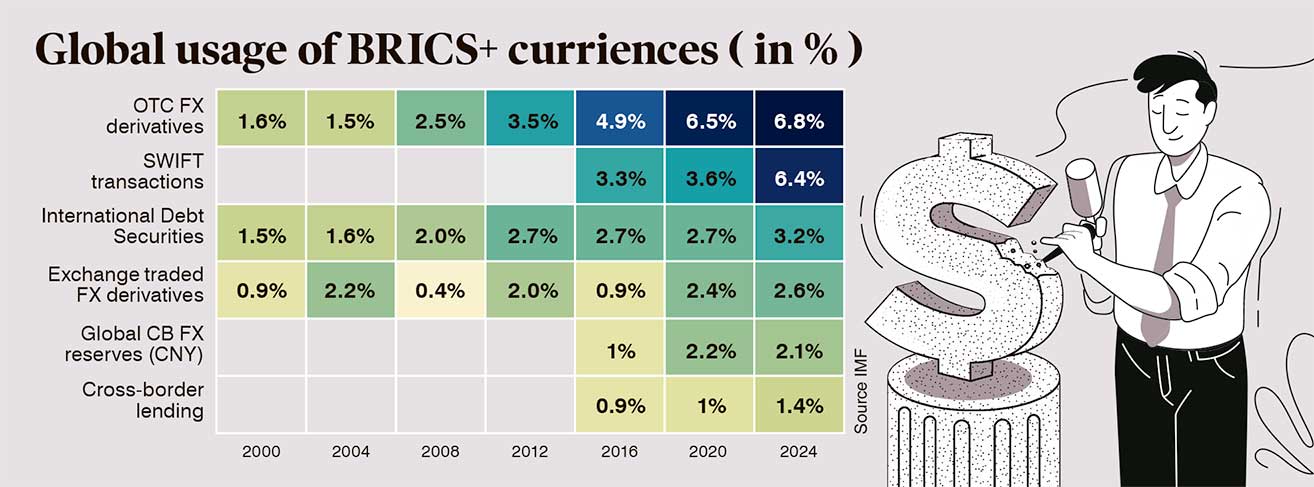
Beyond Southeast Asia, China is promoting the internationalization of the renminbi through bilateral trade cooperation and cross-border payment systems. BRICS members are also exploring the use of national currencies to facilitate trade among participating countries, the article states.
It also underscores that in Europe, the use of the euro in intra-European trade has become an important feature of economic integration. Latin America has a long history of regional trade and local payment arrangements, including bilateral and regional mechanisms. In Africa, the Pan-African Payment and Settlement System (PAPSS) has been developed to facilitate cross-border payments using local currencies.
The article points out that several factors explain the growing interest in LCT. First, local currency arrangements can reduce conversion costs by limiting the need to route transactions through the dollar. Second, they can help businesses manage certain foreign-exchange risks, although the extent of that benefit depends on market liquidity and exchange-rate movements.
Third, geopolitical considerations and economic resilience have become increasingly important. Trade tensions, financial sanctions, and uncertainty surrounding major economies’ policies have encouraged governments to diversify their currency arrangements and seek greater flexibility in managing international trade and financial relationships.
The expansion of LCT is not merely an attempt by some countries to reduce their dependence on the US dollar. It also carries strategic implications for American economic interests. If more countries settle bilateral trade in their own currencies, demand for dollars for international transactions could gradually decline in some segments of the market, the article observes.
Over the longer term, such changes could influence global demand for US financial assets, including Treasury securities, and potentially narrow some of the advantages the United States derives from the dollar’s dominant international role, the article added.

Related News