Honest Money: When the dollar falls and what it looks like for ordinary people
From Hyderabad’s Irani chai to global financial upheavals, monetary shifts quietly reshape livelihoods, savings and economic security


By Chandu Kumar Potti
In 2001, a samosa cost Rs 2.50 in most towns across India.
Also Read
- Honest Money: The patient dragon—what twenty years of quiet preparation looks like, and what it means for India
- Honest Money: What Is India actually worth—the gap between what is declared and what is real
- Honest Money: When money loses its anchor, economies pay the hidden price
- Honest Money: The idea that was right — and ignored
- Opinion: Global reserve currency—how America extracts wealth printing dollars
An Irani chai, that thick, sweet glass that still tastes like old Hyderabad, cost the same. Together: Rs 5. A small pleasure that working people could afford without thinking about it.
Today the samosa costs Rs 20. The Irani chai, where the shop still exists, comes in a smaller cup and costs Rs 15. Many of those old Irani chai shops are simply closed; the economics no longer work.
Nobody announced this change. Nobody signed a document transferring Rs 5 of value out of your pocket. It happened gradually, then all at once, across twenty years.
That is what monetary decline looks like from the ground.
Not a crisis on a television screen. Not a number on a chart.
A smaller cup. A closed shop. A samosa that costs eight times what it did.
Three People, One Event, Three Different Stories
Across India, millions of people are connected to the global monetary system in ways they do not fully see. When that system shifts, the same event lands differently depending on where you stand.
Consider three ordinary people.
Gurpreet Singh farms wheat in Sangrur, Punjab.
His inputs—fertiliser, diesel, pesticides—are priced in global commodity markets, largely denominated in dollars. When the dollar strengthens, or global commodity prices rise, his costs go up. He does not set those prices. He does not know who does.
In recent years, the cost of a bag of DAP fertiliser has more than doubled. His wheat price has not doubled. The gap between what he earns and what he spends to grow it has been quietly narrowing, year after year, for reasons no one in his village fully explains.
Karthik Subramaniam works in software in Bengaluru.
He is paid in dollars, or in rupees pegged to a dollar salary. When the dollar weakens against the rupee, his effective purchasing power falls even if the number on his payslip stays the same. When global technology companies cut costs and freeze hiring, the market for his skills contracts.
He feels like he is doing well. He has a good job. But the real value of what he earns, in terms of what it buys, what it saves, what it builds toward, fluctuates with decisions made in boardrooms and central banks he will never enter.
A family in Malappuram, Kerala waits for this month’s remittance.
Their son works in Dubai. The dirham is pegged to the dollar. When dollar system stress hits, when global risk sentiment shifts, when Gulf economies tighten, when oil revenue contracts, remittance flows slow. Jobs become uncertain. The assumption that Gulf income will continue indefinitely is exactly that: an assumption.
Malappuram’s economy, like much of Kerala’s, is built substantially on this assumption. The houses. The gold. The children’s education. All downstream of a system that runs on Gulf wages, which run on oil revenues, which run on dollar pricing.
Same global event. Three different impacts. None of these people is in any room where the decisions are made.
What Happened To The British Pound
In 1956, Britain was still a major global power. The pound sterling was still a significant reserve currency, held by countries across the Commonwealth, used widely in international trade.
Then Egypt nationalised the Suez Canal.
Britain and France intervened militarily. The United States, which had not been consulted, was furious. President Eisenhower ordered his Treasury Secretary to prepare to sell US government holdings of sterling bonds. The threat was clear: comply or we will destroy the pound.
Britain’s Chancellor of the Exchequer told the Prime Minister that Britain’s foreign exchange reserves could not sustain what would follow. Within weeks of US action, the country would be unable to import sufficient food and energy.
Britain backed down. Humiliatingly. Completely.
The pound lost approximately £100 million in reserves weekly during the crisis. What had seemed like a stable global currency showed, in a matter of weeks, that it rested on American goodwill more than on British strength.
The full decline of the pound as a reserve currency took decades. But Suez was the moment when it became undeniable. The crack at Suez became the fracture of 1967, and the irrelevance of the 1970s.
What seemed permanent turned out to be contingent.
Land Prices Are Not What You Think
Across India, land prices have risen dramatically over the past two decades. A plot that cost Rs 5 lakh in 2005 may cost Rs 50 lakh today. People celebrate this. They call it wealth creation.
But ask a simpler question: has the land itself changed?
The same soil. The same location. The same boundaries. The land has not become more productive, more fertile, or more useful. What has changed is the number of rupees required to buy it.
That is not only wealth creation. Part of it is monetary expansion expressing itself through a fixed asset.
When money supply grows faster than real goods and services, prices rise. Gold rises. Land rises. Everything real and scarce rises, not only because it has become more valuable, but also because the paper measuring it has become less valuable.
The person who owned land before feels rich. The person trying to buy land for the first time, the young worker, the first-generation earner, finds it permanently out of reach.
That is the invisible tax wearing a different mask.
The Dam
A dam does not fail gradually.
It holds. Engineers inspect it. Reports say it is sound. Decades pass. The water level rises slowly. Small seepages appear, noted, monitored, managed. Nothing dramatic.
Then one section gives way. The pressure that had been distributed across the entire structure concentrates at the breach. Within hours, not years, not months, what was a manageable seepage becomes an irreversible collapse.
The water had been building for decades. The break takes an afternoon.
Reserve currency transitions work like this. The pound’s decline was visible in small ways for decades before Suez made it undeniable. After Suez, the process accelerated in ways that surprised people who had been watching it carefully.
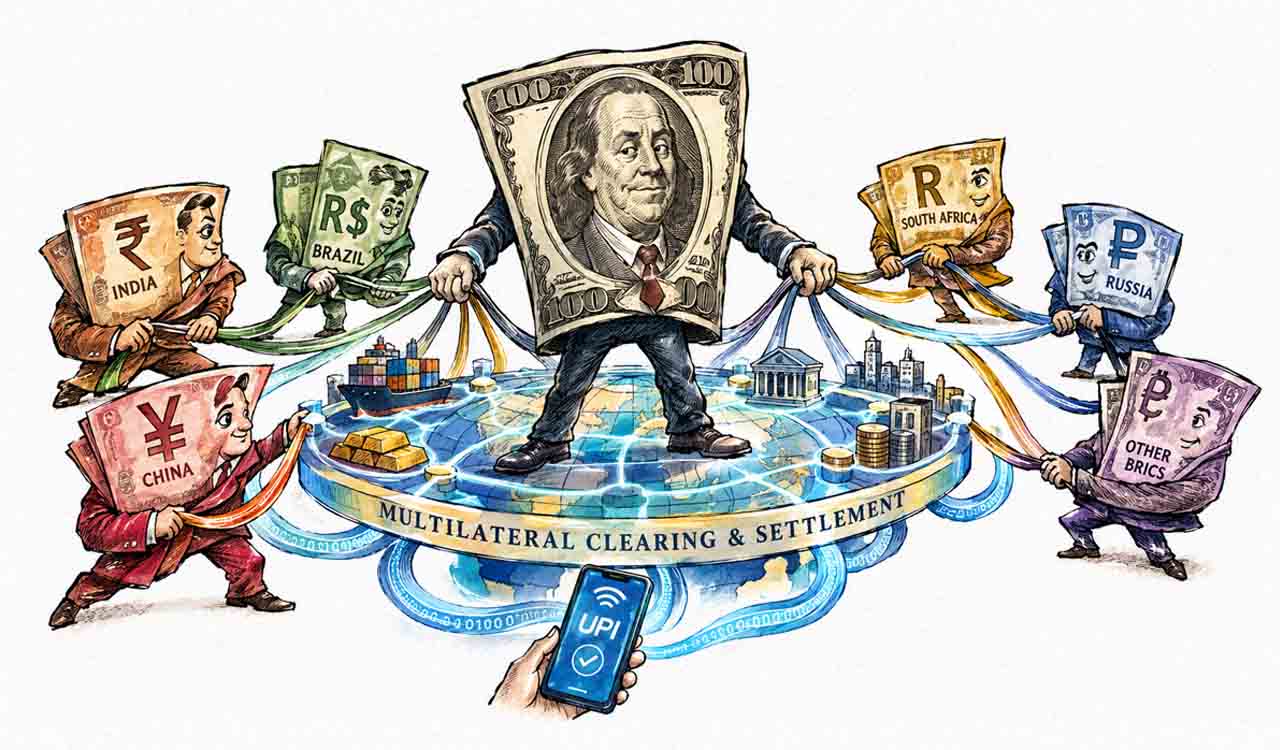
The dollar’s structural vulnerabilities, the debt, the deficits, the weaponisation of SWIFT, and the slow erosion of trust among nations that have been seeking alternatives have been visible and documented for years.
The question is not whether pressure is building. The question is which section of the dam gives way first, and how quickly the rest follows.
The Question Worth Sitting With
Gurpreet in Sangrur does not control fertiliser prices.
Karthik in Bengaluru does not control dollar-rupee exchange rates.
The family in Malappuram does not control Gulf employment conditions.
None of them will be consulted when the monetary system shifts. None of them will be warned in advance.
But some of them will be more prepared than others.
Not because they predicted the timing; nobody can. But because they understood what real value is, held some of it, built some resilience into their lives before the pressure arrived.
Does your family have a boat?
Not to predict the flood. Just to ask: if the water rises faster than expected, what has been built that will hold?
(The author is Founder & Chairman, Versatile Auto Components Pvt Ltd, Versatile Electric Automotive Private Limited, Former Chairman, Pashamylaram Industrial Park and Founding Secretary, Society for Sangareddy Security Council)

Related News