
Mosques covered with tarpaulin sheets ahead of Juta Maar Holi in Shahjahanpur
Authorities in Shahjahanpur have covered mosques and mazars with tarpaulin sheets and deployed heavy security for the centuries-old Juta Maar Holi procession. The event, marked by communal harmony, sees Hindus and Muslims jointly celebrating with flower showers and traditional rituals
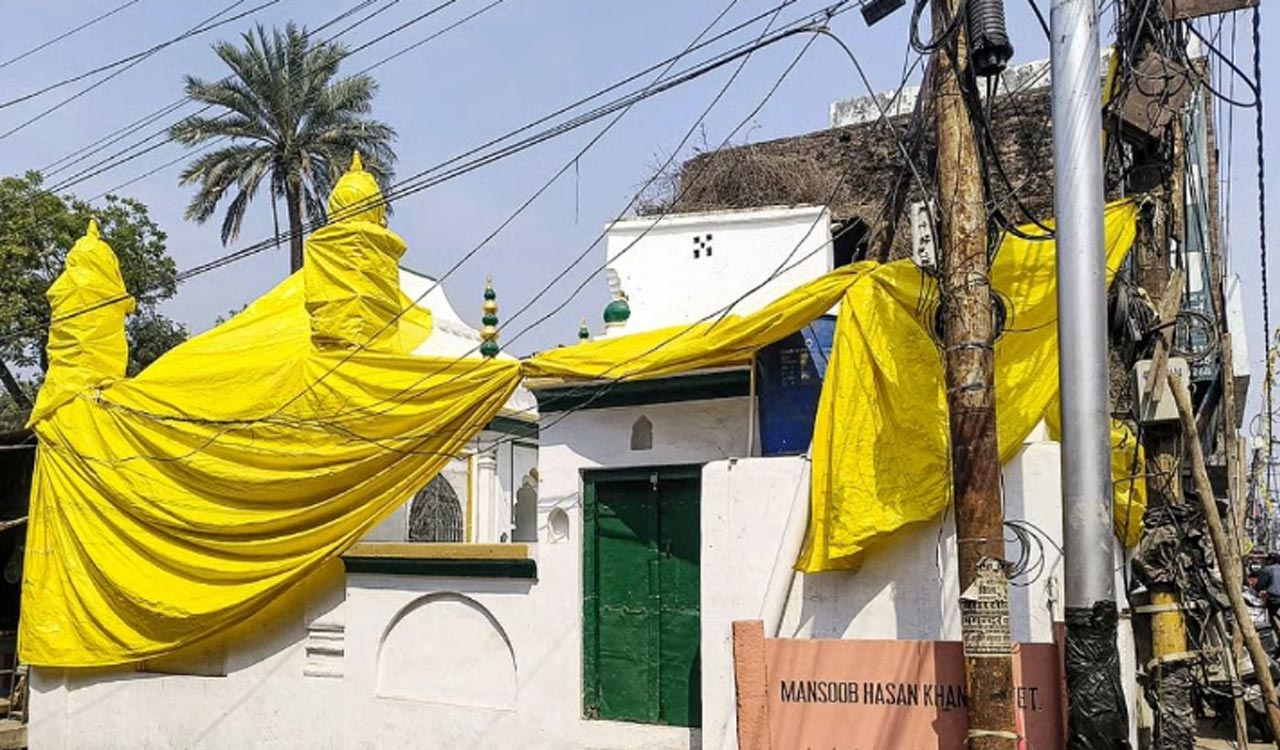


Shahjahanpur (UP): Authorities have covered mosques and mazars along the routes of the traditional ‘Juta Maar Holi’ procession in Shahjahanpur with tarpaulin sheets and announced enhanced security for the annual event.
‘Juta Maar Holi’ is a centuries-old tradition celebrated in Shahjahanpur on Holi, when people hurl shoes and sandals at a person dressed as a British-era ‘Laat Sahab’, riding a buffalo cart as the centrepiece, while playing with colours.
Last year, shoes, slippers and bottles were thrown at police personnel during the Laat Sahab procession, forcing a mild lathi charge.
Superintendent of Police Rajesh Dwivedi said security will be beefed up for this year’s procession. Locals described last year’s mild police action as an aberration and ruled out any problems this time.
They cited the support of both Hindus and Muslims, who greet the procession with a flower shower, as proof of communal harmony. They said Muslims have even delayed their prayers to allow easy passage to the procession.
“Inshallah, this time the procession will be held in a joyful atmosphere,” said Samajwadi Party district president Tanveer Khan, supporting the “centuries-old tradition”.
Congress City President Taqweem Hasan Khan said the administration covers mosques and shrines ahead of the procession and that Muslims have even delayed their prayers when Holi coincides with Friday.
Highlighting that Holi is celebrated here in a harmonious manner, social worker and physician Namita Singh said, “The women in our team also participate enthusiastically and shower flowers on the Laat Sahab procession that takes place through the city.”
Another social worker, Imran Khan, said that in this city of martyrs, Hindus and Muslims celebrate the festival with great love. Last year, the Muslim community even showered flowers on the procession at several locations.
Officials said the Laat Sahab procession is part of the curriculum for candidates selected for the Indian Administrative Service. Newly inducted officers are taught how to administer and manage the procession.
During his city tour, Laat Sahab reaches the city police station, where he is saluted. Laat Sahab asks the police station in-charge for the year’s crime records. To avoid this, the officer gives him a gift.
Regarding the covering of mosques, locals said it is an old tradition followed as a precaution to prevent any untoward incident.
Rajesh Dwivedi said this year’s procession will see around one-and-a-half times more security personnel than the previous one, along with the deployment of over 200 magistrates.
Four Additional Superintendents of Police, 13 Circle Officers, 310 Sub-Inspectors, 1,200 Constables and 500 Home Guards will be deployed, the SSP said.
In addition, four companies each of the Provincial Armed Constabulary and Rapid Action Force, along with a team of the National Disaster Response Force, will be stationed during the procession, he added.
Over 100 solar-powered CCTV cameras have been installed along the eight-kilometre route of the ‘Bade Laat Sahab’ and ‘Chhote Laat Sahab’ processions to ensure uninterrupted surveillance.
In view of minor incidents reported last year, an additional zone has been created this time, he said, adding that for the past month, peace committee meetings involving members of all communities have been held at police stations and outposts.
While urging people to celebrate the festival peacefully, Dwivedi assured strict action against those disrupting the procession.
Additional District Magistrate (Administration) Rajneesh Kumar Mishra said 48 mosques and mazars along the route have been completely covered with thick plastic sheets.
To prevent sudden crowd surges, over 148 lanes opening onto the procession route will be barricaded.
The administration has divided the procession into seven zones with sector and sub-sector arrangements. A total of 136 zonal, sector and static magistrates will supervise proceedings in their respective areas, he said.
Mishra added that 103 magistrates will also be deployed at Holika Dahan sites to oversee rituals from lighting the pyre to the conclusion of ceremonies.
Preventive action, including externment of identified individuals and the opening of history sheets, has also been undertaken in view of the event.
According to historian Dr Vikas Khurana of Swami Sukdevanand College, the procession traces its origins to the 18th century when Nawab Abdullaha Khan became angry with his family and went to Farukhabad. The day he returned to Shahjahanpur in 1728 coincided with Holi celebrations, when Hindus and Muslims jointly marked the festival with a city-wide procession.
Khurana said the British administration later institutionalised the procession after regaining control of Shahjahanpur in 1859.
The event continued peacefully for decades after Independence, and in 1988 it was renamed from “Nawab Sahab” to “Laat Sahab” by then District Magistrate Kapil Dev. The procession begins with prayers at the Phoolmati Devi temple and then proceeds through the city.
He added that a petition filed in the High Court in 1990 seeking a ban on the procession was dismissed, with the court treating it as a long-standing tradition.

