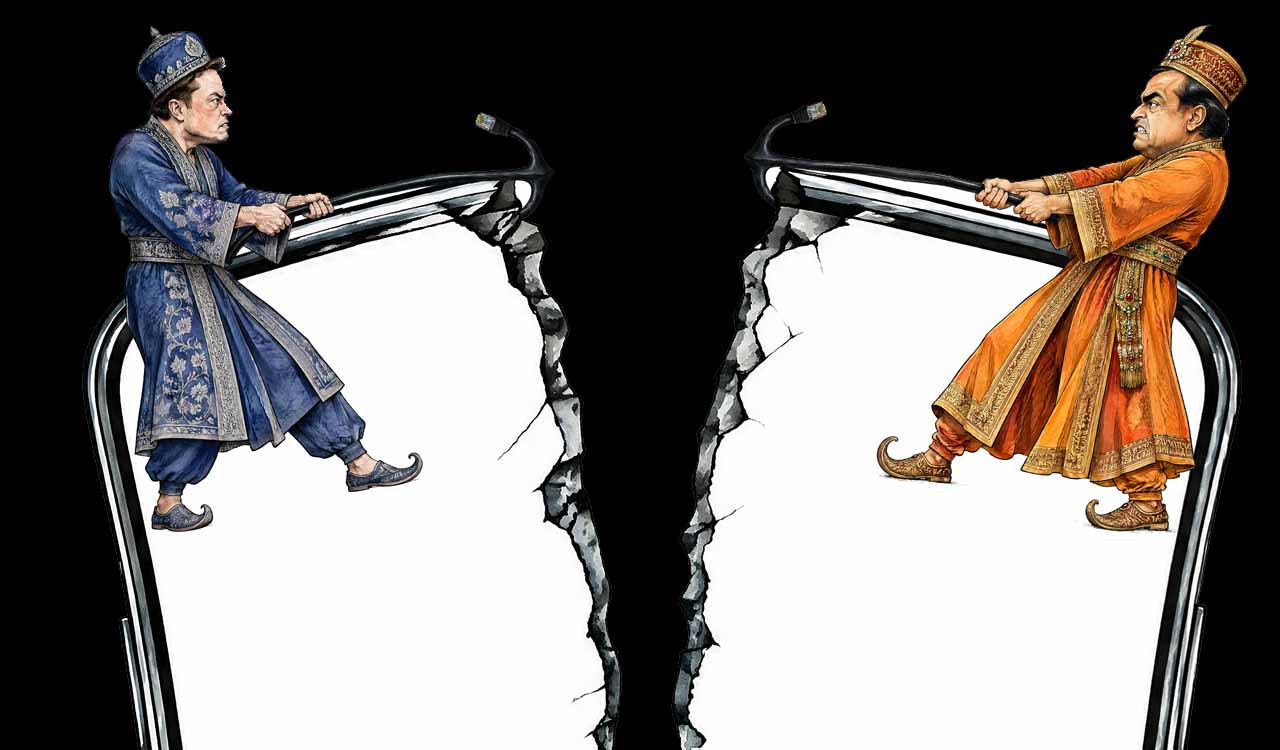
Rewind: Decoding India’s new Labour Codes
India’s landmark labour reforms promise change, but can they break the wage stagnation trap and create more jobs? That’s the real question



By T Muralidharan
Will it solve wage stagnation problem?
The short answer is no. Let me explain why. India’s wage puzzle is one of the most enduring and least understood aspects of its economic story. Over the past two decades, India has grown faster than most major economies. Large corporates have scaled, startups have flourished, exports have grown (except in a few items post-Trump tariffs), and digital infrastructure has expanded dramatically. Yet, under the surface of this impressive economic rise lies a far more troubling reality: wages in India have not kept pace with growth.
For millions of young Indians entering the labour force each year, income mobility remains painfully slow. Wages rise modestly for a few years and then flatten. Real wage growth is inconsistent. In many labour-intensive sectors, wages barely match inflation. The consequences are far-reaching: low household consumption, weak savings, low skilling attraction, and a structural drag on India’s long-term economic potential.
This raises an unavoidable question: Will the new Labour Codes help break India out of its wage stagnation trap? To answer this, we must go deeper into the structural forces shaping India’s labour market.
Real Drivers of Wage Stagnation
Wages do not stagnate in a vacuum. They stagnate when the economic engines that lift incomes—productivity, demand, skills, and technological upgrading—fail to accelerate. India’s wage stagnation is primarily the result of four structural dynamics.
• Oversupply of labour relative to demand
India adds 8-12 million workers to its labour force annually as young people reach the age of 16. Yet job creation has not kept pace. When supply overwhelms demand, wages naturally stagnate. Workers have weak bargaining power, especially in sectors with surplus labour such as construction, retail, security, logistics, hospitality, and frontline sales.
• Low and uneven productivity growth
India’s productivity story is patchy. Some sectors like IT, financial services, pharma, and organised manufacturing have seen consistent productivity gains. But the majority of India’s workforce is employed in low-productivity sectors—small manufacturing, retail, transport, informal services, and agriculture. Low productivity equals low wages. This link is well established globally.
• Skill-system mismatch and weak human capital returns
India’s skill ecosystem has improved, but it remains misaligned with employer needs. Most workers enter the labour market with limited job readiness. Employers spend months on induction and training. When workers cannot meaningfully improve productivity through skills, wages remain stuck.
• MSMEs stuck in low-wage, low-productivity trap despite the PLI
Recently, the Government of India introduced an expanded Production Linked Incentive (PLI) scheme intended to stimulate large-scale job creation by offering cost subsidies tied to net new employment. This scheme provides employers with direct financial incentives—linked to incremental job creation—regardless of wage levels. It aims to reduce the cost of hiring and encourage firms to scale employment rapidly.
Key features of the new employment-linked PLI scheme include:
• A payroll-linked subsidy paid to employers for each net new job created.
• Subsidy duration that ranges from 3 years to 5 years, depending on the sector.
• Incentives tiered by gender and category, with higher payouts for hiring women.
• Mandatory linkage to formal job creation—employees must be on the payroll and contribute to PF.
• Focus on boosting employment elasticity in priority sectors.
However, the fundamental limitation is structural: the scheme applies almost entirely to the manufacturing sector.
Manufacturing accounts for only 11–14% of India’s total workforce, and even within this, large firms—the primary beneficiaries of PLI—account for a small fraction of total employment. The bulk of job creation in India today comes from the services sector, especially MSMEs in retail, logistics, food services, healthcare, education services, financial services, transportation, hospitality, and the entire frontline and gig-oriented economy.
With over 65% of new jobs in the past decade coming from the services sector, a manufacturing-only employment incentive scheme cannot meaningfully impact nationwide wage growth.
India’s old labour regime was a cluttered landscape of 40-plus central laws and 100-plus state laws. The four new Labour Codes: the Code on Wages, the Industrial Relations Code, the Social Security Code, and the OSH (Occupational Safety, Health, and Working Conditions) Code, attempt a long-awaited consolidation
The second limitation is scale. The PLI scheme, while transformational for investment, touches only a narrow base of employers. Micro, Small, and Medium Enterprises (MSMEs), which employ over 110 million workers, are either excluded or unable to meet the eligibility criteria, which typically require minimum investment thresholds, high compliance standards, and multi-year capital commitments.
In contrast, the sectors that generate the largest number of jobs—delivery, sales, field services, transport, micro-retail, construction subcontracting, small digital services, and healthcare support—operate on thin margins, low capital investment, and high churn. For these employers, what they need is not investment-linked subsidy but wage-linked or payroll-linked support, apprenticeship subsidies, and hiring credits.
Thus, while the PLI scheme helps high-value manufacturing and signals a strong policy direction, it does not address India’s wage stagnation problem. The sectors that actually hire the most people, especially youth and first-time workers, receive no such incentive. Unless India introduces a Service Sector Employment Incentive Scheme or an MSME Payroll Support Mission, the gap between job creation and wage growth will persist.
MSMEs employ the largest share of India’s workforce. But most operate with outdated technology, low capital investment, weak formalisation, and limited capacity to pay statutory wages or benefits. When 80–90% of workers are in firms that cannot raise productivity quickly, economy-wide wages stagnate.
Minimum wage increases do not automatically lift average wages. The Code on Wages introduces a national minimum wage floor. This ensures workers are protected from extremely low pay. But minimum wages affect the bottom 10–15% of workers. They do not lift the median or average wage unless productivity rises.
In fact, if minimum wages rise without productivity improvements, MSMEs may hire fewer workers, shift to informal labour to avoid compliance, or reduce working hours.
Social security expansion improves safety net, not wages
Bringing gig workers, fixed-term employees, and contract workers under PF/ESI is a major reform. It strengthens long-term security. But it does not raise take-home pay or expand economic demand. Compliance simplification helps firms, but only indirectly affects wages.
Digital registers, single licences, and reduced inspector discretion make hiring easier for employers. Over time, lower compliance friction can encourage firms to expand. But expansion does not guarantee higher wages unless demand grows strongly or productivity rises.
MSMEs are likely to experience higher employment costs due to statutory minimum wages, compulsory appointment letters, formalised wage calculations, PF/ESI obligations, and stricter safety standards. For large firms, these are manageable. For MSMEs, they can be destabilising.
Productivity Drives Wages, Not Regulation
China’s wage revolution between 1992 and 2007 shows real wages rising by over 202%, driven not by labour laws but by rapid industrial productivity growth, technological upgrading, export competitiveness, and human-capital returns.
India’s own IT sector tells the same story. Wages rose because productivity rose sharply.
Across countries, wage growth follows productivity growth. Labour laws can protect workers and formalise markets, but they cannot substitute for productivity.
Solving Wage Stagnation
If India wants sustained wage growth, five structural interventions matter far more than labour codes:
• Raising MSME productivity
•Wage subsidies and payroll support for MSMEs
• Reducing non-wage labour costs
• Skilling for productivity
• Sectoral productivity and wage missions
India needs a statutory Productivity & Employment Growth (PEG) Commission to measure productivity sector by sector, benchmark India globally, recommend technology pathways, design wage-linked productivity incentives, guide MSME upgrading, and coordinate skill reforms.
Final Assessment
In their current form, no. The Labour Codes modernise regulation but do not raise productivity, increase demand, improve workforce capabilities, or strengthen MSMEs.
LabourCodes set the foundation. Productivity will decide the future. India’s wage stagnation problem is fundamentally an economic and productivity challenge, and much more than a legal issue.
*******
Will it result in employment creation?
Supporters of the new Labour Codes argue that these reforms will stimulate job creation by:
• Reducing hiring friction through fixed-term employment and eased retrenchment norms.
• Lowering compliance costs for pan-India enterprises.
• Pushing informal workers into formal systems, improving productivity and stability.
• Attracting investment by aligning India’s labour market with global standards.
• Increasing employer confidence, enabling companies to hire more aggressively.
In theory, this makes India more competitive, flexible, and job-ready. But employment generation is rarely automatic.
More Output, Fewer Jobs
India stands at a curious crossroads. Over the past two decades, the country has delivered one of the world’s fastest GDP growth stories. Yet this impressive headline masks a more uncomfortable truth: job creation has not kept pace with economic expansion. Despite robust GDP growth and rising gross value added (GVA), the increase in employment has been modest — 1.6% per year according to ‘India at Work’, and the worker-to-population ratio has fallen. In simple terms: more output, not enough jobs.
They can improve transparency, reduce exploitation, and bring more workers under formal rights, simplify compliance, digitise records, reduce inspector raj, introduce fixed-term employment, and raise retrenchment thresholds. On paper, this is a significant improvement for the industry. But can they usher in change?
Against this backdrop, the new Labour Codes have been projected as a major structural reform that can unlock employment. The key question is: will they?
Even the best labour laws cannot compel firms to hire if: demand is weak, exports are shrinking, finance is expensive or business confidence is low. Job creation follows growth.
To stimulate large-scale job creation, India must activate the levers that actually lead employers to expand headcount. These are:
• Higher productivity: Employers hire when incremental workers deliver far higher incremental value. This requires skill development, better induction, and performance systems.
• Demand expansion: Strong domestic consumption, export competitiveness, and private investment spur hiring.
• MSME competitiveness: Small firms must grow from 10 employees to 50–100 employees. This requires digital adoption, easier finance, supply chain integration, and lower cost of capital.
• Sectoral growth engines: Jobs grow where sectors grow. India’s upcoming job engines include retail, logistics, healthcare, BFSI, green energy, construction, and manufacturing under PLI.
• Workforce readiness for the AI era: India must modernise its skilling architecture for digital and AI-centric roles
Labour laws alone cannot drive these shifts — but they can support them.
India’s Real Job Engine
If employment growth is the goal, MSMEs are the battlefield. MSMEs contribute roughly 30% to India’s GDP and employ over 110–120 million people directly. Compare this with current employment in agriculture (2023-24): 205–220 million workers based on agriculture’s share of total employment: 44–45% of India’s workforce (PLFS 2023-24)
When indirect employment is included, MSMEs account for 60% or more of India’s total employment. They create up to eight jobs per Rs 1 crore investment in the manufacturing sector —far more jobs than large capital-intensive industries. Therefore, for India to create new jobs, MSMEs must thrive.
How Labour Codes affect MSMEs
Most MSMEs operate in a semi-informal ecosystem. They hire informally, pay part wages in cash, and handle compliance with minimal administrative structure. The new Labour Codes push strongly toward formalisation:
• Universal minimum wages
• Mandatory appointment letters
• Unified definition of wages
• Stricter safety and working condition norms
While this is good for worker rights, it imposes a cost shock on small firms. Complying fully increases labour cost by 20-30% or more. For a 10-20 person workshop already operating with thin margins, these costs can threaten survival. A small MSME has only three choices: absorb higher costs, pass them on (usually impossible), or cut jobs and automate. None supports mass job creation.
MSMEs, the largest employers of India’s workforce, operate with outdated technology, low capital investment, weak formalisation, and limited capacity to pay statutory wages or benefits. When 80–90% of workers are in firms that cannot raise productivity quickly, economy-wide wages stagnate. Hence, India’s employment future depends on whether the country chooses to support MSMEs as the true drivers of job-rich growth
Supporters of labour reform point to provisions such as fixed-term employment, higher retrenchment thresholds, and digital compliance. These help large employers but mean little to micro-enterprises. A 15-worker unit is unaffected by retrenchment thresholds or formal dispute resolution. However, formalisation raises their costs immediately. This leads to a dangerous two-tier system:
• A compliant, formalised, capital-intensive large firm sector
• A stressed, semi-informal MSME sector unable to grow or hire
The risk is clear: India modernises its labour laws but may lose its employment engine.
Why MSMEs Need Wage Subsidies
If the goal is formalisation and employment creation, MSMEs cannot be left alone to absorb the cost shock. Globally, countries have offered wage subsidies, payroll support, and social security contribution sharing to encourage small firms to formalise.
India recently moved in this direction through the new Employment-Linked Incentive (ELI) scheme, offering subsidies for first-time workers and monthly support for retention. But this was for manufacturing, and most jobs are in the service sector. The threshold levels to claim the benefits are difficult for MSMEs
Labour reform can improve investor confidence. But employment depends on where investment flows. If new investment flows mainly to large, capital-intensive sectors—petrochemicals, data centres, large steel plants— the GDP will rise, but jobs will not.
India needs labour-intensive MSME-linked investment in:
• Garments & textiles
• Food processing
• Local manufacturing clusters
• Construction value chains
• Logistics, transport and retail services
Without shifting the investment mix, Labour Codes alone cannot fix low job intensity.
Final Assessment
Will the Labour Codes create jobs? Alone? No. With complementary policies? Possibly.
The new codes are necessary but not sufficient. They provide a cleaner regulatory foundation, reduce friction, and bring predictability. But they do not automatically create demand, increase productivity, lower hiring costs, or strengthen MSMEs.
Hence, MSMEs require far more tailored support:
• 2–3 year wage subsidy for newly formalised enterprises
• Government co-sharing of PF/ESI for first-time formal workers
• MSME-focused compliance simplification
• Cluster-level facilitation for hiring and HR processes
• Tax credits tied to net new formal jobs
• Create sector-specific employment missions
• Encourage labour-intensive investment
The Labour Codes remove some brakes on hiring, but do not supply the demand engine. That engine lies in MSMEs, productivity, investment mix, and wage support. India’s employment future will depend not on labour laws alone, but on whether the country chooses to support MSMEs as the true drivers of job-rich growth. Without this support, formalisation may shrink MSMEs rather than strengthen them.

(The author is Founder Chairman, TMI Group and Quanta People)

Related News