Opinion: Farcical saga of Tummidihatti talks
With Maharashtra unlikely to readily accept the proposed 152-metre FRL, the latest talks on Tummidihatti Barrage are merely another exercise in political optics


By Sridhar Rao Deshpande
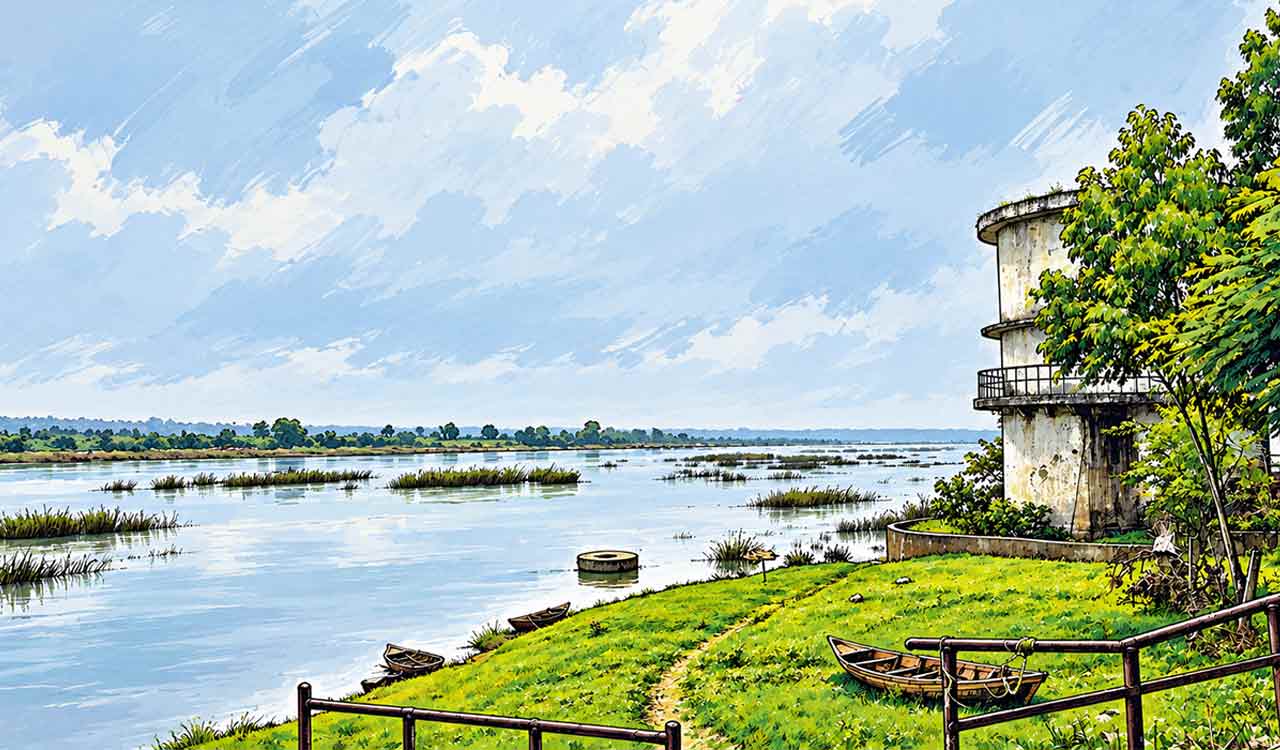
On October 26, the Chief Ministers of Maharashtra and Telangana held talks in Mumbai on the construction of the Tummidihatti Barrage. Immediately after the talks, the Telangana government issued a press note stating a committee comprising secretaries from both States would study the extent of submergence likely to result from the barrage’s construction and its potential impact on the Chaprala Wildlife Sanctuary. The sanctuary is located along the left bank of the confluence of Wardha and Wainganga rivers, where the barrage is proposed to be constructed. The committee would undertake the exercise to develop a roadmap for the construction of the barrage.
Also Read
The press note stated that Maharashtra Chief Minister Devendra Fadnavis had clarified his State’s willingness to reconsider the agreement signed with the previous government of Telangana for the construction of the barrage at a Full Reservoir Level (FRL) of 148 metres, provided there were no adverse effects on Maharashtra or its people. He also added that Maharashtra has no objection to supporting Telangana’s water requirements.
Furthermore, the press note stated that while Maharashtra is open to re-examining Telangana’s request to increase the height of the Tummidihatti Barrage, a final decision could be taken only after a comprehensive study of the technical, environmental, and administrative aspects involved. It was also noted that alternative options should be explored.
Key Points
I shall attempt to analyse the key points mentioned in the carefully and cautiously drafted press note. To begin with, Telangana Irrigation Minister Uttam Kumar Reddy pointed out in a PowerPoint presentation that an agreement had been reached in 2016 to fix the height of the Tummidihatti Barrage at 148 metres.
However, he argued that constructing the barrage at this height would fail to fully meet the drinking and irrigation water requirements of the Telangana region. He emphasised the need to take into account current electricity demands, energy costs, environmental conservation, climate change, and project maintenance expenses, while giving priority to the possibility of transporting water by gravity.
Under these circumstances, he explained that constructing the Tummidihatti Barrage with an FRL of 152 metres would be the most advantageous option for Telangana. Before and during the elections, the present leadership had promised to the people of Telangana that, upon assuming office, they would construct the Tummidihatti Barrage and ensure the transportation of water to Yellampalli through a gravity canal. The leadership reiterated this promise several times even after coming to power.
The then KCR-led government had made intensive efforts at all levels for a year to construct the barrage at Tummidihatti with an FRL of 152 metres
However, the government, as far back as the tenure of YS Rajasekhara Reddy in the then undivided State, was already aware that transporting water from Tummidihatti to Yellampalli by gravity was not feasible. Contrary to the promise made, why was the excavation of the 116-km gravity canal abandoned after just 73 km had been completed? Work on the canal was halted because Singareni Collieries identified coal deposits along the proposed canal alignment.
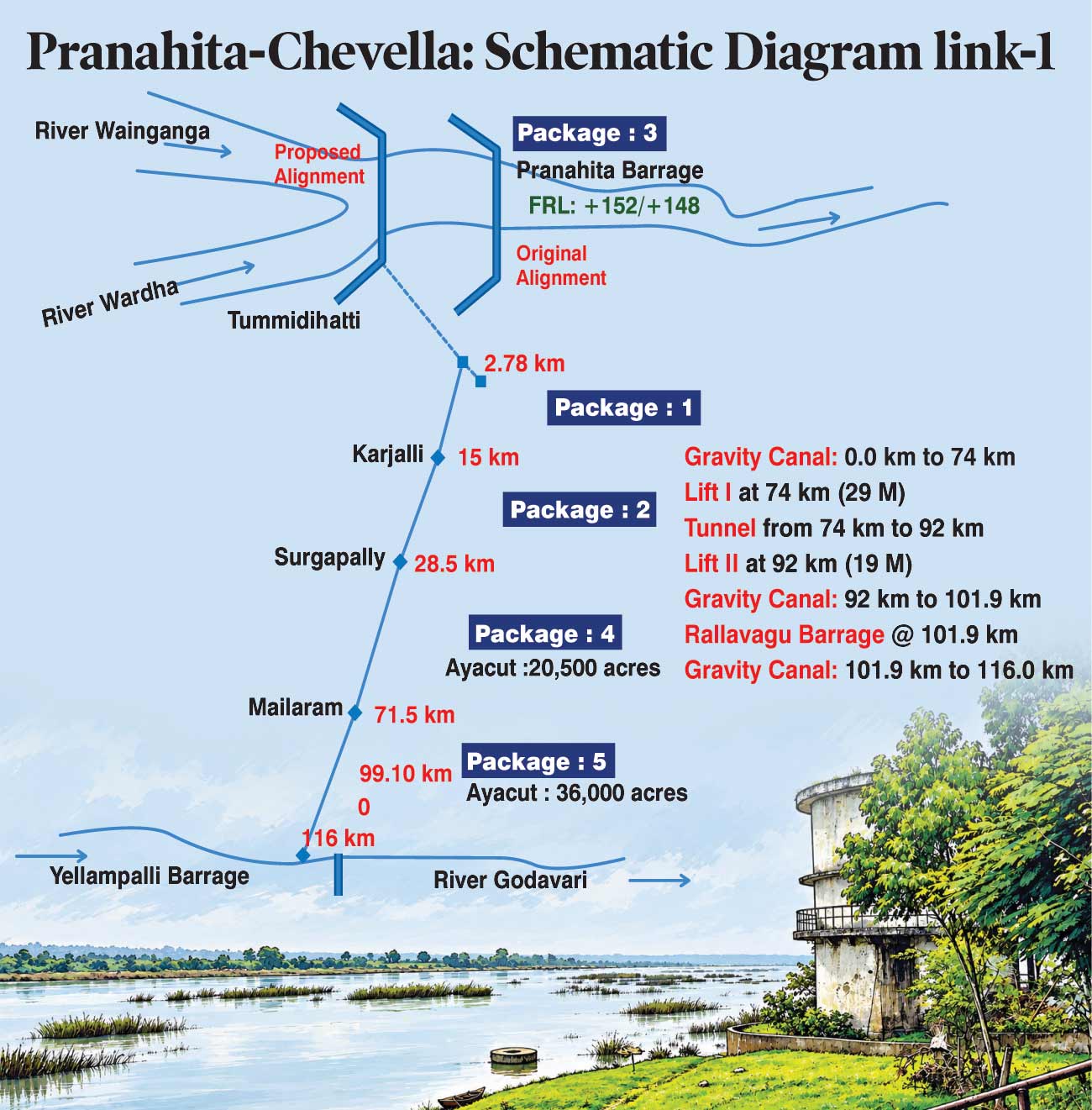
To bypass these coal deposits, the canal would need to be realigned along a higher contour, extending all the way to Yellampalli. This adjustment would require the installation of a 29-metre lift at the 73rd km and a 19-metre lift at the 92nd km. Engineers prepared a schematic map of the Tummidihatti-Yellampalli alignment incorporating these changes and submitted it to the government at that time. However, no decision was taken on the proposal until 2014. Consequently, the 73-km stretch of the canal that had already been excavated remained incomplete, without further progress.
Height of the Matter
Meanwhile, the government of the undivided State had failed to reach an agreement with Maharashtra on the construction of the Tummidihatti Barrage despite seven years of negotiations. Following the formation of Telangana, the K Chandrashekhar Rao-led government made intensive efforts at all levels for a year to construct the barrage at Tummidihatti with an FRL of 152 metres.
However, successive governments in Maharashtra, under both the Congress and the BJP, remained firm in their opposition, stating that they would not permit a height even an inch above 148 metres. The KCR government eventually concluded that, rather than wasting more time on negotiations with Maharashtra, it would be prudent to proceed with the construction of the barrage at an FRL of 148 metres.
Concurrently, the Central Water Commission (CWC) sent three letters within a span of one month, pointing out that the net water availability at the Tummidihatti site was insufficient to meet the project’s requirements. It advised a re-evaluation of the volume of water proposed to be diverted. Project simulation studies indicated that if the barrage were constructed at a height of 148 metres sought by the Government of Maharashtra, it would not be possible to divert more than 44 TMC of water. Consequently, the project had to be re-engineered.
Dividing the Project
Following this re-engineering, the Pranahita-Chevella project was divided into two parts. The BR Ambedkar Pranahita Project was conceived to provide irrigation water to two lakh acres in the eastern part of Adilabad district by constructing a barrage at Tummidihatti with an FRL of 148 metres and utilising 20 TMC of water. The Kaleshwaram Project was designed to meet the requirements of other districts.
The CWC accorded permission to utilise 240 TMC of Godavari River water through the Medigadda, Annaram, and Sundilla barrages. An agreement was reached with Maharashtra in 2016, during the Fadnavis government, for the construction of a barrage at Tummidihatti with an FRL of 148 metres and another at Medigadda with an FRL of 100 metres.
However, owing to several factors, including technical challenges at Tummidihatti, the potential impact on the Chaprala Wildlife Sanctuary, the complex design of the barrage (with a length of 6.5 km, 102 gates, a storage capacity of just 1.85 TMC and a 40-degree skew), and a construction cost of Rs 2,500 crore, the then KCR-led government explored an alternative: the BR Ambedkar Wardha Project.
A Detailed Project Report (DPR) for this project was prepared and submitted to the CWC and other central government organisations. It proposed the construction of a barrage on the Wardha River near Veerdandi village in Kautala Mandal of Adilabad district (now Asifabad district). The proposed barrage would have a storage capacity of approximately 3 TMC, a length of 1.75 km, 29 gates, and a pond level of 152 metres, with an estimated total cost of Rs 4,500 crore.
The CWC had even begun issuing the necessary clearances. However, following a change of government in the State, the new administration sidelined the Wardha barrage proposal, and the Tummidihatti Project once again came to the forefront.
As a resident of Adilabad district, I had hoped that the construction of a barrage, whether under the Wardha Barrage proposal or the Tummidihatti Project, whichever was ultimately chosen, would benefit our region. Three years have passed, but the Tummidihatti Project remains stagnant. Despite endless discussions and reviews, it has made no real progress, much like a wooden toy horse that rocks back and forth without ever moving forward.
After wasting three years, the government has now initiated a farcical round of discussions with Maharashtra on the Tummidihatti project. It is being claimed that studies already completed will be undertaken all over again. Assessments of the extent of submergence likely to be caused by the construction of the Tummidihatti Barrage and its impact on the Chaprala Wildlife Sanctuary have already been carried out multiple times, both during the undivided State and subsequently after the formation of Telangana. It was precisely because these studies indicated outcomes unfavourable to Maharashtra’s interests that the neighbouring State had earlier refused to agree to a barrage with an FRL at 152 metres, insisting instead on a reduction of 4 metres.
What geographical changes could have taken place at Tummidihatti that would lead to different results in these new, proposed studies? In fact, a recently prepared Pre-Feasibility Report (PFR) for the ‘Tummidihatti-Sundilla Project’ by a reputed survey agency already contains detailed data on submergence at different barrage heights at Tummidihatti. The PFR was also communicated to the Government of Maharashtra through the CWC.
According to the PFR:
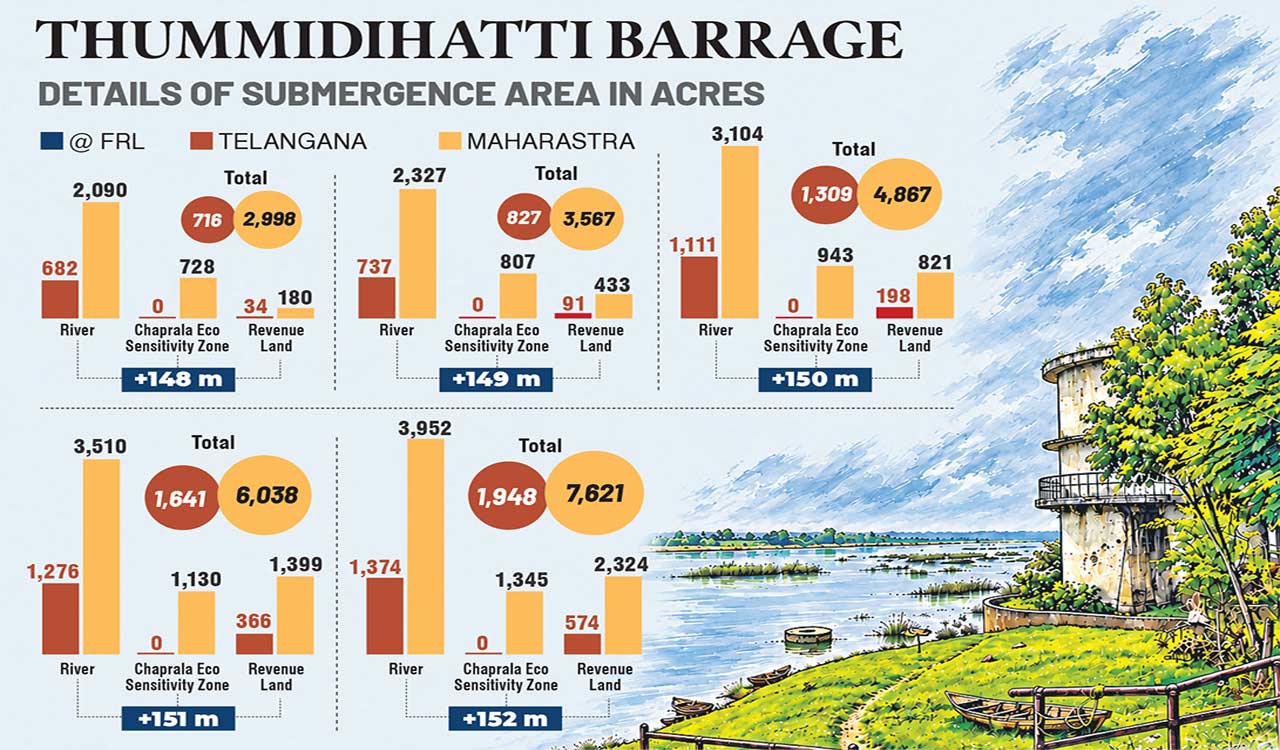
- At an FRL of 152 metres, the submergence in Maharashtra would comprise 3,952 acres of riverbed area, 1,345 acres within the Eco-Sensitive Zone of the Chaprala Wildlife Sanctuary and 2,324 acres of revenue land, taking the total affected area to 7,621 acres.
- At the agreed FRL of 148 metres, 2,090 acres of riverbed in Maharashtra would be submerged, along with 728 acres within the Eco-Sensitive Zone of the Chaprala Wildlife Sanctuary and 180 acres of revenue land, taking the total affected area to 2,998 acres.
- At an FRL of 151 metres, the total affected area would be 6,038 acres.
- At 150 metres, the total affected area would be 4,867 acres.
- And at an FRL of 149 metres, the total affected area would be 3,567 acres.
Given that an FRL of 152 metres would result in 7,621 acres in Maharashtra being affected by submergence due to the Tummidihatti Barrage, expecting the government of Maharashtra to agree to its construction at this height is would be like trying to get blood out of a stone. It must be remembered that the BJP government in Maharashtra faces opposition from the Shiv Sena and the Congress.
Political Playbook
Even when the Congress was in power in both States, it did not agree to the construction of a barrage at an FRL of 152 metres. Why would it agree to it now, when it is in the Opposition? The parties in the Opposition will undoubtedly seize upon the Tummidihatti issue as a political weapon. The BJP has already suffered political setbacks both in Maharashtra and across the country due to controversies such as irregularities in the voter list revision (SIR) process and the alleged Chanda Chori controversy relating to the Ayodhya Ram temple.
I do not believe the Fadnavis government will risk granting permission for the Thummidihatti Project at an FRL of 152 metres, as doing so would provide the opposition with yet another political weapon. That is why Mr Fadnavis chose his words very carefully, ensuring that the stick remained unbroken while the snake also remained unharmed.
The meeting between the Chief Ministers on the construction of the Tummidihatti Barrage, an initiative on which high hopes had been pinned, ultimately ended as a mere formality, without any concrete decisions. In fact, such an outcome was anticipated. The Fadnavis government indicated that it would communicate its position only when the Central Water Commission (CWC) sought its opinion on the project.
Futile Exercise
At present, the CWC has only a Pre-Feasibility Report for the project, not a Detailed Project Report (DPR). A DPR cannot be prepared until the technical parameters, most crucially the FRL of the barrage, are finalised through discussions between the two States. Will this entire process turn into a futile, drawn-out exercise involving endless meetings and studies for the next two years, or will it actually lead to a roadmap for the construction of the barrage? Only time will tell.
The irony of the entire episode is that the government has neither restored the Medigadda barrage and brought the Link-1 of Kaleshwaram Project back into operation nor constructed a barrage at Tummidihatti in the last three years. The government ignored a technically viable solution proposed by the Telangana Retired Engineers Association to lift water from the Kannepalli Pump House, located 16 km upstream of the Medigadda Barrage, without closing the gates of the barrage. As a result, about 750 TMC of water was allowed to flow downstream without being utilised this season.
The acute water shortage in the State has been attributed to El Niño. But no, the drought is not induced by El Niño. Rather, I would say, it is because of the government’s lack of discernment and foresight.
(The author is Superintending Engineer [Retd], I&CAD Department)

Related News