Opinion: AI is not in the Cloud—the hidden environmental cost of artificial intelligence
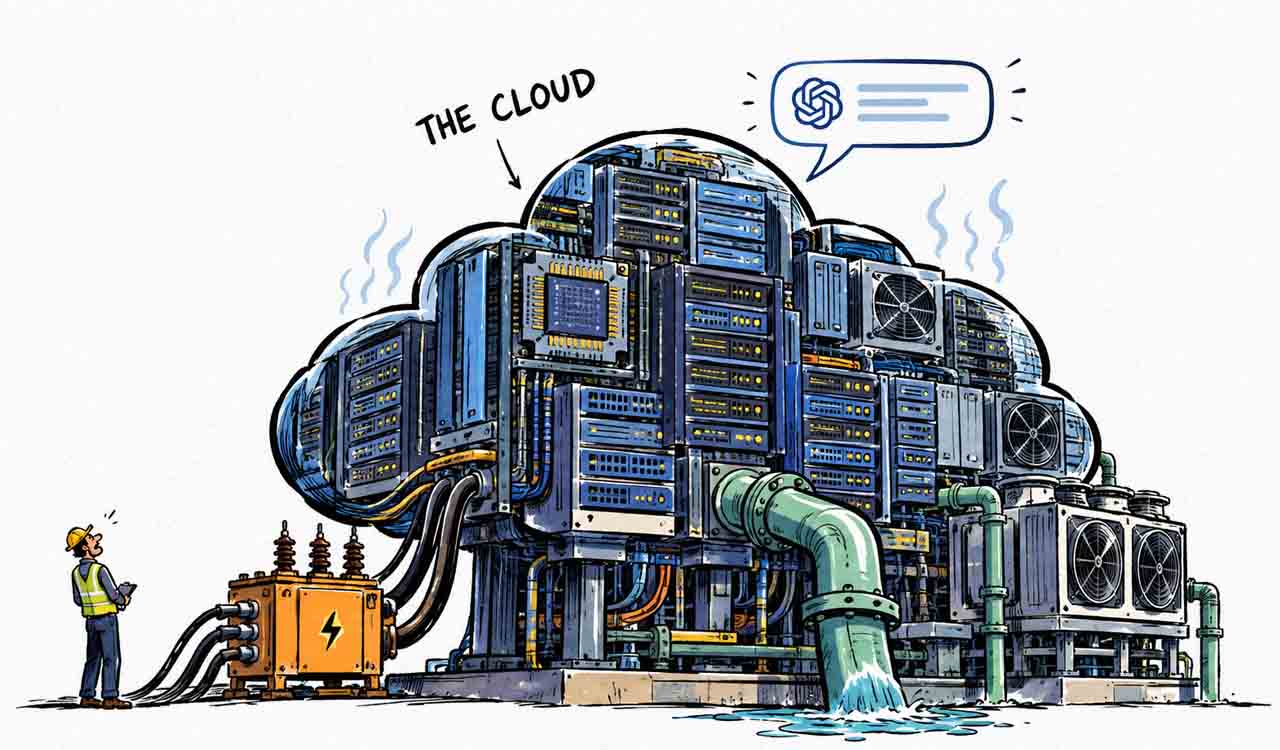
The cloud is on the ground, powered by electricity, cooled by water and sustained by engineering. AI isn’t just digital anymore; it has a very physical footprint


By Prof Ravipudi Venkata Rao
Millions of people ask ChatGPT, Gemini, Claude and other AI assistants for help. The answers appear within seconds, and the experience can feel almost magical—as though intelligence had simply arrived from ‘the cloud.’ But that expression has one problem: there is no cloud.
Also Read
Every artificial intelligence response begins in a data centre connected to massive transformers, substations, thousands of high-performance processors, kilometres of fibre-optic cables, cooling towers, water pipelines, and engineers working around the clock. What we call ‘the cloud’ is not floating somewhere above us; it is firmly anchored to the earth. And like every physical system, it obeys the laws of energy, thermodynamics, and resource constraints.
Before an AI system can answer a question, electricity must race through billions of transistors, processors must perform trillions of calculations, and cooling systems must remove the enormous heat generated in the process. The greatest limitation on tomorrow’s AI may not be computing power but clean electricity and freshwater. Engineers have long pursued a simple objective: achieving more output with fewer resources. AI now faces the same challenge—not at the scale of a machine or factory, but at the scale of an entire planet.
Invisible Infrastructure
Every AI answer is first an electrical event, and only then an intellectual one. This invisible infrastructure is rapidly becoming one of the defining engineering achievements of our time. It is also emerging as one of the least understood environmental challenges.
AI promises to accelerate medical discoveries, improve agricultural productivity, optimise transport networks and make industries more efficient. Yet the very technology that appears weightless on our screens is firmly rooted in the physical world. AI is often described as “the new electricity.” Ironically, its own future may depend on how wisely we generate and use electricity.
The scale of this transformation is remarkable. The International Energy Agency (IEA) estimates that data centres consumed about 485 terawatt-hours (TWh) of electricity worldwide in 2025—roughly equivalent to the annual electricity consumption of a medium-sized country. By 2030, that demand is projected to rise to around 950 TWh, accounting for roughly 3% of global electricity consumption, with AI-focused data centres driving much of this increase.
Yet the IEA also offers an important perspective: AI is not merely an energy consumer; if deployed wisely, it could become one of the world’s most powerful tools for improving energy efficiency across power systems, transport, manufacturing and buildings.
Not Just a Digital Technology
Until recently, discussions about AI’s environmental impact focused largely on carbon emissions. A report released in June 2026 by the United Nations University Institute for Water, Environment and Health (UNU-INWEH) significantly broadened that conversation.
The report delivers a sobering message: AI is no longer just a digital technology—it is becoming a major consumer of physical resources. Every leap in computational intelligence carries an accompanying demand for electricity, freshwater, land, critical minerals and, eventually, electronic waste. The age of AI is, therefore, not only a software revolution but also an infrastructure revolution.
India should encourage the development of energy-efficient AI chips and require greater transparency in reporting electricity, water use and carbon emissions from large AI facilities
One of the report’s most thought-provoking observations is that the AI revolution is fundamentally a physical revolution disguised as a digital one. The benefits of AI are enjoyed instantly by users across the world, but the environmental burdens are often concentrated elsewhere—in communities hosting large data centres, regions supplying freshwater for cooling, areas extracting critical minerals for advanced chips, and countries managing increasing volumes of electronic waste. The report is not a warning against AI. Rather, it is a call to ensure that the technological revolution of the 21st century develops within the ecological limits of the planet.
Urgency in India
For India, this question is particularly urgent. Every day, an Indian farmer may consult an AI-powered advisory before irrigating a field. A radiologist may seek AI assistance while reviewing a CT scan. A student may ask an AI tutor to explain calculus in Telugu or Hindi. A banker may rely on intelligent algorithms to detect fraudulent transactions within milliseconds. Millions of such interactions now occur quietly across the country and appear almost effortless.
This transformation is only beginning. Recognising AI as a strategic technology, India has launched the IndiaAI Mission while building on the remarkable success of Digital India, Aadhaar, UPI, DigiLocker and ONDC. Together, these initiatives are helping create one of the world’s largest AI-enabled digital ecosystems, with applications expanding rapidly across agriculture, healthcare, education, manufacturing, finance and public services.
Supporting this digital transformation requires an equally massive physical transformation. India, therefore, stands at a unique crossroads. It seeks to become a global AI leader while simultaneously expanding renewable energy, strengthening water security and pursuing its net-zero commitment by 2070.
Debate surrounding large data centre projects such as Google’s proposed project near Visakhapatnam illustrate this challenge. While the project promises employment, investment and technological advancement, it has also raised legitimate questions about water availability and environmental sustainability. Such debates should not be viewed as obstacles to progress; rather, they reflect the growing recognition that the AI revolution must be built on foundations that are both technologically advanced and environmentally responsible.
The paradox is striking. AI undoubtedly consumes electricity, water and advanced semiconductor resources. Yet it also has the potential to reduce society’s overall consumption of these very resources. Intelligent algorithms are already being used to optimise electricity grids, improve renewable energy forecasting, reduce traffic congestion, minimise industrial waste, enhance precision agriculture and increase energy efficiency in buildings and factories. Properly deployed, AI may ultimately save more resources than it consumes.
Greener Algorithms
The challenge, therefore, is not whether India should adopt AI, but how India can build AI sustainably. Several priorities deserve immediate attention. New data centres should increasingly be powered by renewable energy. Water-efficient cooling technologies and greater use of treated wastewater should become standard practice. India should encourage the development of energy-efficient AI chips and require greater transparency in reporting electricity, water use and carbon emissions from large AI facilities. Research should focus not only on smarter algorithms but also on greener ones.
We often celebrate AI for giving us smarter answers. Perhaps it is time to ask smarter questions. Where does that intelligence come from? What resources does it consume? Who bears its environmental cost? The future of AI will not be decided only in research laboratories or technology companies. It will also be shaped in power plants, renewable energy farms, water management systems, engineering design centres and public policy institutions.
Every prompt begins with electricity, travels through engineering and returns as intelligence. Whether that journey leaves behind a carbon footprint or a blueprint for sustainable innovation depends on the choices we make today. The cloud is not in the sky. It is on the ground—powered by electricity, cooled by water and sustained by engineering.
(The author is Professor [Higher Administrative Grade], Department of Mechanical Engineering, Sardar Vallabhbhai National Institute of Technology [SVNIT], Surat)

Related News