Opinion: When Telangana’s villages become film studios, who calls the shots?
Digital platforms have given rural filmmakers audiences and cultural visibility, but have yet to ensure creative autonomy or financial security


By Srikanth Nayaka and Nimmagadda Bhargav
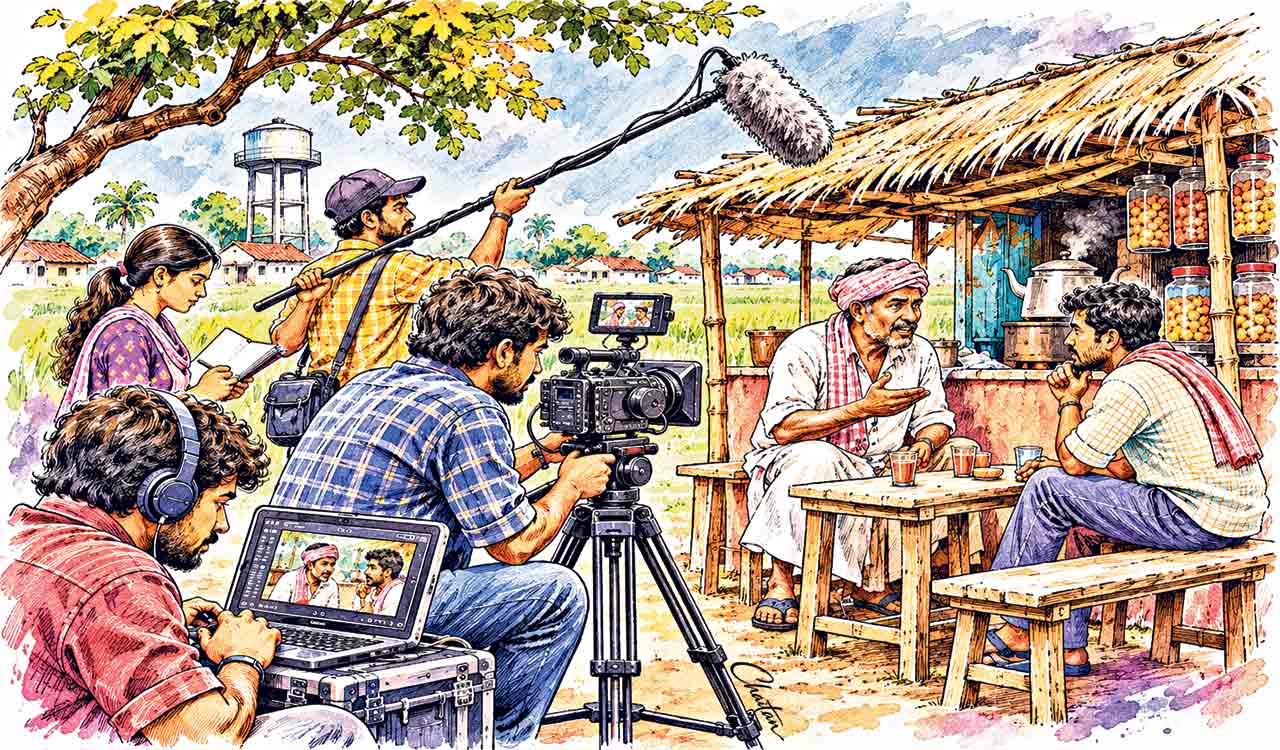
In Lambadipally, a hamlet in Jagtial district, a makeshift tea stall stands in an open field. But it is not meant to serve customers. It is a film set built by young creators shooting a YouTube video. Cameras, microphones, and other filmmaking equipment have become part of their work, while village streets, fields, and everyday gathering places serve as production locations.
Also Read
For decades, mainstream cinema and television have often portrayed villages through stories produced in metropolitan cities, mostly Hyderabad or Chennai. Rural people appeared as characters in narratives about poverty, migration, tradition, and development, but rarely exercised control over how their lives were represented.
That situation is changing. Across India, young people in small towns and villages are producing their own entertainment, reaching audiences far beyond their immediate communities, and building careers around digital content. This is shifting who gets to tell stories and whose experiences find an audience. However, a wider audience does not necessarily mean a fairer share of the rewards. Digital platforms have made production more accessible without guaranteeing economic security.
From Village Life to Popular Entertainmentt
My Village Show, a Telangana-based YouTube collective, was founded in Lambadipally by Sriram Srikanth. Its early videos, some shot and edited on a third-generation iPad, used comedy, songs, and short films to address sanitation, public health, and village elections. The creators drew on local lingo, familiar characters, and village festivals instead of imitating television. Village PUBG in Real Life, a comic take on mobile gaming addiction, garnered millions of views.
Over time, the collective evolved into a media enterprise with several channels and a battery of writers, actors, directors, cinematographers, and editors. Some members went on to find work in Telugu cinema and reality shows.
This challenges two assumptions: that compelling entertainment must come from metros, and that rural creators are amateurs working with smartphones. Many successful YouTube channels operate like small production companies. They script, schedule shoots, edit, and manage audiences, with crew members often doubling up across roles. Their knowledge of village life is not a shortcoming but a creative resource.
These creators bring Telangana language, traditions, and everyday experiences to audiences often overlooked by mainstream entertainment.
When Popularity Does Not Pay
Professionalisation brings its own risks. As My Village Show invested in better cameras, editing, and original music, it produced Husharu Pittalu, a web series that took months to complete. Its initial budget was about Rs 5 lakh, with additional expenditure on salaries and music.
The anticipated revenue from paid promotions and platform monetisation did not materialise, leaving the project financially unsustainable despite the collective’s popularity. The episode captures the difference between building a popular channel and sustaining a financially viable production. The costs of making a video are immediate, and the returns are uncertain.
The creator economy must be recognised as an emerging cultural industry, sustained by writers, performers, and technicians whose labour often remains hidden behind subscriber counts
Views are not wages. Subscribers are not financial security. Celebratory accounts of overnight sensations rarely mention production costs, fluctuating revenues or financial risks. For rural creators, unequal access to sponsors, commercial networks, training, and investment compounds the problem. The irony is that the ambition to improve production quality also deepens financial vulnerability.
Deciding Production
Platforms do not merely distribute content; they share its production. Creators track views, likes, and comments, tweak release schedules, and improvise their storytelling to stay visible. The rise of YouTube Shorts shows the pressure. For creators invested in longer, cinematic work, short-form video offers greater reach but demands a different rhythm. My Village Show responded by launching a separate channel for shorter videos while continuing its longer productions.
Lower entry barriers are a reality. A young person in a Telangana village no longer needs a television network’s approval to reach an audience. However, easier access to distribution does not translate into control over the economics of production.
A creator may choose the story, bear the production costs, and assemble the team, but the platform’s systems of visibility and monetisation significantly influence whether that work pays. Rural creators may control the camera, but they do not control the platforms on which their livelihoods depend.
Beyond the Viral Story
Yet rural creators are not passive participants in this creator ecosystem. They adapt, collaborate, and create opportunities of their own. The challenge is to recognise both their agency and the constraints they face. That means seeing the creator economy as an emerging cultural industry, sustained by writers, performers, and technicians whose labour remains hidden behind subscriber counts.
Meaningful support is essential. Greater transparency about monetisation rules and changes in platform policies would help creators plan and thrive. Affordable production infrastructure, technical training, fairer access to commercial partnerships and multiple distribution channels could reduce dependence on any single platform. Universities and public agencies could nurture regional creative ecosystems without dictating content. For Telangana, a State rich in folk performance and storytelling traditions, such support could turn scattered successes into a durable industry.
A village can now become a film studio. The question is whether its filmmakers can afford to keep the cameras rolling.
(The authors are Assistant Professors in the Communication Area, Indian Institute of Management Indore. Views are personal)

Related News