Opinion: Beyond the veto: Why the world needs a new architecture for peace
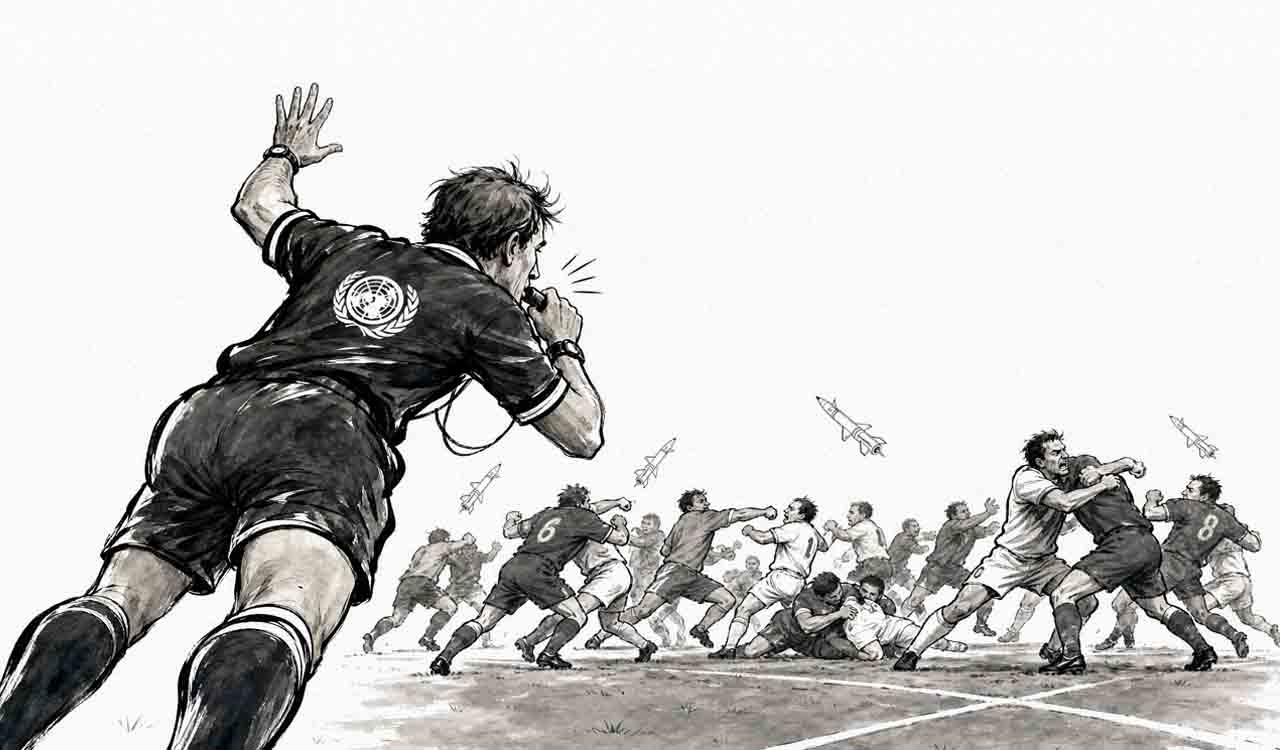
The promise of the United Nations was never merely about the absence of war but about creating an international order where disputes would be settled through law rather than force


By Chittarvu Raghu
Wars in the 21st century are increasingly exposing an uncomfortable truth: military superiority no longer guarantees political victory. The belief that overwhelming technological prowess, economic strength and sophisticated weaponry can deliver decisive outcomes is steadily giving way to a more sobering reality. In an interconnected world, conflicts have become prolonged, costly and inconclusive, leaving devastation in their wake but seldom producing clear winners.
Also Read
Recent geopolitical crises have underscored this transformation. Whether in the prolonged Russia-Ukraine conflict or in the escalating tensions involving the United States, Iran and Israel, the limits of military power have become increasingly evident. Nations equipped with advanced capabilities have found themselves trapped in cycles of retaliation, economic disruption and diplomatic deadlock. The eventual return to negotiations has demonstrated a lesson that history appears determined to teach repeatedly: modern warfare offers diminishing returns, and sustainable peace cannot be secured through force alone.
Recurring Wars
This changing nature of conflict raises a larger question. If wars are no longer capable of delivering decisive solutions, does the international system possess adequate mechanisms to prevent and resolve them? The answer, unfortunately, remains deeply troubling.
The United Nations emerged from the ashes of the Second World War with an ambitious vision. It represented humanity’s determination to create institutions capable of preventing another global catastrophe. International law was strengthened, conventions were established, and the Security Council was entrusted with the responsibility of maintaining peace and security.
Yet, despite decades of treaties, resolutions and diplomatic initiatives, the world continues to witness recurring wars and humanitarian crises. More troublingly, many of these conflicts persist not because solutions are unavailable, but because the mechanisms meant to enforce peace are themselves constrained.
At the heart of this structural weakness lies the veto power enjoyed by the five permanent members of the United Nations Security Council. Conceived in 1945 to reflect the realities of a post-war world, the arrangement may have provided stability during the early decades of the Cold War. However, the geopolitical landscape of the 21st century bears little resemblance to that era. What was intended as an instrument of balance has gradually become an instrument of paralysis.
International Order
Time and again, critical resolutions have been blocked because they conflicted with the strategic interests of one or another permanent member. Consequently, international law often appears selective rather than universal. Smaller nations remain subject to the discipline of global norms, while major powers and their allies frequently enjoy protection from meaningful accountability. The result is a perception that the international order functions less as a system of equal rules and more as a hierarchy shaped by geopolitical privilege.
Structures designed for 1945 cannot indefinitely govern a world transformed by digital interdependence, multipolarity and shared vulnerabilities
At the same time, the world itself has undergone profound changes. Globalisation has woven nations into networks of economic interdependence unprecedented in human history. Supply chains span continents. Financial markets operate across borders. Energy security, digital infrastructure, climate change and food systems have become shared concerns that no country can address in isolation.
The recent disruptions surrounding the Strait of Hormuz provided a vivid illustration of this reality. Events in a narrow maritime corridor reverberated through energy markets and affected economies far beyond the immediate region. Similar patterns have been witnessed during conflicts elsewhere. The consequences of war no longer remain confined to battlefields; they ripple across the globe.
Paradoxically, this interconnectedness may also offer humanity its greatest opportunity. Interdependence has created forms of leverage that did not exist when the United Nations was established. No country, including the most powerful, can entirely detach itself from global economic systems, technological ecosystems and diplomatic relationships. In a world where isolation carries immense costs, collective action possesses greater potential than ever before.
This reality should encourage serious thinking about the future of global governance. The international community must begin discussing reforms that place accountability above hegemony. The United Nations itself need not be discarded, but its institutional architecture requires urgent adaptation. The concentration of veto power in the hands of a few nations increasingly appears incompatible with contemporary realities.
Reformed Framework
A reformed framework must seek broader and more democratic forms of consensus. Matters concerning international peace and grave humanitarian crises cannot remain hostage to the strategic calculations of individual powers. Equally important, violations of international commitments should invite predictable consequences rather than depend upon political convenience.
Such accountability need not rely solely on military responses. Economic measures, technological restrictions, diplomatic isolation and multilateral sanctions can serve as instruments of collective responsibility. Their effectiveness would depend on transparent rules and broad international participation rather than the discretion of competing power blocs.
Admittedly, such reforms are easier to propose than to implement. The permanent members themselves are unlikely to surrender privileges voluntarily. Yet history suggests that institutions survive only when they adapt to changing realities. Structures designed for 1945 cannot indefinitely govern a world transformed by digital interdependence, multipolarity, and shared vulnerabilities.
The stalemates of contemporary warfare should serve as a warning. Military might may destroy infrastructure, weaken economies, and prolong suffering, but it rarely guarantees political success. The pursuit of absolute victory has become increasingly expensive and increasingly futile.
Humanity, therefore, faces a choice. It can continue to operate within an international system where rules apply unevenly and where peace depends upon the calculations of a few powerful states. Or it can embrace the opportunity to redesign global governance around a principle both simple and profound: that no nation, however powerful, should stand above the rules that bind humanity together.
The promise of the United Nations was never merely the absence of war. It was the creation of an international order in which disputes would be settled by law rather than by force. Eight decades later, fulfilling that promise may require not abandoning that vision, but finding the courage to reform it.
(The author is a senior Advocate)

Related News