Opinion: China’s waiting game on Line of Actual Control
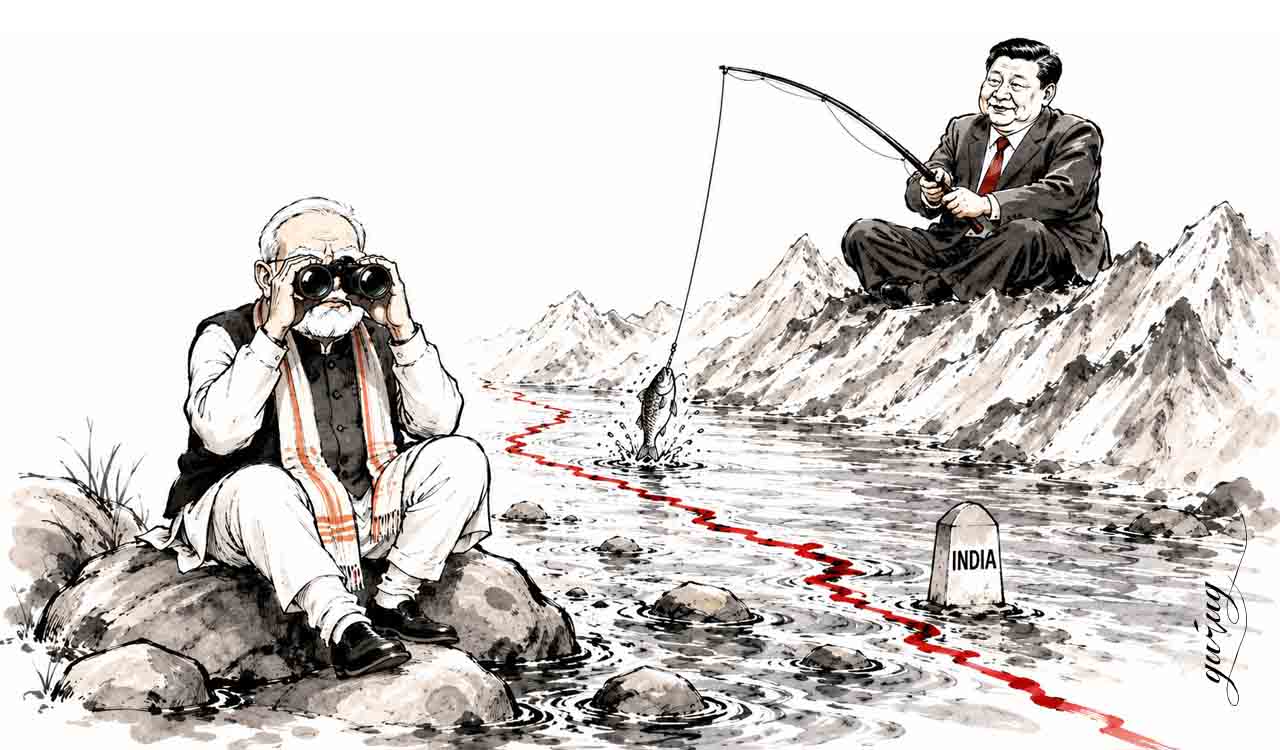
The issue is no longer only about where the boundary lies but also about the strategic advantages that flow from keeping it undefined


By Brig Advitya Madan
The meeting between National Security Adviser Ajit Doval and Chinese Foreign Minister Wang Yi during the recent BRICS National Security Advisers’ gathering offered another reminder that despite decades of dialogue, the India-China boundary dispute remains unresolved. Conventional explanations focus on competing territorial claims and differing historical narratives. Yet a more important question deserves attention: What if China sees strategic value in keeping the Line of Actual Control (LAC) ambiguous rather than settling it?
Also Read
That possibility helps explain a persistent pattern in India’s dealings with China. More than three decades after both countries agreed to maintain peace and tranquillity along the border, Beijing continues to resist efforts to clarify the LAC. The issue is no longer only about where the boundary lies. It is also about the strategic advantages that flow from keeping it undefined.
Arunachal Pradesh
This is particularly relevant in Arunachal Pradesh, which remains central to China’s territorial claims. The roots of the dispute go back to the Simla Conference of 1914 attended by representatives of British India and Tibet. The boundary in the eastern sector, later known as the McMahon Line, was initialled in draft form on April 27, 1914. The Chinese representative declined to sign the final convention on July 3, 1914, primarily because of disagreements over Tibet’s status and boundaries, rather than a direct objection to the India-Tibet boundary alone.
The historical context is important. Following the collapse of the Qing Dynasty, China exercised little effective control over Tibet until the entry of Communist forces in 1950. Yet contemporary Chinese claims increasingly overlook this reality while asserting expansive positions on Arunachal Pradesh, including repeated attempts to rename locations that remain firmly under Indian administration.
Zhou’s Letter to Nehru
The modern dispute over the LAC has its origins in a letter written by Chinese Premier Zhou Enlai to Prime Minister Jawaharlal Nehru on November 7, 1959. It was in this correspondence that Zhou first proposed a “Line of Actual Control” and suggested that both sides withdraw 20 kilometres from it. Nehru rejected the proposal. After the 1962 war, Zhou reiterated a similar formulation in his letter of November 15, 1962. Acceptance would have effectively legitimised Chinese occupation of Aksai Chin.
A crucial point often overlooked in public discussions is that India eventually accepted the concept of the LAC, but never accepted the Chinese definition of it. The Border Peace and Tranquillity Agreement (BPTA) of 1993 provided a framework for maintaining peace pending a final settlement. Article I committed both countries to respecting and observing the LAC. However, India’s acceptance of the concept did not amount to acceptance of the Chinese claim line first articulated in 1959.
China’s negotiating position on the broader boundary dispute also underwent significant changes. During Zhou Enlai’s visit to India in 1960, Beijing proposed what later became known as the “package proposal” — Chinese flexibility in the eastern sector in return for Indian accommodation in the western sector. Deng Xiaoping conveyed a broadly similar approach during Atal Bihari Vajpayee’s visit to China as External Affairs Minister in 1979.
The turning point came in 1985 when China altered its position and began insisting that India should first make substantive concessions in the eastern sector before receiving corresponding concessions elsewhere. India rejected this approach. During subsequent negotiations, New Delhi successfully ensured that the interests of settled populations in border areas would be protected in any future settlement, an important principle reflected in the 2005 Agreement on Political Parameters and Guiding Principles.
Actual Challenge
Having served with 27 Punjab in the aftermath of the Sumdorong Chu crisis and later participated in several Border Personnel Meetings with Chinese counterparts while serving as Brigade Major in the Galwan sector, I have seen firsthand how differing perceptions on maps translate into friction on the ground. The challenge has never been the absence of agreements. The challenge has been the absence of a common understanding of where the LAC actually lies.
India must strengthen its maritime posture and ensure China’s border strategy does not narrow New Delhi’s strategic horizons
Recognising this problem, the 1996 agreement on military confidence-building measures envisaged clarification of differing perceptions through an exchange of maps. Such a process was intended to identify areas of disagreement and work towards a common understanding of the LAC. Yet the effort stalled.
By 2002, maps had been exchanged only in the middle sector, where differences were relatively limited. China showed little willingness to proceed similarly in the western sector. India maintained that both sides should exchange maps reflecting their respective perceptions, but the process effectively collapsed in 2004.
The significance of that breakdown is insufficiently appreciated. A mutually clarified LAC would reduce opportunities for competing patrol claims and recurring stand-offs. An ambiguous LAC serves a different purpose. It allows China to exert pressure while remaining below the threshold of conventional conflict.
The pattern was visible before Galwan in 2020 and remains evident in Chinese behaviour today.
China’s method is often one of calibrated escalation. It advances claims, creates pressure and then partially disengages while preserving some strategic advantage. This approach enables Beijing to alter facts on the ground without incurring the costs of a full-scale military confrontation.
The larger strategic question is whether China now sees value in not resolving the dispute at all. An unsettled boundary compels India to devote substantial military resources to the continental front. It requires sustained deployment, infrastructure development and defence expenditure along the Himalayan border. Every additional division committed to the mountains is a resource unavailable elsewhere.
This has implications beyond the boundary itself. China’s principal long-term strategic concerns lie in the maritime domain, including critical sea lanes passing through the Malacca Strait. An India preoccupied exclusively with the continental challenge is an India less able to project influence across the wider Indian Ocean Region. From this perspective, preserving ambiguity on the border imposes costs on India while generating strategic space for China.
India must therefore avoid viewing the boundary dispute in isolation. Vigilance and military preparedness along the LAC remain essential. Equally important is the need to continue strengthening India’s maritime posture, including strategic initiatives such as the Great Nicobar project. New Delhi must ensure that China’s border strategy does not succeed in narrowing India’s strategic horizons.
As India and China continue their diplomatic engagement, the question before New Delhi is not simply whether the boundary dispute can be resolved. China may well have concluded that an unresolved dispute serves its interests better than a settled one. If that is the case, India’s challenge is larger than defending a line on a map. It is to deny Beijing the strategic advantages that flow from keeping that line undefined.
(The author attended several border personnel meetings with Chinese counterparts while serving as Brigade Major in the Galwan sector. He earlier served with 27 Punjab in the aftermath of the Sumdorong Chu crisis in Arunachal Pradesh in 1987 and has closely followed developments relating to the India-China boundary question)

Related News