Opinion: From Chandragupta to CJP—youth discontent has repeatedly redefined political power in India
Governments may win young people’s support through promises, but they retain it only through performance. Young people are not merely voters of tomorrow; they are legitimacy test of today


By Pendyala Mangala Devi
There is a recurring lesson in India’s political history: governments may possess administrative machinery, institutional authority and electoral power, but when a generation of young people loses faith in its future, political legitimacy itself begins to erode.
Also Read
From Chandragupta Maurya to Bhagat Singh, from Swami Vivekananda to Mahatma Gandhi, from the students of the 1969 Telangana movement to KCR’s statehood struggle, from Jayaprakash Narayan’s student movement to the Assam agitation, from Mandal to Anna Hazare, and now to digitally organised youth movements such as Cockroach Janata Party (CJP), the pattern is strikingly consistent: youth grievance becomes collective anger; collective anger becomes organisation; organisation becomes political pressure; and political pressure can ultimately alter governments.
Hannah Arendt observed that “Power corresponds to the human ability not just to act but to act in concert.” That is the essence of youth politics. Governments can command institutions, but they cannot indefinitely command public consent. Young people are, therefore, not merely voters of tomorrow. They are the legitimacy test of today.
Chandragupta and Chanakya: The First Lesson in Organised Political Change
The story begins with Chandragupta Maurya. Guided by Chanakya, the young Chandragupta transformed scattered military and political forces into an organised challenge to the Nanda order. The outcome was not merely a change of ruler but the establishment of the Mauryan Empire and one of the subcontinent’s first great centralised political orders.
The lesson remains relevant more than two millennia later: discontent can create revolt, but organisation can create a new political order. Youth provides energy; strategy provides direction; institutions provide permanence. Chanakya’s enduring political insight was that power must first be organised before it can be exercised.
Young Bengal and Vivekananda: Change the Mind Before Changing the State
The Young Bengal movement associated with Henry Louis Vivian Derozio demonstrated that political transformation often begins with intellectual rebellion. Young minds first question inherited ideas, social conventions and established authority before challenging political power itself.
Swami Vivekananda carried this awakening to a much wider civilisational level. He died at just 39, yet his influence on generations of Indian youth was extraordinary. His exhortation “Arise, awake, and stop not till the goal is reached” and his declaration that “Strength is life, weakness is death” were not merely spiritual messages.
In a colonised society, self-confidence itself was political. Before India could fight successfully for freedom, Indians had to believe that they were capable of shaping their own destiny. As John Dewey later observed, “Democracy has to be born every generation anew.” Every generation, therefore, must rediscover its own political confidence.
Bhagat Singh, Rajguru and Sukhdev: When Youth Became the Conscience of a Nation
If Vivekananda awakened confidence, Bhagat Singh’s generation gave Indian youth the language of courage, sacrifice and political defiance. Bhagat Singh, Shivaram Rajguru and Sukhdev Thapar became enduring symbols of revolutionary youth. Alongside them stood Chandrasekhar Azad, Batukeshwar Dutt, Ram Prasad Bismil, Ashfaqulla Khan, Jatin Das and countless other young revolutionaries.
They were not simply angry young men; they represented a political generation. Bhagat Singh combined revolutionary action with serious intellectual inquiry. His concerns extended beyond British rule to imperialism, economic exploitation and the transformation of society. His words remain powerful: “Revolution is the inalienable right of mankind. Freedom is the imperishable birthright of all.”
The execution of Bhagat Singh, Rajguru and Sukhdev in 1931 was intended to extinguish their political challenge. Instead, it transformed them into immortal national symbols. The British could execute individuals; they could not execute an idea. As Hannah Arendt warned, “Power and violence are opposites.” Force can suppress individuals, but it cannot manufacture legitimacy. The political life of a martyr can outlast the political life of a regime.
Gandhi: Turning Youth Anger into Mass Political Power
India had revolutionaries, anger and resentment against colonial rule. Mahatma Gandhi’s extraordinary contribution was to convert these scattered energies into a disciplined national movement. Through Ahimsa and Satyagraha, he gave ordinary citizens, particularly young people, a method of political resistance through boycott, civil disobedience, non-cooperation, marches and peaceful defiance.
Gandhi did not eliminate anger; he disciplined it. He transformed emotion into organisation, sacrifice into moral authority and individual courage into collective power. His political method demonstrated that youth energy, when combined with discipline and moral legitimacy, could challenge even an empire.
His observation that “In a gentle way, you can shake the world” captured the power of non-violent mass mobilisation. Decades later, Telangana would demonstrate how these principles could be adapted to a regional democratic struggle.
1969 Telangana: A Massive Youth Uprising That Fell Short
The 1969 Jai Telangana movement was one of the most powerful youth uprisings in post-Independence India. Students, particularly from Osmania University, became the emotional and organisational heart of the agitation. The movement raised fundamental questions concerning regional safeguards, employment, resources, development and perceived injustice towards Telangana.
The pattern across all movements is strikingly consistent: Youth grievance becomes collective anger; collective anger becomes organisation; organisation becomes political pressure; and political pressure can alter governments
There were extraordinary sacrifices and repression. Yet Telangana was not achieved in 1969. The movement had passion, students and public emotion, but it lacked a sufficiently durable political structure capable of carrying the demand through changing political circumstances. A spontaneous uprising can shake the establishment; a permanent political organisation is required to outlast it. That failure became one of the most important political lessons for the later Telangana movement.
Professor Jayashankar and other intellectuals: Keeping Telangana Alive
After the political momentum of 1969 weakened, the Telangana cause survived because intellectuals refused to allow it to disappear. Professor Kothapalli Jayashankar became one of the foremost intellectual architects of Telangana. His historic contribution was to transform emotion into evidence, articulating the Telangana argument through irrigation, employment, regional development, resource allocation, public expenditure, historical safeguards and administrative inequality.
Alongside professors, writers, poets, researchers, journalists and cultural activists, Jayashankar preserved the intellectual foundation of the movement. Antonio Gramsci’s concept of the “organic intellectual” is relevant here: intellectuals become politically consequential when they connect ideas with the lived experiences and aspirations of society. That is precisely what Telangana’s intellectual movement achieved. The streets may have become quieter after 1969, but the idea of Telangana never disappeared.
KCR: Learning From 1969 and Turning Aspiration into Political Power
KCR’s historic contribution was not to invent Telangana sentiment; that sentiment had existed for decades. His contribution was to understand why the 1969 movement had failed to achieve statehood and to build what the earlier movement lacked: a permanent political vehicle.
KCR recognised that emotion alone could not achieve statehood. Telangana needed political organisation, intellectual legitimacy, youth mobilisation, electoral representation, sustained agitation and continuous pressure on national politics.
The formation of the TRS in 2001 fundamentally changed the nature of the struggle. The earlier cycle of youth uprising, government assurance, and movement weakening was replaced by a more sustained process of intellectual foundation, political organisation, youth mobilisation, mass agitation, electoral pressure and national political intervention.
KCR combined the intellectual foundation built by Professor Jayashankar and others with the organisational strength of a political party and the emotional energy of students and youth. His methods included hunger strikes, peaceful mass mobilisation, resignations and sustained political pressure. The 2009 fast became a turning point, re-energising the Telangana movement, particularly among students and youth.
The difference between 1969 and the later Telangana movement was decisive: 1969 produced an explosion of youth anger; KCR built a political structure capable of converting that anger into a constitutional and political outcome. Telangana was finally achieved in 2014, and KCR became the first Chief Minister of the new State.
JP Movement: How Student Power Helped Bring Down Indira Gandhi
The 1970s provided one of the strongest examples of youth unrest becoming a national political crisis. The Navnirman movement in Gujarat began with student anger over inflation, corruption and economic hardship. Bihar soon witnessed a much larger student mobilisation, which Jayaprakash Narayan transformed into a national call for Sampoorna Kranti—Total Revolution.
Students became the organisational backbone of the movement, connecting local grievances with national dissatisfaction. The Emergency transformed political anger into a national crisis involving civil liberties, political repression and democratic accountability. When elections were finally held in 1977, Indira Gandhi suffered a historic defeat, and the Janata Party formed India’s first non-Congress government at the Centre under Morarji Desai.
Students alone did not defeat Indira Gandhi; the Emergency and wider public dissatisfaction were decisive. But the JP movement demonstrated an enduring political truth: when youth anger joins wider public dissatisfaction and finds political direction, even the most powerful leader can become electorally vulnerable.
Assam: When Student Leaders Became the Government
The Assam Movement carried the logic of youth politics even further. The All-Assam Students’ Union led a prolonged mass agitation that fundamentally reshaped Assam’s political landscape. Its leaders did not remain permanent protesters; they entered electoral politics. The result was the formation of the Asom Gana Parishad.
Student leaders became political leaders, political leaders became ministers, and Prafulla Kumar Mahanta became Chief Minister at the age of 32. The sequence was complete: student movement → political organisation → electoral victory → government. The Assam experience demonstrated that youth movements do not merely influence governments; they can become governments.
Mandal: Youth Unrest That Reshaped Indian Politics
The anti-Mandal agitations of 1990 became another major youth political eruption. Students across large parts of North India mobilised against the implementation of the Mandal Commission recommendations.
The fall of the VP Singh government resulted from wider political and parliamentary developments, but the Mandal moment permanently changed Indian politics. It intensified caste-based political mobilisation, backwards-class political assertion, the rise of regional parties and the broader Mandal-Kamandal political realignment.
The lesson was clear: a youth movement does not have to capture power immediately to permanently change the political agenda. As Mancur Olson’s theory of collective action suggests, shared interests become politically consequential when they are converted into organised political behaviour. Mandal transformed a policy dispute into a long-term restructuring of Indian politics.
Anna Hazare: One Movement, Multiple Political Beneficiaries
The India Against Corruption movement of 2011 became one of the most consequential political movements of modern India. Anna Hazare provided moral authority, while students, young professionals, activists and a rapidly expanding digital generation supplied the energy.
The movement placed corruption at the centre of national politics and severely damaged the credibility of UPA-II. But the political beneficiaries were not limited to the movement’s original leadership.
Arvind Kejriwal emerged with national recognition, volunteer networks, political credibility, organisational experience and an anti-establishment identity. He converted part of the movement’s energy into the Aam Aadmi Party, which subsequently transformed Delhi’s political landscape. Anna created the moral movement; Kejriwal converted a significant part of its energy into electoral politics.
At the national level, the movement also created a powerful anti-incumbency environment. It made corruption a dominant political issue, weakened UPA credibility, mobilised urban youth and contributed to a national demand for political change. Narendra Modi and the BJP successfully captured that larger national mood in 2014.
The political sequence was, therefore, remarkable: Anna created the outrage; Kejriwal converted part of it into a new political party; Modi and the BJP captured the broader national demand for change. The lesson is fundamental: the people who create political anger are not necessarily the people who inherit political power.
Telangana 2023: TSPSC, Youth Anger and Electoral Change
The 2023 Telangana election again demonstrated the political importance of youth. Growing frustration among students and job aspirants over TSPSC controversies, paper leaks, cancelled examinations, delayed recruitment and unemployment became an important component of the wider political environment.
Youth unrest was not the sole reason for the BRS defeat; elections are determined by multiple factors. But the anger among students and aspirants clearly became politically relevant. Congress recognised the opportunity and, through its Hyderabad Youth Declaration, Yuva Vikasam and extensive electoral commitments, presented itself as the alternative for students, job aspirants and unemployed youth.
The lesson was familiar: when youth anger finds a political alternative that promises change, it can become electoral power.
Congress’s Youth Promises: A Political Contract Awaiting Delivery
Congress created a broad political contract with Telangana’s youth: two lakh government jobs in the first year; filling SC, ST, BC and Minority backlog vacancies; an annual job calendar; Rs 4,000 monthly unemployment assistance; TSPSC reform and UPSC kind of systems for unemployed youth and skill development; a Youth Commission; support for startups and self-employment; interest-free financial assistance; the Rs 5 lakh Vidya Bharosa Card for higher education, coaching, overseas education, tuition, books, hostels, examination fees, skill development and research; clearance of fee reimbursement dues; strengthening universities and establishing new institutions including IIITs and a Sports University; educational assistance at different stages from Class 10 to PhD ranging from Rs 10,000 to Rs 5,00,000 for eligible disadvantaged students; overseas education support; free electric scooters for eligible girl students; recognition, financial support and welfare measures for Telangana movement martyrs and activists; and Indira Yuva Vikasam, with expectations of substantial financial assistance, including up to Rs 5 lakh, for unemployed youth, entrepreneurship, self-employment and livelihood generation.
These were not merely election slogans. They created expectations, and expectations become politically dangerous when governments fail to convert promises into visible delivery.
When Unfulfilled Promises Become Political Anger
Governments can sometimes survive the delay of one scheme. The danger begins when young people connect multiple delays into one narrative of governance failure.
Two lakh jobs promised, but recruitment remains. A job calendar is promised, but uncertainty continues. Rs 4,000 unemployment assistance is promised, but unemployed youth continue to wait. Vidya Bharosa of Rs 5 lakh became unfulfilled, and students continue to face financial pressures. Fee reimbursement became a failure. Indira Yuva Vikasam creates expectations, but unemployed youth await meaningful livelihood and self-employment support. Electric scooters promised to girl students become another test of delivery. Every promise given by Congress to youth remains unfilled.
Albert O Hirschman described the choices of dissatisfied citizens through “Exit, Voice, and Loyalty.” For unemployed youth and students who cannot simply escape unemployment or unaffordable education, voice becomes the political weapon.
CJP and the Age of Algorithmic Youth Resistance
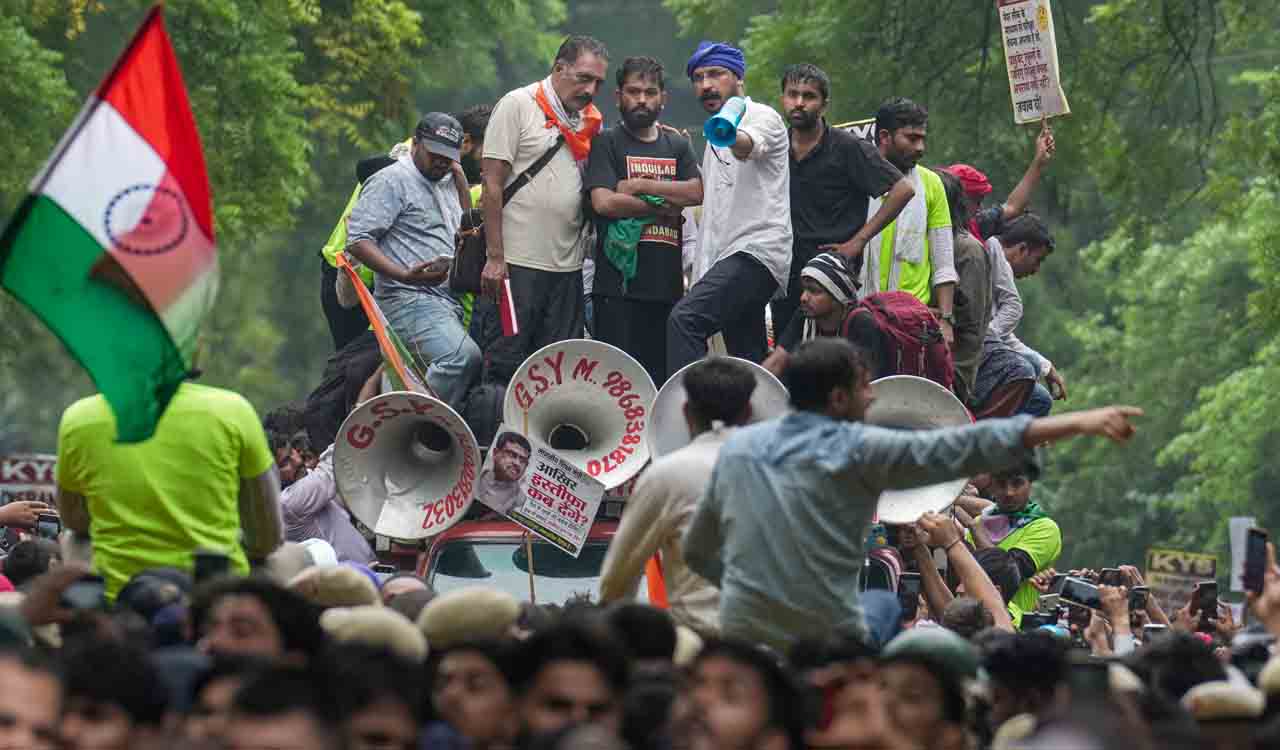
The emerging CJP phenomenon represents a new stage in Indian youth politics. It may have no supreme leader, permanent headquarters, conventional hierarchy or traditional party structure. Instead, it can operate through independent digital creators, social media, viral videos, satire, memes, WhatsApp, Telegram and aspirant networks.
Its concerns increasingly revolve around paper leaks, examination integrity, unemployment, recruitment, institutional credibility and the future anxiety of India’s young generation.
This is algorithmic resistance. Yesterday’s movement needed a meeting. Today’s movement can begin with a message.
Manuel Castells’s analysis of network society becomes increasingly relevant: power flows through communication networks, while resistance increasingly emerges through alternative networks. A smartphone can now amplify the grievance of one aspirant into the anger of lakhs. A hashtag can perform the political function that a pamphlet once performed.
Could CJP-Style Youth Anger Become a Political Problem for Modi?
It would be premature to claim that CJP or any single youth movement will automatically defeat Narendra Modi or the BJP. Indian elections are shaped by numerous political, social and economic factors.
But history provides a warning. The JP movement helped create the conditions for Indira Gandhi’s defeat. The Anna movement helped weaken UPA-II and created an anti-incumbency environment that benefited both Kejriwal and, at the national level, the BJP.
The question today is whether anger among NEET aspirants, UGC-NET aspirants, government-job candidates, unemployed graduates and digitally connected youth can converge into a larger political narrative. If examination failures, paper leaks, unemployment and recruitment uncertainty are increasingly perceived not as isolated administrative failures but as manifestations of a larger governance problem, the political consequences could be substantial.
The CJP does not necessarily need to become an electoral party. It can define the grievance, set the national agenda and create the demand for political change. The decisive question will then be: Who captures the anger? That happened after JP. That happened after Anna. It can happen again.
Youth Discontent Is Now Looking for BRS
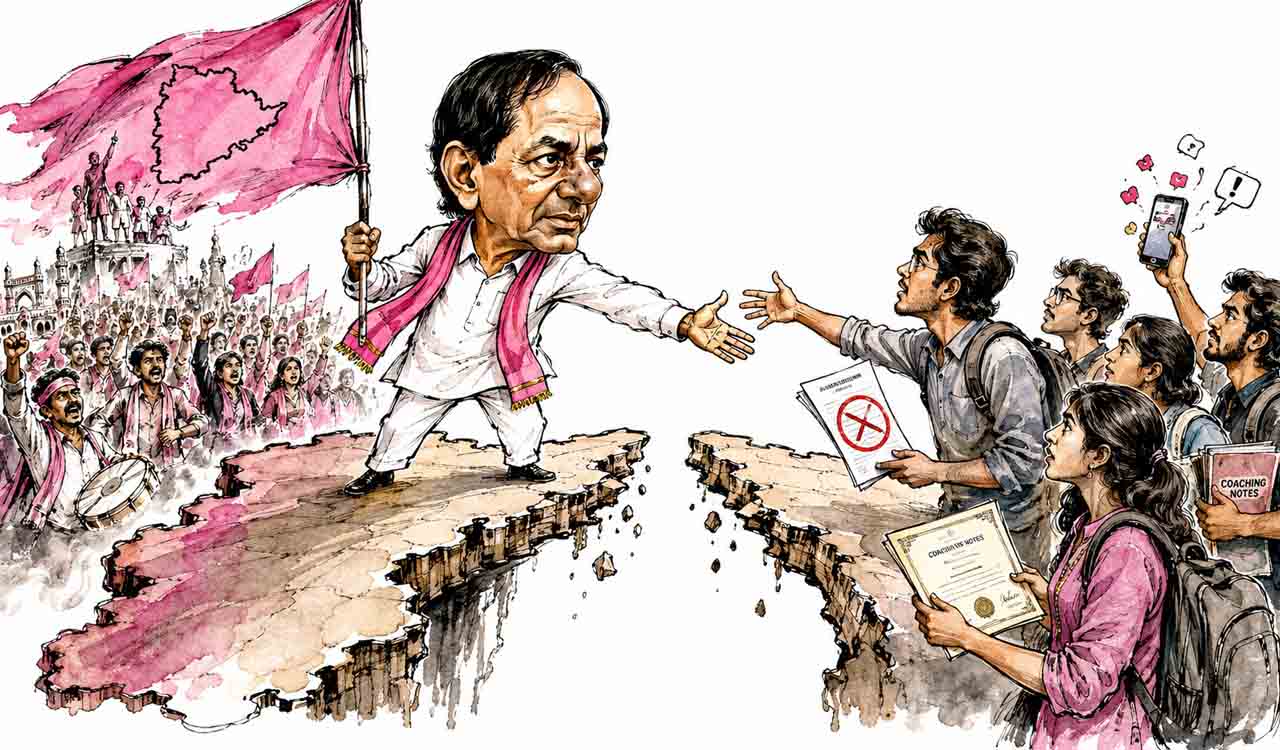
Telangana may now be entering another important political phase. The Congress government’s failure to deliver electoral promises has started moulding into political anger; however, it does not automatically belong to any one opposition party. Anger creates a political vacuum. Organisation decides who occupies it.
That is precisely where the BRS is attempting to rebuild its political relevance. The BRS’ challenge is not simply to criticise Congress. It is to re-establish trust with a generation that once saw KCR and the Telangana movement as instruments of political change.
KCR’s greatest political asset remains the legitimacy derived from the Telangana statehood movement. He did not inherit Telangana; he made its statehood the central political project of his career. From understanding the lessons of 1969, to building the TRS in 2001, to sustained mobilisation, the 2009 fast, student participation and national political pressure, his political identity remains inseparable from the creation of Telangana.
But that historical legitimacy must now be connected to the concerns of a new generation. The second pillar of the BRS argument is the development narrative of Telangana under KCR. The party is likely to increasingly remind people of its record and claims relating to irrigation, drinking water, welfare, agriculture, power, rural infrastructure, industrial development, investment, urban infrastructure and economic growth.
Its political message can therefore be framed simply: “We fought for Telangana. We built Telangana. We understand Telangana’s aspirations. Now we must rebuild its future.”
But nostalgia alone cannot win back youth. A generation born or educated in Telangana after statehood judges politics differently. It wants jobs, credible examinations, affordable higher education, entrepreneurship, technology, skills and economic mobility.
Therefore, the BRS’ attempt to regain youth trust will have to go beyond defending the past. It must present a credible future-oriented youth agenda, while reconnecting that agenda with KCR’s historical legitimacy and Telangana’s development story. KCR’s Telangana legacy may reopen the political conversation. A convincing promise of Telangana’s future will determine whether the conversation becomes political support.
The Political Economy of Youth Anger
Youth unemployment is not merely an economic statistic. It is a political statistic. John Maynard Keynes observed that “The ideas of economists and political philosophers… are more powerful than is commonly understood.” The same is true of the economic experience of young people.
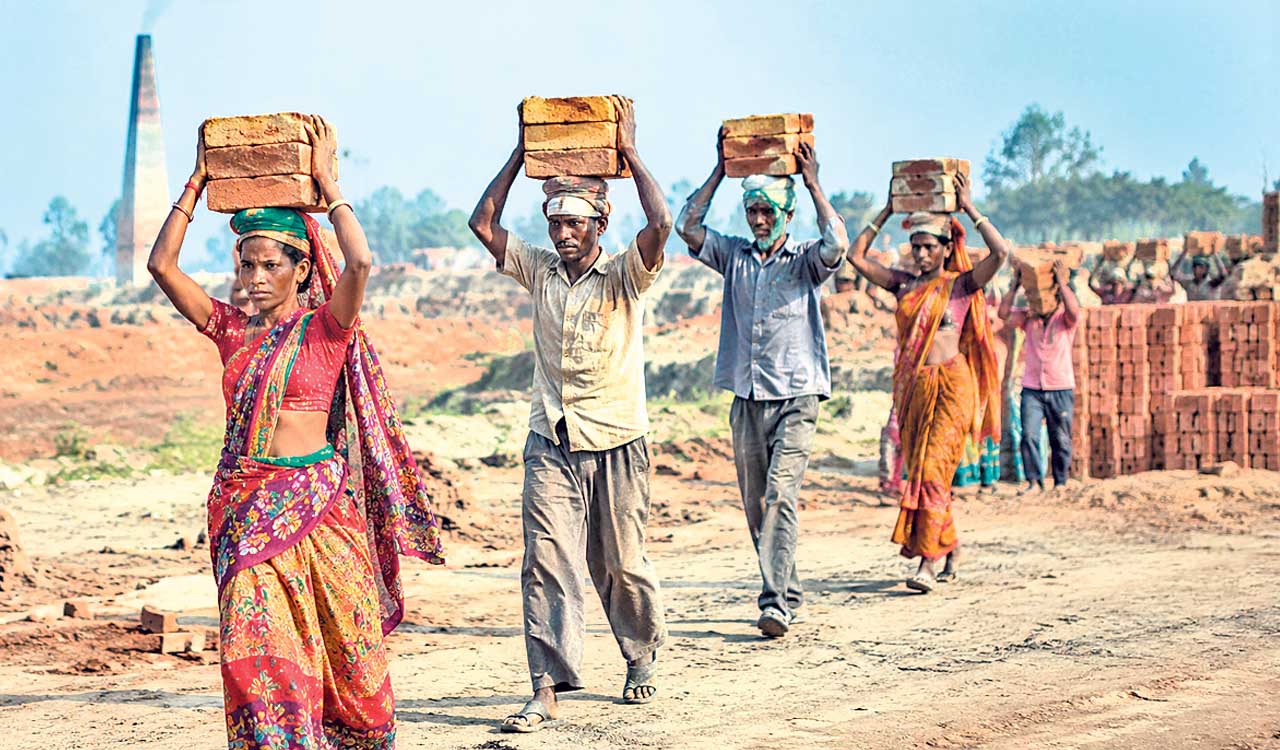
A young person does not experience unemployment as a percentage in an economic survey. They experience it as a cancelled examination, a delayed recruitment notification, an unaffordable college fee, a scholarship that has not arrived, a coaching bill, a loan, a lost year or a postponed future.
Political legitimacy increasingly depends upon whether governments can create a credible pathway: Education → Skill → Employment → Income → Security → Social Mobility. When that chain breaks, frustration grows. When frustration is shared, networks emerge. When networks become organised, political pressure follows.
Final Warning to Every Government
The greatest political mistake any government can make is to treat youth merely as a demographic category. They are not. They are an expectation economy. They ask simple questions: Can I study? Can I afford education? Can I trust the examination system? Can I get a job? Can I start a business? Can I build a future?
John Rawls wrote: “Justice is the first virtue of social institutions.” For today’s youth, institutional justice has a practical meaning: Are examinations fair? Are recruitments transparent? Are promises implemented? Is opportunity genuinely available?
That is the ultimate lesson from Chandragupta to CJP. Youth do not permanently belong to any leader. They do not permanently belong to any political party. They do not permanently belong to any ideology. They belong to the future. Governments may win youth support through promises. They retain it only through performance. When promises remain unfulfilled, frustration becomes anger. When anger becomes collective, it becomes power. When power becomes organised, it becomes a movement. And when a movement finds political direction, history shows that even the strongest governments can face a new verdict.
Gandhi’s observation remains a warning to every political establishment: “The future depends on what you do today.” That is not merely a philosophical statement. It is a political warning. The next political transformation may not begin in Parliament. It may begin in a university classroom, a hostel, a coaching centre, an examination hall or even on a smartphone.
And it may begin with a question that every government should fear: “You asked us to trust you with our future. What did you do with it?”

Related News