Opinion: Is Mother Nature metaphor normalising a culture of extraction?
As long as nature remains imagined as an endlessly giving mother, humanity may continue to mistake exploitation for affection


By Aanjaneya Sekhar R, Jay Prasad
The ecological crisis is often described as a crisis of technology, governance or economics. Yet it is equally a crisis of imagination. The metaphors through which societies understand nature are not politically innocent; they shape moral expectations, institutional choices and public attitudes.
Also Read
Among these metaphors, none has enjoyed greater cultural legitimacy than that of ‘Mother Nature’. From Bhoomi Mata in India to Mother Earth in the Americas, the Earth has been imagined as feminine — nurturing, fertile, forgiving and infinitely generous. The symbolism appears reverential.
Yet an uncomfortable question deserves attention — has the feminisation of nature inadvertently normalised an expectation of endless sacrifice, making ecological exploitation appear morally permissible?
Moral Template
This is not an argument against feminine symbolism itself. Many Indigenous cultures that personify rivers, forests and mountains as female have simultaneously evolved sophisticated traditions of ecological restraint. The issue is not that nature is imagined as feminine; it is the particular social expectations historically attached to femininity.
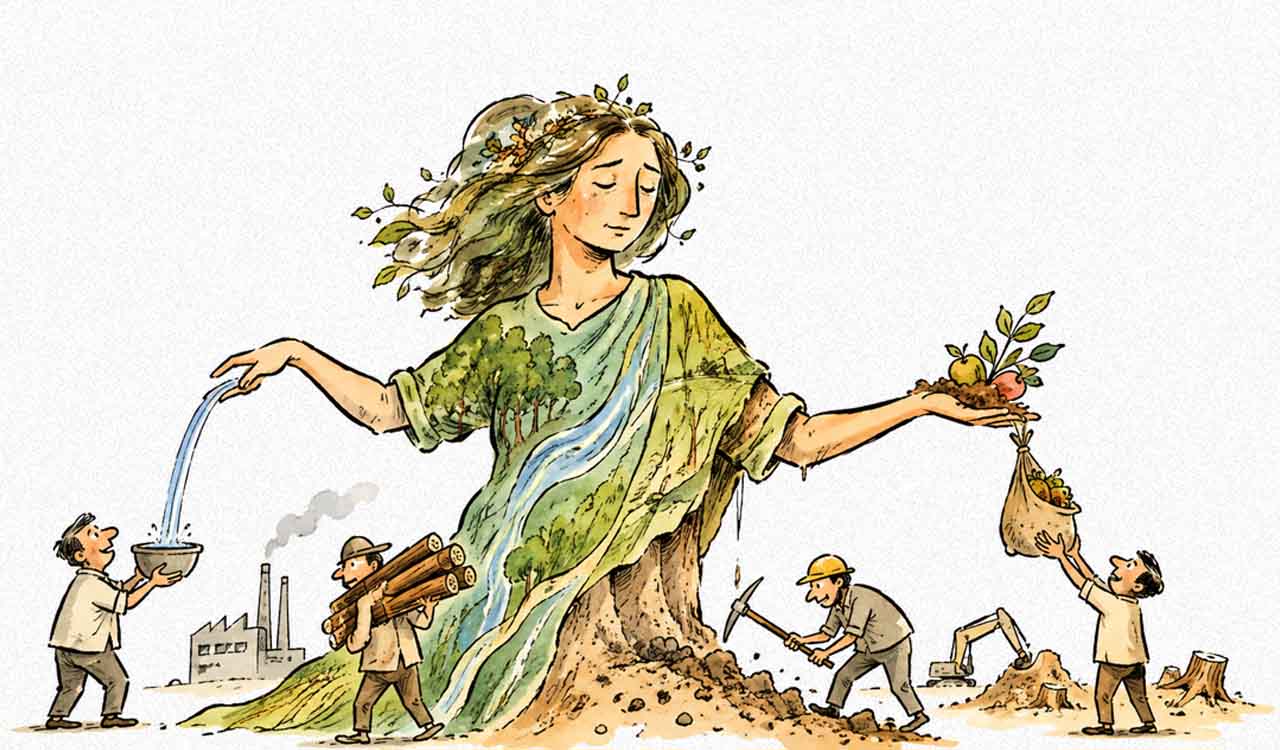
In patriarchal societies, motherhood has often been celebrated for its selflessness. A “good” mother is expected to give without calculation, endure without complaint and forgive without limit. When this moral template is projected onto nature, environmental exploitation risks being interpreted not as violence but as dependence upon an endlessly giving parent.
The distinction is significant because language influences political behaviour. Cognitive linguists George Lakoff and Mark Johnson argued that metaphors are not merely literary devices but conceptual frameworks through which societies organise thought and action.
Metaphors determine what appears natural, legitimate and inevitable. If nature is framed primarily as a mother, it becomes easier to imagine her as an inexhaustible source of care rather than as a living system with ecological limits and intrinsic rights. The metaphor may unconsciously privilege gratitude over reciprocity and entitlement over restraint.
Reverence and Reality
Empirical evidence reveals the contradiction between reverence and reality. According to the Intergovernmental Science-Policy Platform on Biodiversity and Ecosystem Services (IPBES), nearly 75% of Earth’s terrestrial environment and about 66% of the marine environment have been significantly altered by human activity, while around one million species now face the risk of extinction.
The UN Environment Programme’s Global Resources Outlook estimates that global material extraction has risen from roughly 27 billion tonnes in 1970 to more than 100 billion tonnes by 2019, a nearly fourfold increase driven by expanding consumption and industrialisation.
Simultaneously, the Food and Agriculture Organization (FAO) reports that approximately 420 million hectares of forest have been lost globally since 1990. These figures expose a profound paradox: societies continue to invoke ‘Mother Earth’ in public discourse even as they intensify the extraction of the ecosystems upon which life depends.
The contradiction extends to the language of development itself. Rivers are increasingly described as ‘water resources’, forests as ‘timber stock’ and mountains as repositories of minerals awaiting economic utilisation. Environmental valuation frequently reduces ecosystems to the services they provide for human welfare. Yet when ecological disasters strike, political rhetoric swiftly returns to appeals for protecting ‘Mother Nature’.
The metaphor survives because it generates emotional resonance, while economic policy often proceeds according to an entirely different logic — that of extraction, efficiency and growth. The coexistence of sentimental language and instrumental practice suggests that reverence alone offers little protection against exploitation.
Ecofeminism
Ecofeminist scholarship has long recognised these parallels. Carolyn Merchant, in The Death of Nature (1980), argued that the Scientific Revolution transformed nature from a living organism into a machine designed for human control. Maria Mies and Vandana Shiva later suggested that the historical subordination of women and the domination of nature emerged from similar systems of hierarchy, commodification and control.
However, ecofeminism has also been subject to important criticism. Scholars such as Val Plumwood cautioned against assuming any essential or natural connection between women and the environment. To romanticise women as inherently closer to nature risks reproducing the very stereotypes feminism seeks to dismantle. The analytical value of ecofeminism, therefore, lies not in biological claims but in exposing how structures of domination operate through similar cultural logics.
Genuine ecological justice requires moving beyond reverence towards responsibility, beyond gratitude towards reciprocity, and beyond metaphors that celebrate sacrifice towards institutions that respect limits
India presents a particularly revealing case. Few societies have embedded ecological symbolism more deeply within religious and cultural traditions. Rivers such as the Ganga are worshipped as mothers, forests have historically been regarded as sacred spaces, and the Earth itself is invoked through rituals of gratitude. Yet India also ranks among the world’s largest consumers of natural resources, while its cities continue to confront severe air pollution, groundwater depletion and biodiversity loss.
The contradiction is not evidence that cultural reverence is meaningless; rather, it demonstrates that symbolic respect without institutional accountability cannot restrain ecological degradation. Rituals alone cannot substitute for environmental regulation, sustainable production or democratic accountability.
It would nevertheless be simplistic to argue that calling nature ‘Mother’ causes environmental destruction. Such determinism ignores the decisive roles of capitalism, industrialisation, colonial extraction and state policy. The metaphor did not produce the climate crisis.
However, metaphors shape the moral vocabulary within which these systems operate. They influence what societies perceive as acceptable relationships between humans and the non-human world. When the Earth is imagined as an endlessly patient mother, ecological limits are more easily ignored because motherhood itself has historically been associated with unconditional giving.
The metaphor thus becomes compatible with extraction precisely because it normalises sacrifice.
The Challenge
Perhaps the challenge, therefore, is not to abandon personification altogether but to rethink it. Instead of imagining the Earth primarily through relationships that presuppose obligation and sacrifice, environmental ethics might emphasise reciprocity, partnership and mutual dependence. Contemporary ecological thought increasingly recognises that humans are not masters of nature but participants within complex living systems whose resilience depends upon restraint rather than domination.
The environmental crisis is ultimately not only about carbon emissions, disappearing forests or declining biodiversity. It is also about the stories societies tell themselves regarding who exists to serve whom. As long as nature remains imagined as an endlessly giving mother, humanity may continue to mistake exploitation for affection.
Genuine ecological justice requires moving beyond reverence towards responsibility, beyond gratitude towards reciprocity, and beyond metaphors that celebrate sacrifice towards institutions that respect limits.

(Aanjaneya Sekhar R is postgraduate student of Economics, and Jay Prasad works as Research Associate at Azim Premji University)

Related News