Rewind: Hyderabad Untreed — City’s fading eco-memory
Once a multidirectional eco-memory of trees, dogs, and other nonhumans, the road to glitzy corporate, educational, and industrial hubs in Hyderabad is now a mono-memory — dominated by humans and their wheels


By Pramod K Nayar
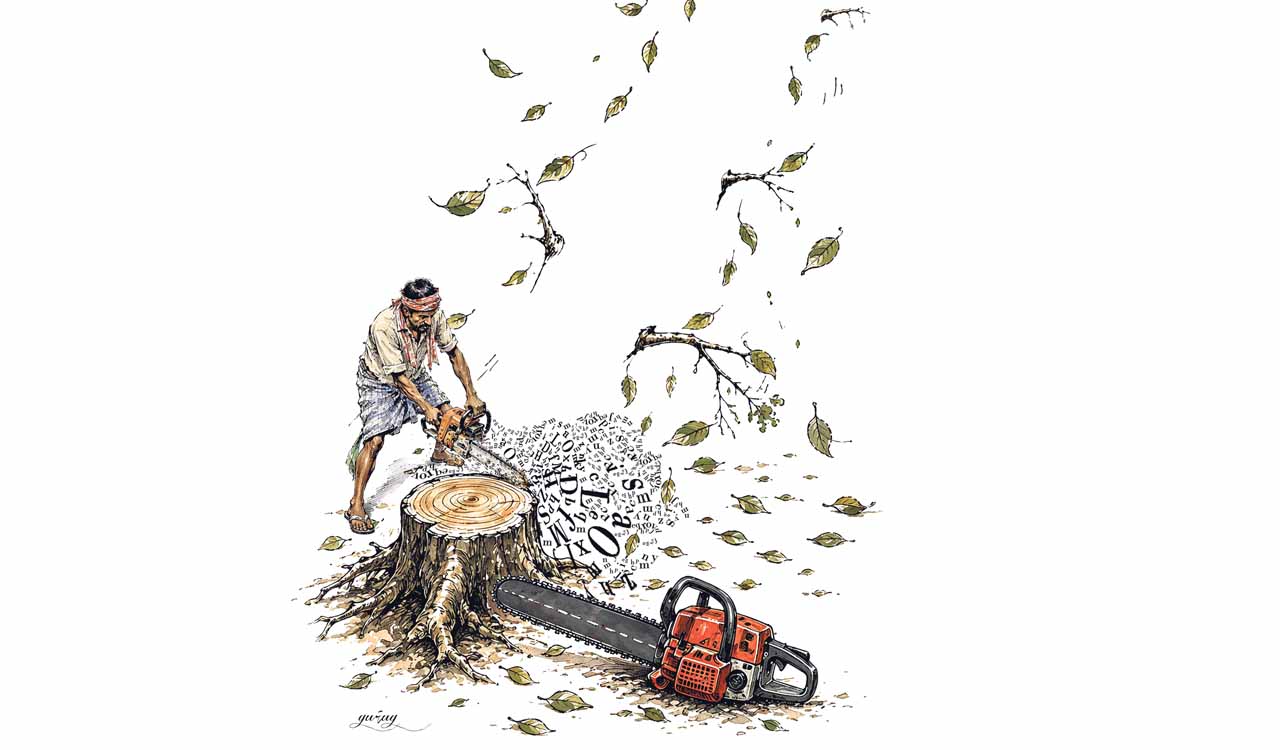
In the space of a few weeks, the route I take to the University campus has witnessed unparalleled devastation. A large number of trees were cut, uprooted and taken away for the construction of yet another flyover.
Also Read
Road expansion, flyovers, service lanes are all purchased at the cost of one of the last tree-lined avenues of the city. Promises of replanting were issued by the state, but the condition of the uprooted trees withering by the roadside does not indicate any such possibility.
Accidental Archives
We see on the drive to and fro work, daily uprooted trees lying by the roadside awaiting their eventual obliteration — to use a term popularised by POTUS, no less.
The road and these sad trees constitute the ‘accidental archives’ of the city. Critic Ann Rigney describes the ‘accidental archives’ as the ‘as yet-unarticulated traces rather than verbal records, of potential rather than as-yet-unarticulated actualised meanings’. These objects of the ‘accidental archives’, ‘by threatening to disintegrate, they demand to be looked after and, as multiple restoration projects show, they activate our sense of caring’.
- Human time, in which Hyderabad seems to be increasingly immersed, is at odds with the time of the land on which this city rests
The trees did not transform themselves into archives for the simple reason that they lack the agency to do so. They are accidental because they have been absorbed, temporarily until all signs of them will be, literally, levelled into the new road so that nothing much remains except memories of motorists who may recall that this was once a tree-lined green avenue.
The trees by the side of the road, awaiting the next round of JCBs, are disintegrating, despite statements that they will be relocated and planted elsewhere. They silently demand to be taken care of, as the Earth does. But does anyone care?
Multidirectional Eco-memory
Memories of these roads are not of automobiles alone. For users over time, these roads that took people to the Financial District, the major software companies, BHEL, the University of Hyderabad, were disruptions in the sense after the barren flyovers, the treed sector provided a sudden and cool cover. The bright sunshine was suddenly in abeyance, as the trees served as a canopy.
The accidental archives of the devastated trees constitute what the critic Rosanne Kennedy called ‘multidirectional eco-memory’. Such a memory‘links human and nonhuman animals and their histories of harm, suffering and vulnerability in an expanded multispecies frame of remembrance’.
That summarises the route now. The trees share vulnerability with the other denizens of the terrain, including the numerous dogs that ran up and down and rested on the service lane outside business houses, between parked cars and so on, lending the road a fascinating visual variety beyond humans and their automobiles.
- Untreeing Hyderabad means we measure the ‘now’ in terms of how much faster we get from Point A to Point B. But this ‘now’ is a fraction of the time taken for a tree to reach its full growth
Just as the dogs were evicted, once upon a time, as ‘nuisances’, the trees are now being uprooted. The road to the glitzy corporate offices, educational institutions and industrial houses, marked my multidirectional eco-memory that included the nonhuman such as trees and dogs, is now reduced to a mono-memory site: all we can see is humanity and its wheels.
Planetary Memories
The fuel we consume is a part, of course, of planetary memory. The trees from Deep Time that collapsed and decayed become, through nonhuman, geochemical processes, the subsurface oil. These are prehuman and nonhuman materialities over which humanity has asserted control. What we use up is the product of millions of years of planetary memory embodied in these materials.
Understandably, this kind of argument smacks of a certain romantic view of the planet. But feeling sorry for the wilful destruction of lifeforms that have taken decades to reach their present status — like trees — is romanticism merged with the desire for a redemptive or restorative nostalgia: of a road, a site repopulated with trees. But, like most nostalgias, these are at the level of the fantasy, given the state-corporate desire to annihilate (another POTUS favourite!) the multinatural, multispecies world in favour of the human alone.
Eco-destruction is the new normal. Every generation’s idea of what is the acceptable normal in our world, which we share with trees and animals, is shaped by their own experience, as a result of which, we forget what we have lost and have no sense of the magnitude of environmental degradation. Therefore, in less than five years, this same road will only be known as a road devoid of trees — which was emphatically not the case.
The refusal to acknowledge planetary memory is accompanied by the creation of such accidental and purely temporary archives such as the uprooted trees. The sooner these signs of callous destruction are removed, the easier it becomes to normalise a tree-less road.
- On par with Heritage Walks or visual archives of times, past acts of mnemonic (memory) responsibility are necessarily multispecies. Recording the destruction of the trees is one such act of responsible memory
We are witnessing here the seductive construction of brand-new memories for the future. Like history textbooks that get rewritten in order to erase specific communities and their role, the landscape is being rewritten so that there was never any tree, any street dog.
It remains, therefore, in the realm of the fantastic and the literary —or the literary-fantastic — to exercise mnemonic responsibility towards the accidental archives. On par with Heritage Walks or visual archives of times past, yet different from them, acts of mnemonic responsibility are necessarily multispecies. Recording the destruction of the trees or eviction of street dogs and community animals, as in this piece, is one such mnemonic act.
Human time, in which alone Hyderabad seems to be increasingly immersed, is at odds with the time of the land and biome that hosts this city. Aboriginal poet Oodgeroo Noonuccal in ‘The Past’, writes: ‘Now is so small a part of time’. Because time is not merely human time but earth time.
In Hyderabad, we are notoriously lax about time. Untreeing Hyderabad means we measure the ‘now’ in terms of flyovers and expressways and how much faster we get from Point A to Point B. But this ‘now’ is a fraction of the time taken for a tree to reach its full growth, and that tree is a part of earth time, over which humanity now seeks to impose a temporality measured exclusively as speed of human transport.
Indigenous poet Linda Hogan in ‘I Live in the Time of Breaking Trees’ describes falling trees, and the debris of trees being removed by bulldozers. Unable to bear the sight of this denudation, and admitting that she loves trees, the speaker rushes away into a forest on a hill.
The Australian poet John Kinsella writes in his Divine Comedy:
the last blocks of bushland
cleared away to placate the hunger
for the Australian Dream.
Our techno-dreams for this city do not, evidently, entail any trees, and we clear them to pave the way towards these spires of fame and fortune. In another poem, Kinsella writes:
I avoid some places because the death of trees / Is overwhelming
The last word that links the tree-plunder with other forms of plunder belongs to Niyi Osundare, the African poet who speaks of urban bureaucrats who look at trees for money, trees as money, and whose only planting is the documentation in obscure files:
Reaped in the city
Cocoa, tree of money,
Spewing gold from every pore
For those who plant trees
In confidential files.
(The author is Senior Professor of English and UNESCO Chair in Vulnerability Studies at the University of Hyderabad. He is also a Fellow of the Royal Historical Society and The English Association, UK)

Related News