Opinion: Presidential Reference verdict — Supreme Court’s missed opportunity to strengthen federalism
By rejecting timelines for gubernatorial assent, the Court has weakened prospects for stronger federalism
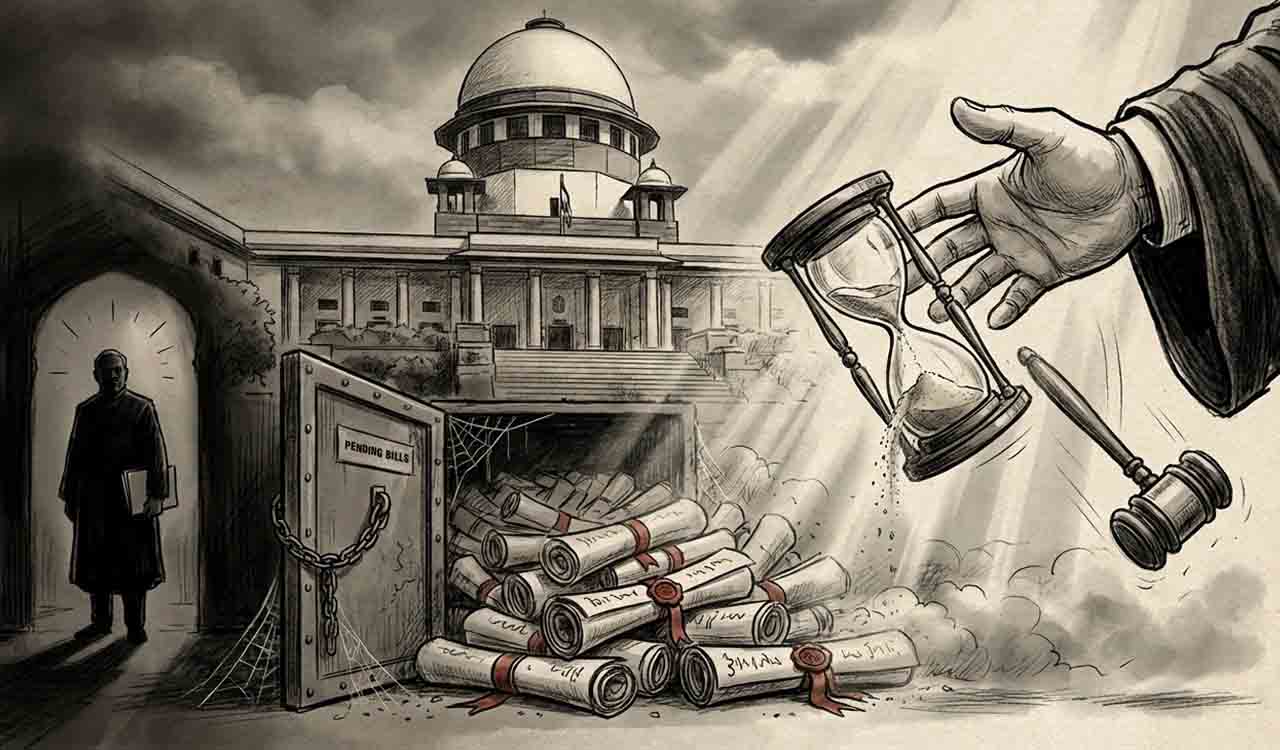


By Nayakara Veeresha
The relationship between the Legislature, Executive and Judiciary constitutes the heart and soul of a democratic form of government. Understanding and analysing the nuances among these organs is essential to assess the health of democracy. In 1950, India established itself as a republic with a parliamentary democratic system.
Also Read
The President of India is the highest constitutional authority of the Union government, whereas the Governor occupies the highest constitutional position in a State. The decisions of the President and Governor are exempt from judicial review, except when they breach the doctrine of the ‘basic structure’ of the Constitution. The office of the Governor is expected to function as the guardian of the Constitution in the State, while also acting as a link between the Union and State governments.
The President and Governors play a significant role in the overall framework of constitutional governance. It is only with their assent that Bills passed by Parliament and State Legislative Assemblies become law. Article 200 of the Indian Constitution outlines provisions regarding the assent of Bills by the Governor, while Article 111 deals with the assent of Bills by the President.
Rising Friction
In terms of presidential assent, the relationship between the Union government and the office of the President has, by and large, remained smooth and frictionless. However, similar cordiality is often absent between elected State governments and Governors, largely due to the partisan conduct of some Governors.
Since 1952, the misuse of the office of the Governor has been a continuing pattern, irrespective of the party in power at the Centre. Given that Governors are appointed by the Union government, many have tended to serve its political interests. Political intrusion into the functioning of the Governor has become a major concern over the last 10-12 years, particularly with respect to the withholding of Bills passed by the State Assemblies. This trend is especially visible in States governed by parties other than the Bharatiya Janata Party (BJP) or the National Democratic Alliance (NDA).
The Supreme Court’s advisory opinion on the Presidential Reference prioritises constitutional formalism over democratic accountability, raising concerns about the future of Union–State relations
The deadlock between State governments and Governors reached its peak in Punjab, Karnataka, Kerala, Rajasthan and Tamil Nadu. To address this impasse, a division bench of the Supreme Court delivered its verdict in the case of The State of Tamil Nadu Vs. The Governor of Tamil Nadu & Anr. on April 8, 2025. The court ruled that the inordinate delay and withholding of assent to the Bills are illegal and bad in law. It prescribed timelines for the Governor and the President to act on such Bills. The judgement has drawn mixed responses among the legal scholars, lawyers, democrats and other concerned citizens.
Major Arguments
Broadly, four major arguments have come up: judicial overreach by the court by setting timelines for gubernatorial authorities; judicial review — court as the final adjudicator of constitutional and legal provisions; federalism — as a deepening of democracy by strengthening Union-State relations; and the doctrine of separation of powers.
In May 2025, the President of India referred 14 questions to the Supreme Court, seeking an advisory opinion under Article 143(1) of the Constitution of India. The provision empowers the President to seek the court’s opinion on questions of law or constitutional importance. This provision has been invoked sparingly, and the 2025 Presidential Reference marked the 14th such instance in independent India.
On 20th November, 2025, then Chief Justice of India BR Gavai-led constitutional bench delivered its opinion on the Presidential Reference. The court held that the concept of deemed assent is alien to the Constitution and that fixing timelines for the Governor or President in granting or withholding assent is contrary to the Constitution, especially the basic structure doctrine.
It observed that imposing such timelines violates the doctrine of separation of powers. However, the top court clarified that Governors have to provide their assent to the Bills within a reasonable time. The advisory opinion further stated that Governors can withhold assent or return Bills only with proper reasoning; otherwise, such inactions would invite limited judicial review.
Through Legal Prism
While the court’s opinion appears legally tenable, it seems to have interpreted the provisions of the Constitution purely from a legal prism while overlooking its implications on democracy. The court missed out on a golden opportunity to clear up certain grey areas of the Constitution and strengthen the federal foundation of Indian democracy. Reinforcing the immunity and privilege of the President and Governors in matters of assent, without prescribing any time-bound framework, merely on the basis of their constitutional status, is antithetical to democratic governance.
The court’s reliance on the doctrine of separation of powers is misplaced in this verdict, as the top court construed its role as ‘restrictivism’ rather than ‘reformism’.
The advisory opinion reflects a rigid interpretation of the separation of powers, akin to the American constitutional model, which is inconsistent with India’s constitutional scheme. In Asif Hameed v. State of Jammu and Kashmir (AIR 1989 SC 1899), the Supreme Court observed:
“Although the doctrine of separation of powers has not been recognised under the Constitution in its absolute …the functioning of democracy depends upon the strength and independence of each of its organs…”
The advisory opinion comes at a time when the Union-State relations are already strained due to persistent conflict over legislative competence. Instead of reducing the tensions, the court had added another layer of constitutional friction. A significant opportunity to strengthen the federal character of Indian democracy and reinforce parliamentary accountability has been lost, thereby deepening the ongoing constitutional crisis.

(The author is Assistant Professor, Symbiosis Law School, Pune, Symbiosis International [Deemed University], Pune. Views are personal)

Related News
-

Supreme Court clarifies legal route for complaints against elected candidates
-
Opinion: India’s Urban Challenge Fund—bankable isn’t the same as vulnerable
-
NEET-PG 2026: Plea seeks permanent copies of question papers and response sheets
-
SC issues notice to ECI on Rahul Gandhi-led plea against Special Intensive Revision exercise