Opinion: Who really pays the price of global instability?
Consumption is not merely market behaviour — it reflects deeper economic resilience and vulnerability


By Dr Harsha Sheelam
When conflicts erupt thousands of kilometres away, their consequences often appear much closer — at the fuel pump, in grocery prices, and within household budgets. Wars and geopolitical tensions disrupt energy markets, strain global supply chains, and trigger inflationary pressures that ripple across economies. For a country like India, which depends heavily on global trade and imported crude oil, these shocks quickly translate into everyday economic realities.
Also Read
Yet the transmission of global shocks into domestic economies is rarely linear. Prices rise, markets fluctuate, and policy responses follow — but the true economic story lies in how these shifts filter through different layers of society. Consumption patterns become a quiet indicator of economic stress: what people delay buying, substitute, or stop consuming altogether often reveals more about economic strain than headline statistics. In this sense, consumption behaviour functions as an early signal of how deeply global turbulence penetrates domestic economic life.
This raises deeper questions. Who ultimately absorbs the cost of global instability? How do international conflicts reshape everyday consumption decisions within emerging economies? And can India build greater economic resilience so that external shocks do not disproportionately burden its most vulnerable households?
Lower-Income Consumers: Vulnerability at the Base of Consumption Pyramid
- Income Elasticity and Consumption Constraints
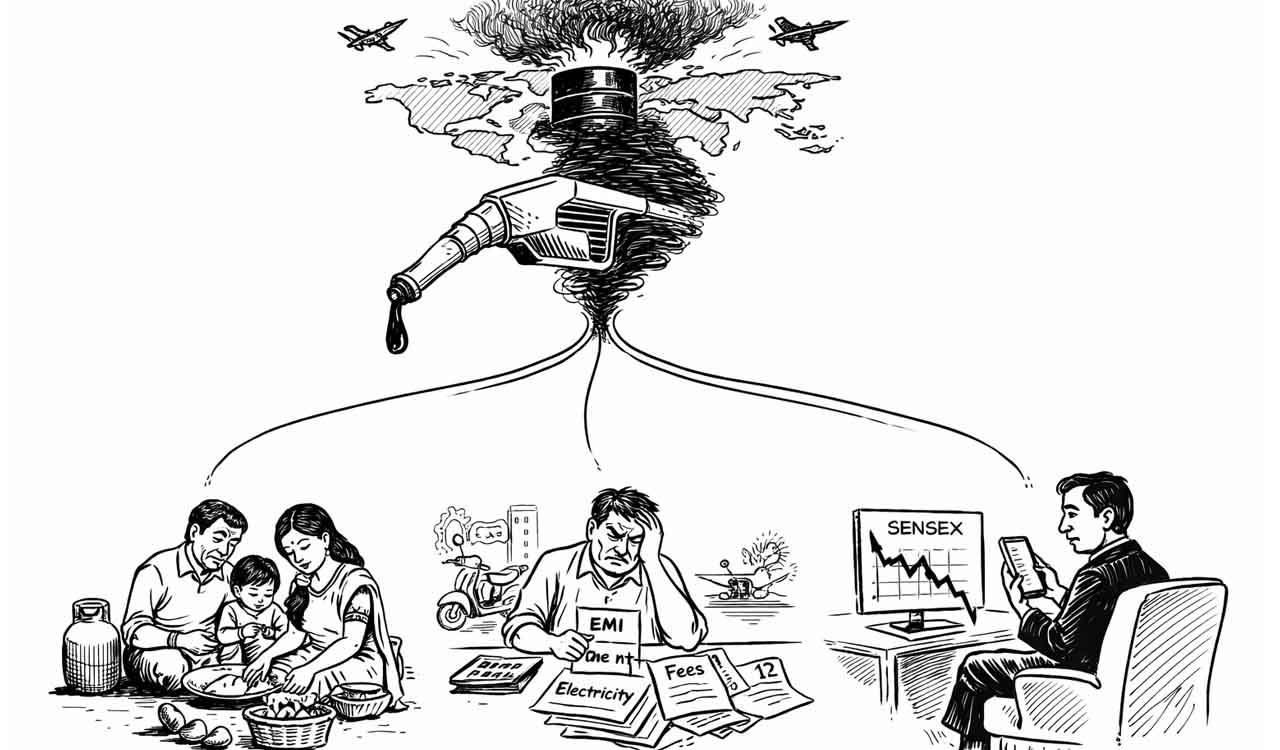
Lower-income households operate under severe income elasticity constraints, where even small price changes dramatically affect consumption behaviour. Because most of their income is spent on essential goods — food, transport, and utilities — their ability to adjust spending is extremely limited.
For instance, food inflation often intensifies when fuel prices rise because modern agricultural systems are deeply energy-dependent. Transportation of produce from farms to urban markets, the operation of irrigation systems, and the production of fertilizers all rely significantly on fuel and energy inputs. When energy costs increase, these higher input and logistics expenses cascade through the supply chain, ultimately raising the retail prices of essential food commodities such as vegetables, edible oils, and grains.
For lower-income households, the impact is particularly severe because food typically constitutes a substantial share of total household expenditure. Consequently, even modest increases in food prices can significantly erode purchasing power, forcing families to reduce consumption diversity and reallocate spending toward basic survival needs.
These households experience what we may call consumption compression. Instead of reallocating spending across categories, they often reduce the quantity or quality of essential consumption itself. Nutritional diversity declines, healthcare visits may be postponed, and educational expenditures can be reduced.
From a behavioural perspective, these households prioritise short-term survival over long-term welfare, reinforcing cycles of economic vulnerability. This highlights a structural issue in developing economies: external shocks disproportionately affect those whose consumption is already constrained.
Squeezed Middle-Class: Balancing Credit and Consumption
- Intertemporal Consumption and Credit Sensitivity
The middle-class operates within what we may describe as intertemporal consumption planning — balancing present consumption with future financial commitments. Loans for housing, education, and automobiles allow households to smooth consumption over time. For instance, middle-class households function within a credit-driven consumption framework, where major purchases such as housing and automobiles are financed through loans. When inflation rises, monetary tightening increases interest rates, raising loan repayments and compressing disposable income.
As financial obligations expand, households reprioritise spending—protecting essentials such as education, healthcare, and housing while postponing discretionary consumption. Rather than eliminating spending entirely, middle-class consumers typically recalibrate their choices, shifting from premium products to budget alternatives and from international to domestic travel. These adjustments illustrate how credit commitments and economic uncertainty reshape middle-class consumption behaviour.
Geopolitical tensions are reshaping consumption in India, hitting lower-income households the hardest, forcing middle-class adjustments, and tempering affluent spending
Geopolitical shocks often trigger inflationary pressures that lead central banks to increase interest rates. This disrupts the delicate balance of intertemporal planning. Rising loan costs increase financial commitments, reducing disposable income and forcing households to reassess consumption priorities.
Unlike lower-income households that cut essential spending, middle-class consumers typically adjust by reducing discretionary consumption. Leisure spending, travel, and premium goods become the first casualties. In this way, geopolitical crises reshape middle-class consumption patterns through financial tightening rather than direct deprivation.
Affluent Consumers: Wealth Buffers and Lifestyle Consumption
Affluent consumers respond to geopolitical shocks through a different mechanism: the wealth effect. Their consumption decisions are influenced less by immediate price changes and more by fluctuations in financial markets and perceived wealth. When geopolitical tensions create uncertainty in stock markets or global investment flows, wealthy households often experience declines in portfolio valuations. Even when their income remains stable, this perceived reduction in wealth can lead to sentiment-driven spending adjustments.
For instance, luxury consumption — international travel, high-end automobiles, premium experiences — may be temporarily postponed as affluent consumers adopt a cautious outlook. However, unlike other groups, these adjustments rarely threaten essential consumption. Instead, they reflect a strategic moderation of lifestyle spending, illustrating how financial sentiment rather than price shocks shapes consumption behaviour at the top of the income distribution.
Geopolitical tensions often create volatility in equities, currencies, and global investments, influencing perceptions of wealth. In response, high-income households tend to moderate lifestyle spending —postponing international travel, luxury purchases, or high-value experiences. However, rather than eliminating consumption, they typically reallocate spending, shifting from international to domestic luxury experiences or premium local services. This pattern reflects the wealth effect, where perceived changes in asset values influence consumption behaviour, demonstrating how financial confidence —rather than immediate economic hardship — shapes spending decisions among affluent consumers.
At the same time, a segment of ultra-wealthy consumers remains largely insulated, as diversified assets and high liquidity buffer them from immediate economic shocks. These asymmetries highlight how global crises amplify structural inequalities, underscoring the need for policies that strengthen economic resilience and protect the most vulnerable consumers.
For policymakers and businesses, this highlights the need to view consumption not merely as market behaviour but as a reflection of deeper economic resilience and vulnerability. Strengthening domestic supply chains, reducing dependence on volatile energy imports, and safeguarding essential consumption sectors become crucial in limiting the transmission of global shocks. Yet important questions remain. How can economies protect essential consumption when global markets become unstable? Are existing policy tools sufficient to shield vulnerable households from external price shocks? And can India build a consumption structure that remains resilient even when global geopolitical tensions intensify?
Addressing these questions will determine whether global instability translates into domestic insecurity — or whether the Indian economy can develop the structural resilience needed to protect its most economically fragile consumers.

(The author is Visiting Faculty, Department of Management Studies, Pondicherry University, Port Blair (Sri Vijaya Puram), Andaman & Nicobar Islands. She is also Marketer & Digital Brand Experience Consultant for Island Tourism Brands)

Related News