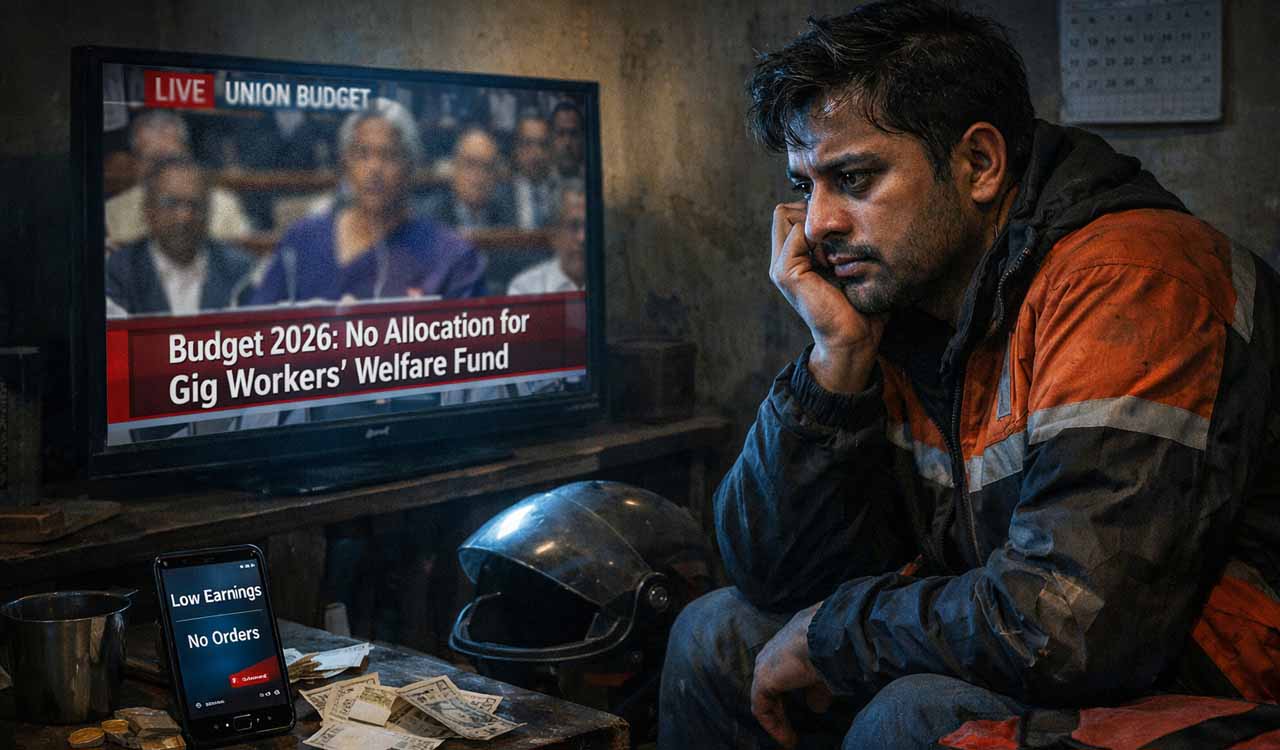
Opinion: Why Budget 2026 fails to deliver real protection for India’s gig workers
Despite recognising gig workers under the Code on Social Security, the Budget fails to allocate funds or outline implementation plans


By Sunetra Ghatak, Soumen Ghosh
Six years ago, we witnessed a historic moment when the Code on Social Security, 2020, was acknowledged in India’s labour law architecture. It formally recognised gig and platform workers as a distinct category, departing from the traditional binary framework of employer and employee to extend social protection. India took a landmark step in late November 2025 by implementing this Code. This long-awaited reform was expected to reshape the country’s labour market by providing social security and protection to gig workers.
Also Read
Now, nearly six years after its enactment and months after the labour codes became operational, expectations were high that Budget 2026 would articulate the fiscal operationalisation of these provisions. Contrary to these expectations, the Budget made no dedicated allocation for gig workers. No timeline has been provided for activating the Social Security Fund, nor is there clarity on the government’s co-financing commitments.
The Disconnect
Interestingly, the Economic Survey offered a more candid assessment of gig work. It noted that a substantial proportion of gig workers earn below Rs 15,000 per month, face high income volatility, remain outside health insurance, maternity benefits, and old-age security. Moreover, it highlighted algorithmic control as a source of insecurity, noting that platform-determined work allocation and opaque wage-setting mechanisms limit workers’ bargaining power.
The Survey recommended minimum earnings standards, portable social security benefits, and mechanisms to address income instability. However, Budget 2026 failed to incorporate these analytical insights. There was no dedicated allocation for gig workers, and no consideration was given to budgetary instruments or policy timelines.
The disconnect between the Codes on Social Security and Budget 2026 signals a broader pattern in India’s labour reform strategy — legal modernisation without commensurate fiscal commitment. While the legal framework has expanded to accommodate a workforce of over 500 million, budgetary policy remains grounded in traditional labour definitions, favouring formal employment over informal welfare arrangements.
Policy Gap
As a result, gig workers continue to occupy a complex and ambiguous position. They are neither part of formal employment structures that grant access to contributory social insurance nor sufficiently recognised within informal welfare frameworks to qualify for traditional social assistance schemes.
This is a major concern not only from an equity perspective but also for its macroeconomic implications. Gig workers are no longer a marginal labour market phenomenon; rather, they have become a structural component of urban service delivery and consumption growth. They now contribute measurably to GDP while absorbing a growing share of the urban workforce. An economy increasingly reliant on insecure labour cannot sustain aggregate consumption demand or long-term productivity growth. This is especially concerning given that a significant portion of gig work involves feminised labour.
While gig workers have been recognised under existing legal frameworks, budgetary policy remains anchored in traditional labour definitions, favouring formal employment over informal welfare arrangements
Nowhere is this policy gap more visible than in India’s rapidly expanding platform-based economy. In particular, the emergence of ultra-fast or ‘quick delivery’ models — often promising customers deliveries within 10-15 minutes — has further intensified vulnerabilities faced by gig and platform workers.
Food or grocery delivery platforms increasingly rely on dense delivery networks and strict time-bound performance metrics to maintain a comparative advantage. In this hyper-competitive model, delivery partners operate under algorithmic management systems that reward speed and penalise delays. This often pushes workers towards unsafe driving practices and irregular work schedules in order to secure higher ratings and wages. The absence of formal job contracts, employment security, health insurance, accident coverage and income stability further magnifies these vulnerabilities. Operational risks and market uncertainties are effectively transferred onto workers themselves.
As the ‘quick delivery’ economy expands across Indian cities, it institutionalises a labour regime marked by precarity, informality, rising occupational hazards, and minimal regulatory oversight. This condition stands in stark contrast to the broader objectives of employment security and job stabilisation highlighted in the Budget’s rural employment discourse.
Missed Opportunity
The Budget adopted a growth-centric framing, remaining cautious while aligning with India’s macroeconomic priorities. It emphasised rural employment and livelihoods through the Viksit Bharat-Guarantee for Rozgar and Ajeevika Mission. The scheme aims to provide 125 days of guaranteed wage employment per rural household, positioning itself as the government’s primary instrument for rural labour security and income stabilisation.
At the same time, allocations for MGNREGA have been scaled back to adjust pending liabilities and support a transition phase. While the government maintains that MGNREGA will continue alongside the new scheme for now, concerns remain that a shift towards cost-sharing frameworks with States may dilute its rights-based employment-guarantee approach.
Overall, Budget 2026 missed an opportunity to integrate protection for gig or platform workers with existing policy missions on women’s employment, urban livelihoods, skilling and financial inclusion. If the Code on Social Security is to be more than symbolic, future Budgets must move decisively from recognition to operationalisation. The question is not whether the State can afford to extend social security to gig workers; it is whether the economy can afford not to.
The Budget 2027 must translate institutional and legal recognition into concrete fiscal and institutional commitments through a well-structured, inclusive social security fund, co-financing arrangements between different levels of government, flexible benefits frameworks and a minimum earning safety net. Only then can India’s gig-driven economic growth remain compatible with job security, income stability and sustainable demand in a transforming urban economy.
(Sunetra Ghatak is Associate Professor, OP Jindal Global University, Sonipat. Soumen Ghosh is Assistant Professor, RV University, Bengaluru)

Related News