Opinion: Solution to farmer suicides
Govt and stakeholders must focus on psychology, rather than economics



By Seela Subba Rao
Hyderabad: Despite a multi-pronged approach to iproving the income level and social security of farmers, over 10,000 suicides have been reported in the agricultural sector every year since 2013. Farmer suicides account for approximately 8% of all suicides in India. There is no denying that the issue exists and runs counter to the aspirations of reaping the benefits of our demographic dividend.
Also Read
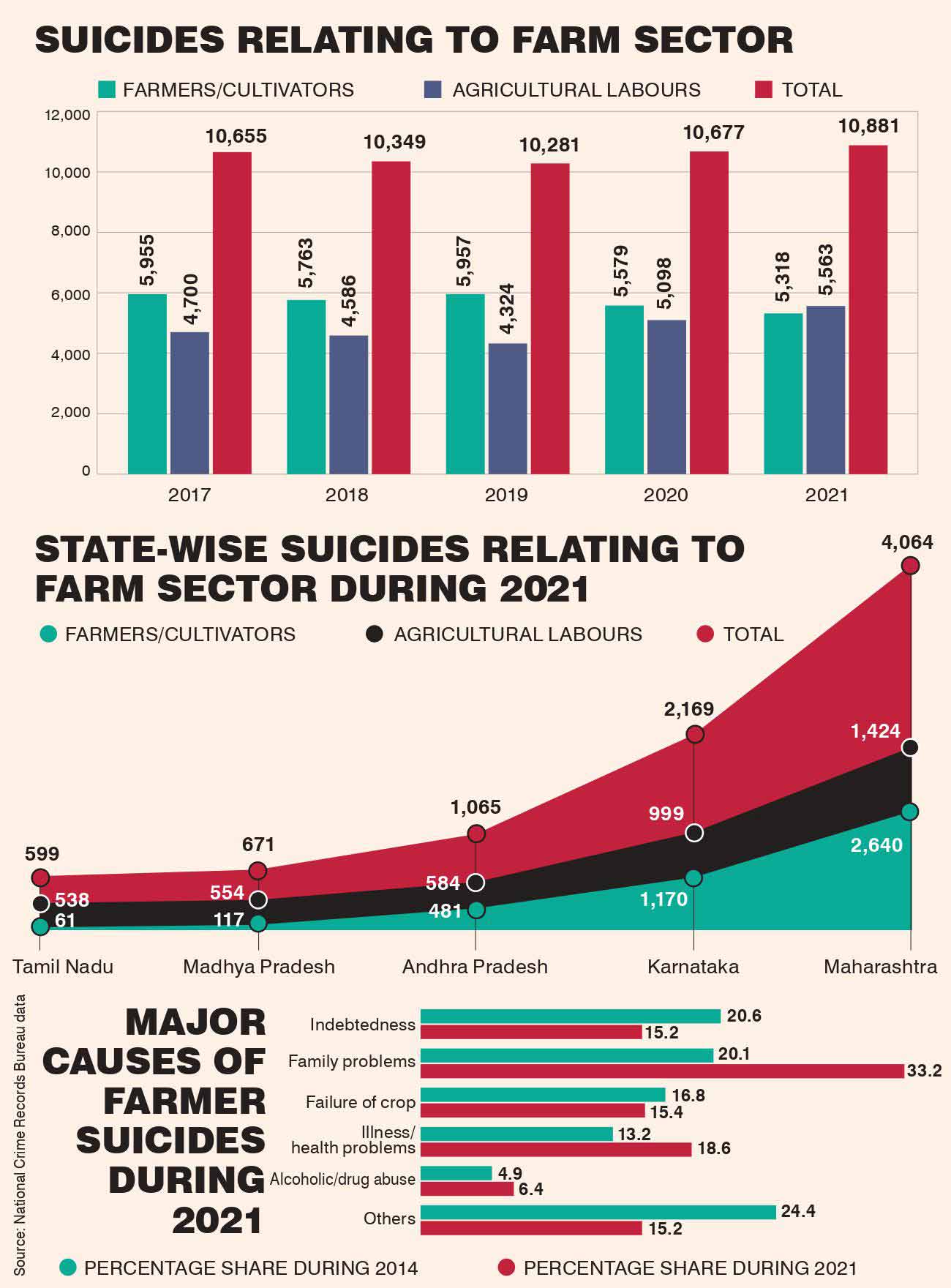
As per the National Crime Records Bureau, there were 10,665 suicides in the farm sector in 2017. This went up to 10,881 in 2021. These suicides comprise farmers/cultivators as well as agricultural labours. Further analysis of the relevant data confirms that the number of suicides by farmers/cultivators declined from 5,955 in 2017 to 5,318 in 2021. However, during the corresponding period, that of agricultural labourers increased from 4,700 to 5,563.
Cause for Concern
Five states — Maharashtra, Karnataka, Andhra Pradesh, Madhya Pradesh and Tamil Nadu — together recorded 80% of the total suicides in the farm sector and about 85% of farmer suicides in 2021. Maharashtra continues to top the dubious list with 4,064 suicide cases. (see infographics).
Major causes attributing to suicides in the farming community are:
• Increasing burden on farmers because of inflated prices of agricultural inputs like chemicals and seeds, agricultural equipment. This has resulted in an overall increase in the cost of cultivation.
• Lack of direct integration with the market. Although initiatives such as National Agricultural Market and contract farming are helping integrate farmers’ produce directly with the market cutting the role of intermediaries, it is still lagging behind.
• Concentration of these suicides in water-deficit regions of States like Maharashtra and Karnataka is a manifestation of how the water crisis and thereby failure to meet production demands have intensified the penance.
• Factors like crop failure, unsustainable production, lack of dynamic and comprehensive crop insurance mechanism, and subsequent farmers’ indebtedness.
• While incidents like flash floods have led to crop losses, deferred monsoons have seen production shortfall year-in and year-out.
A Misnomer
The current analysis assumes that the NCRB database on accidental deaths and suicides in India captures only suicides by farmers. The fact is, this database includes suicides committed by both farmers/cultivators and agricultural labours. Farmers/cultivators are those who cultivate on their own land as well as those who cultivate on leased land/other’s land with or without the assistance of agricultural labours. However, agricultural labours are those who primarily work in the farming sector (agriculture and horticulture) and whose main source of income is from agricultural labour activities only. Hence, the usage of the term “farmers’ suicides” is a misnomer. Instead, the appropriate term is “agrarian suicides”.
It is pertinent to mention here that the Commission on Farmers’ Welfare headed by Jayati Ghosh in its report (December 2004) had spelt out the following interventions in six important areas:
• Correct spatial inequities in access to irrigation and work towards sustainable water management
• Bring all cultivators into the ambit of institutional credit, including tenant farmers
• Shift policies to focus on dryland farming through technology, extension, price and other incentives
• Encourage cheaper and more sustainable input use, with greater public provision and regulation of private input supply and strong extension support
• Protect farmers from high volatility in output prices
• Emphasise rural economic diversification to more value-added activities and non-agricultural activities.
Long-term Measures
Thus, there is no single sure-shot method to reduce the burden on farmers. The government, along with stakeholders, should come up with effective and long-term measures to reduce farmers’ indebtedness, improve crop yield, manage water resources effectively and make alternative income sources for farmers.
Reducing reliance on nature is important. The government should focus on preventing crop failure. Adoption of effective water management techniques is also paramount in this regard. Making institutional finance available for every farmer, particularly marginal and small, is a must. Another area of importance is effective and timely counselling to farmers on economic methods of cultivation. Technological advancements in agriculture should be made available to poor and needy farmers with the help of agricultural universities and Krishi Vigyan Kendras.
The main proportion of the government’s outlay on agriculture goes towards subsidies which contribute very little to growth. They benefit the rich farmers the most while the marginal and small live on the fringes. These need to be done away with to arrive at a long-term solution. There is also a need to promote watershed management and massively increase the acreage under irrigation.
This would reduce their susceptibility to drought and avoid crises.
The National Mental Health Association of the US states that “No matter the race or age of the person, how rich or poor they are, it is true that most people who commit suicide have a mental or emotional disorder. Suicide is not a matter of economics”. This theory is supported by the data released by World Health Organisation in 2011.
While the suicide rate in India, being an agrarian economy, was 13 per 1,00,000, that of advanced countries (South Korea -28.5, Japan-20.1, Russia-18.2, US-12.6 and UK-11.8) were often higher or comparable. Hence, it advocates that farmers’ suicides are driven more by psychology, rather than economics.


Related News