Opinion: The Amendment Republic—are we legislating through constant repairs?
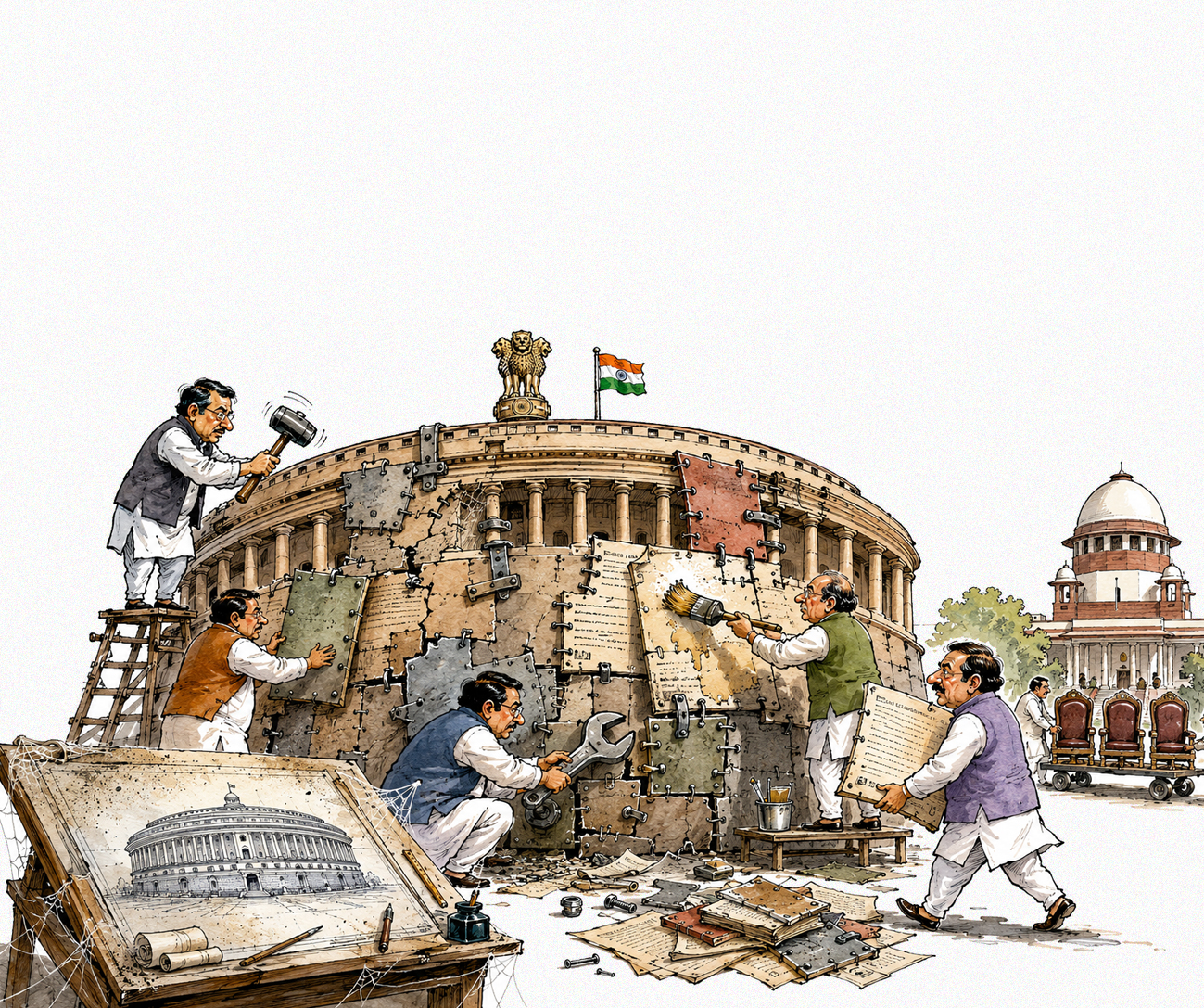
Frequent amendments raise a bigger question: Is Parliament adapting to changing needs, or do they expose deeper deficiencies in India’s law-making process?


By Shashank Shekhar
Parliament is often described as the nation’s foremost law-making institution. Yet, an increasing number of legislative sessions reveal a different reality: Parliament is spending as much time repairing its own laws as it is creating new ones. Amendment Bills have become a recurring feature of India’s legislative calendar, cutting across governments, ministries, and policy areas. From criminal law and taxation to company law, environmental regulation, and judicial administration, legislation is frequently revisited within months—or a few years—of its enactment.
Also Read
This trend raises an uncomfortable constitutional question. Are frequent amendments evidence of a responsive legislature adapting to changing circumstances, or do they expose deeper deficiencies in India’s law-making process?
Flexibility vs Legislative Instability
Democracy certainly requires flexibility. No statute is immune from revision, and Parliament must possess the authority to respond to judicial decisions, technological developments, economic transformations, and administrative experience. Constitutionalism does not demand legislative rigidity. However, when amendments become routine rather than exceptional, they invite scrutiny of the quality of the original legislative process itself.
The recently passed Supreme Court (Number of Judges) Amendment Bill, 2026, which increases the sanctioned strength of the Supreme Court from 34 to 37 judges, illustrates this dilemma. The objective is difficult to dispute. India’s apex court faces an enormous backlog of cases, and expanding judicial capacity appears to be a reasonable institutional response. Yet the legislation also demonstrates Parliament’s growing preference for incremental structural adjustments over comprehensive institutional reform.
Increasing the number of judges may improve the Court’s capacity, but it cannot, by itself, resolve persistent challenges such as inconsistent listing practices, delays in constituting Constitution Benches, the overwhelming use of Article 136 jurisdiction, and the absence of a coherent case-management system. Numerical expansion addresses symptoms more readily than structural causes. Legislative amendments that merely fine-tune institutions without confronting underlying systemic issues risk becoming temporary repairs rather than lasting solutions.
A Pattern Across Legal Domains
The problem extends well beyond judicial administration. India’s legislative landscape increasingly resembles a continuous cycle of enactment, amendment, clarification, and further amendment. Tax statutes undergo frequent revisions through successive Finance Acts. Corporate legislation has witnessed repeated modifications following the Companies Act, 2013. Insolvency law has been amended several times since the Insolvency and Bankruptcy Code came into force in 2016. Even the recently enacted criminal law framework has already prompted calls for legislative clarification regarding its interpretation and implementation.
Amendment Bills should reflect legislative responsiveness—not repeatedly remind us that Parliament is repairing laws it could have built more carefully in the first place
Some degree of legislative evolution is inevitable. Law cannot remain static in a rapidly changing society. Yet the frequency with which Parliament returns to recently enacted legislation suggests that many statutes enter the legal system before receiving sufficiently rigorous scrutiny.
The Decline of Committee Scrutiny
One explanation lies in the changing nature of parliamentary deliberation. Parliamentary committees have historically served as the institutional laboratories of legislation. They receive expert testimony, hear from stakeholders, identify drafting inconsistencies, and examine constitutional implications, all away from partisan political theatre. Their reports often improve legislative precision while reducing the likelihood of future amendments.
However, an increasing number of Bills have bypassed detailed committee examination altogether. Legislative debates have also become progressively shorter, with important Bills sometimes passed within limited periods of discussion. The result is that defects which could have been identified during pre-legislative scrutiny instead emerge during implementation, requiring Parliament to revisit the law through subsequent amendments.
Constitutional Consequences
This trend carries constitutional implications beyond legislative efficiency. The Supreme Court has repeatedly recognised that while Parliament enjoys broad legislative competence, constitutional democracy depends upon reasoned deliberation and institutional accountability. Law-making is not merely the production of statutory text; it is a constitutional process requiring informed debate, public participation, and careful evaluation of competing interests.
Poorly scrutinised legislation generates uncertainty for citizens, businesses, administrators, and courts alike. Frequent amendments complicate compliance, increase litigation, and impose significant costs on governance. Instead of providing legal certainty—a fundamental objective of the rule of law—the legal system begins to resemble a moving target.
Democratic Costs of Constant Correction
There is also an important democratic dimension. Every amendment effectively acknowledges that the original legislation required correction. While correction is preferable to legislative stubbornness, repeated corrections may gradually erode public confidence in Parliament’s capacity to produce durable and coherent laws. Citizens expect legislation to be carefully considered before enactment, not perfected through successive rounds of repair.
Comparative constitutional experience offers useful lessons. In the United Kingdom, Green Papers, White Papers, Law Commission reports, and extensive committee consultations often precede major legislative reforms. Australia similarly relies upon significant public consultation and parliamentary committee engagement before introducing substantial statutory changes. Amendments certainly occur in these jurisdictions, but they generally follow implementation experience rather than compensate for inadequate legislative preparation.
Bridging Gap Between Design and Practice
India already possesses many of these institutional mechanisms. The difficulty lies not in constitutional design but in institutional practice. Pre-legislative consultation policies are inconsistently followed. Stakeholder engagement varies significantly across ministries. Committee referrals remain discretionary rather than routine. Legislative impact assessments are rarely comprehensive. As a consequence, Parliament often legislates under considerable time pressure while expecting subsequent amendments to resolve foreseeable shortcomings.
Reforming the Amendment Culture
The answer is not fewer amendments. Democracies must retain the capacity to improve their laws. Indeed, refusing to amend defective legislation would be far more damaging than acknowledging the need for correction. The challenge is ensuring that amendments remain instruments of genuine policy refinement rather than substitutes for inadequate legislative craftsmanship.
Several reforms deserve serious consideration. Significant Bills should ordinarily undergo mandatory committee scrutiny unless exceptional urgency is demonstrated. Draft legislation should be accompanied by comprehensive legislative impact assessments explaining anticipated constitutional, economic, and administrative consequences. Ministries should institutionalise meaningful public consultation before introducing major reforms. Parliament should also devote greater time to legislative deliberation rather than allowing complex Bills to pass with limited discussion.
From Quantity to Quality
Ultimately, the quality of legislation cannot be measured by the number of laws Parliament enacts or amends. It must instead be judged by whether those laws provide certainty, command public confidence, withstand constitutional scrutiny, and remain effective over time.
A mature democracy is not defined by its willingness to legislate frequently but by its ability to legislate well. Amendment Bills should remain evidence of legislative responsiveness—not recurring reminders that Parliament is too often compelled to repair what it could have built more carefully in the first place.

(The author is Assistant Professor of Law, Lloyd Law College, Greater Noida)

Related News
-

Apex court summons senior Delhi police officer assault on women journalists covering protests
-
SC stays trial in defamation case against Rahul Gandhi over derogatory remarks against PM Modi
-
SC urged to initiate suo motu contempt action over social media post targeting CJI, INDIA bloc protest
-
Telangana BJP chief accuses Rahul Gandhi of ‘dragging SC’ into political row