Opinion: When engineered democracies unravel
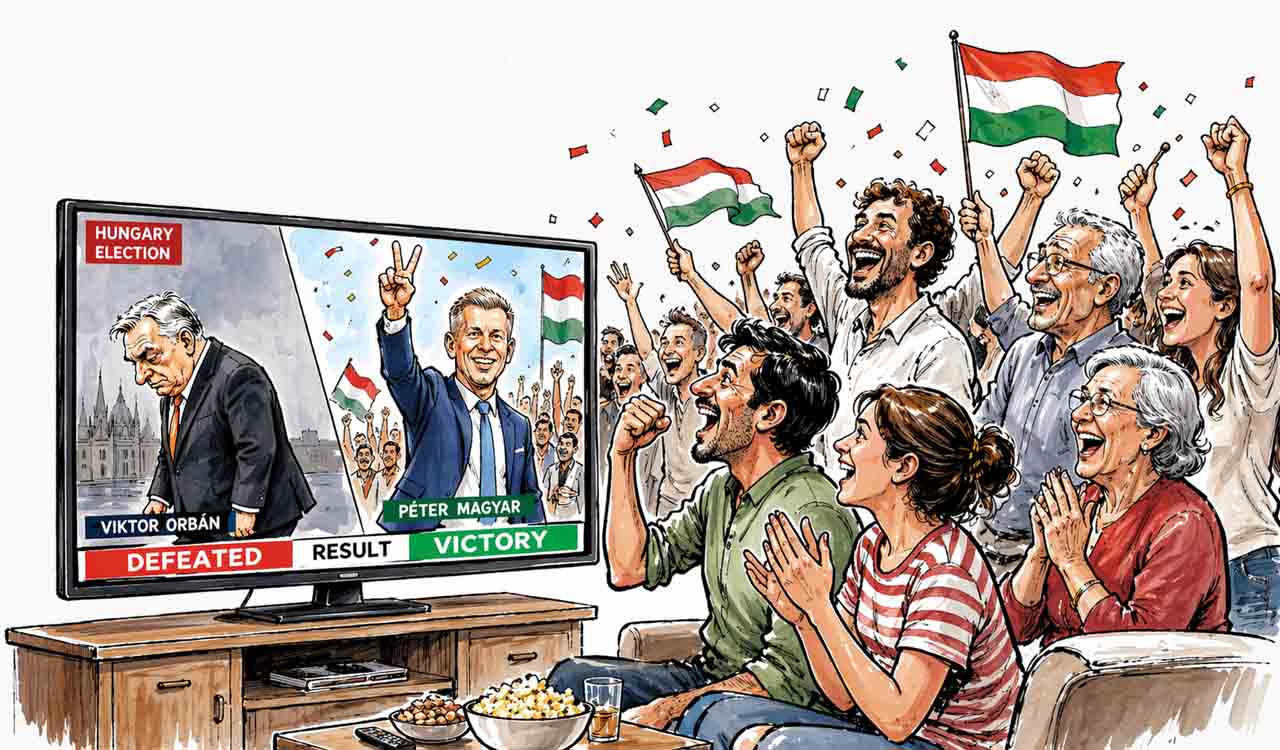
The fall of Orbán and the rise of Magyar in Hungary reveal how controlled electoral systems can collapse when public anger, elite defection, and strategic political reframing converge within institutions designed to resist change


By Sainandan Sridhar Iyer
For over a decade and a half, Hungary’s erstwhile leader Viktor Orbán appeared to have resolved one of democracy’s enduring dilemmas: how to retain electoral legitimacy while steadily reducing the uncertainty that elections are meant to produce. Hungary did not abandon democracy under Orbán; it recalibrated it into a system where outcomes became increasingly predictable, yet never entirely foreclosed. This paradox lies at the heart of both his longevity and his eventual defeat.
Also Read
Much has been written about the institutional architecture that sustained Orbán’s dominance, including constitutional redesign, electoral engineering, and the consolidation of media ecosystems. These were not incidental changes but deliberate attempts to embed political advantage into the structure of governance itself.
Yet, focusing only on these mechanisms risks missing a deeper truth. Orbán’s system endured not simply because it was engineered, but because it was accepted. Its durability rested as much on political sociology as on institutional design.
Orbánism functioned by aligning state power with lived experience. In rural Hungary, where economic opportunities are often mediated by the state and media plurality is limited, the government’s presence was tangible and immediate. Public employment schemes, infrastructure development, and targeted welfare created a material relationship between citizens and the regime.
At the same time, Orbán’s narrative of national sovereignty, cultural protection, and resistance to external interference resonated with genuine anxieties. Migration, economic precarity, and cultural change were not manufactured concerns; they were reframed and politically harnessed. This combination of responsiveness and control made the system resilient.
From Fatigue to Political Rupture
Systems that rely on managed consent are also vulnerable to cumulative fatigue. By the mid-2020s, the equilibrium began to weaken. Economic stagnation, declining public services, and persistent allegations of corruption were not new developments. What changed was their political salience. Across many entrenched regimes globally, such issues remain electorally inactive for years. They become decisive only when voters begin to interpret them as systemic failures rather than isolated grievances.
This is where the emergence of Péter Magyar becomes analytically significant. His victory in the April 2026 election was not merely an electoral upset; it represented a structural disruption. Securing a decisive majority, his Tisza Party crossed the constitutional thresholds that Orbán had once used to consolidate power. Yet, the more important question is not simply how Orbán lost, but how defeat became possible within a system designed to prevent it.
Entrenched electoral regimes rarely fall simply because they are flawed. They endure because those flaws are normalised, fragmented, or politically inarticulate
Magyar’s strategy departed from the traditional opposition playbook in important ways. Rather than directly challenging Orbán on ideological terrain, particularly on issues such as migration or national identity, he shifted the axis of political competition.
His campaign reframed the election as a question of governance rather than identity, bringing corruption, institutional decay, and the erosion of everyday public services to the forefront. This was not just a change in messaging but a recalibration of political language. Through this shift, Magyar transformed widespread dissatisfaction into a coherent electoral narrative.
Equally important was his ability to engage rural strongholds that had long supported Orbán. Opposition politics in Hungary had often remained concentrated in urban centres, especially Budapest. Magyar disrupted this pattern through sustained grassroots mobilisation and the strategic use of digital platforms that bypassed traditional media networks. His outreach in smaller towns and rural regions revealed that dissatisfaction had spread well beyond elite and metropolitan circles.
Limits of Engineered Democracies
One of the most critical and often underestimated factors in this transition was elite defection. As a former insider within the Fidesz ecosystem, Magyar represented a fracture within the ruling order. This mattered not only for credibility but also for political signalling. In many entrenched systems, voters may recognise governance failures yet remain uncertain about the possibility of change. Insider defection alters this perception by demonstrating that the system is neither unified nor invulnerable.
In Hungary, Magyar’s position blurred the boundary between establishment and opposition, weakening one of Orbán’s most effective rhetorical tools, which was the portrayal of critics as external or unpatriotic.
The Hungarian case underscores a broader insight from comparative politics. Entrenched electoral regimes do not collapse simply because they are flawed. They persist because their flaws are normalised, fragmented, or politically inarticulate. Their unravelling requires a convergence of factors, including economic strain, narrative reframing, and signals from within the elite that change is both possible and legitimate.
There is also a deeper institutional irony at work. The very features that made Orbán’s system durable, especially the retention of electoral processes, also made it vulnerable. Unlike fully closed autocracies, competitive authoritarian systems preserve a narrow but real pathway for political turnover.
When opposition forces align effectively, that pathway can expand rapidly. Hungary did not experience collapse through external pressure; instead, change emerged through the very mechanisms that had been carefully managed for years.
For observers elsewhere, including in large and complex democracies, Hungary offers neither a simple warning nor an easy template. Its importance lies in showing that democratic erosion is not necessarily permanent, but its reversal is never automatic. The defeat of entrenched power does not arise from opposition unity alone, nor from exposing corruption in isolation. It requires a redefinition of the terrain on which political contestation takes place.
Hungary’s 2026 election ultimately reveals a central paradox of modern electoral autocracies. Systems designed to minimise uncertainty cannot eliminate it entirely. Over time, the strategies used to stabilise power, such as centralisation, narrative control, and institutional rigidity, generate pressures that can lead to sudden disruption when conditions shift.
Orbán did not simply lose an election. His system encountered its limits, and in doing so, it demonstrated that even the most carefully engineered democracies remain contingent.
(The author is Assistant Professor of Political Science, DCT’s Dhempe College [Autonomous], Miramar-Panaji, Goa, and is pursuing his PhD [International Relations] from BITS Pilani, KK Birla Goa Campus, Sancoale)

Related News