Opinion: US-Iran war — the cost of ignoring history
All wars end in negotiations — the only question is who sits down first and who holds the better cards, as history shows



By Ayyappa Nagubandi
My history teacher once said something that has stayed with me ever since: To learn life and to live life, you must know history — because most of what happens today has already happened somewhere, in some form, before.
It was a quiet observation, almost offhand. But it cuts to the heart of why the world keeps stumbling into the same traps, the same wars, the same miscalculations of power.
The uncomfortable truth is that most people never take that lesson seriously. History classes are endured, not absorbed. Adults rarely pick up a history book once school is done. And so, generation after generation, decision-makers — including some of the most powerful governments on earth — walk confidently into situations that history already has a verdict on.
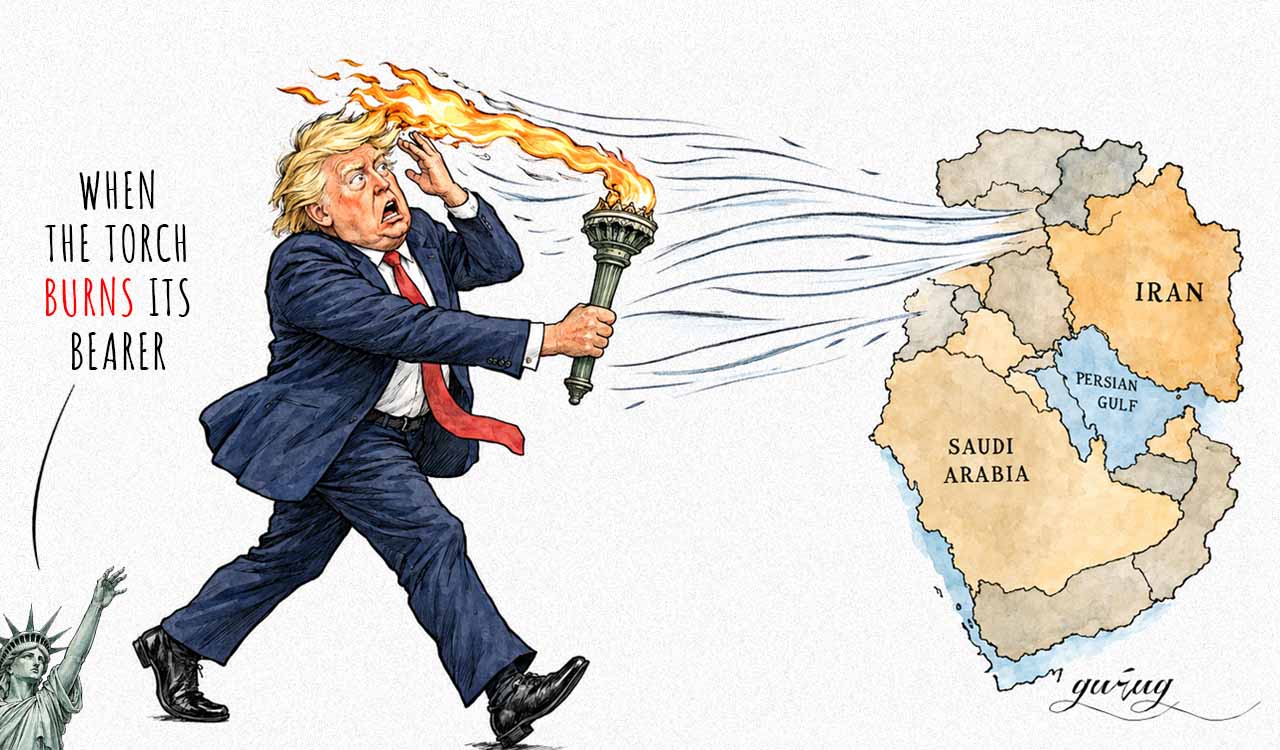
Nowhere is this more visible today than in the tensions between the United States and Iran.
The Illusion of Military Superiority
Since the end of World War II, the United States has been, by almost every conventional measure, the most powerful military force on the planet. It has more aircraft carriers than the next ten navies combined. Its defence budget dwarfs those of its rivals. And yet — a question worth sitting with — how many wars has the United States actually ‘won’ since 1945?
Korea ended in a stalemate, with the peninsula still divided to this day. Vietnam ended in a withdrawal that left the country unified under the very government the US had spent decades and 58,000 lives trying to prevent from taking power. Iraq, despite the swift toppling of Saddam Hussein, descended into a sectarian quagmire that arguably gave rise to ISIS. Afghanistan ended with a Taliban return to Kabul in a matter of days, after 20 years of the longest war in American history. The record is not one of decisive, lasting victory — it is one of superior firepower meeting the limits of what military force alone can actually achieve.
This is not a slight against the courage or capability of American soldiers. It is an observation about the nature of war itself, and about what victory actually means.
The Stubborn Lesson of Iran
History offers a remarkably instructive case study in this regard — one that predates the current tensions by centuries.
When the Ottoman Empire, at the height of its power — arguably the wealthiest and most expansive regime the world had seen — went to war with Persia (modern-day Iran), it expected a familiar outcome. The Ottomans had resources, reach, and a fearsome military reputation. What they encountered instead was something their treasure chests could not solve: an opponent who simply refused to break.
The borders between the two empires remained, in essence, intact. The Ottomans did not lose the war in any dramatic, decisive sense — but they ‘bled’. Slowly, persistently, at great cost. The Persians did not need to defeat the Ottomans on every battlefield. They needed only to make the cost of conquest greater than the reward. They succeeded. And the Ottoman Empire, for all its wealth and power, found that it had been worn down by a smaller adversary who understood its own terrain, its own patience, and its own will to endure far better than its enemy did.
That historical character — call it strategic resilience, or stubbornness — did not disappear with the Persian Empire. It is deeply woven into Iranian statecraft to this day.
Sanctions and the Miscalculation of Pressure
For decades, the United States and its allies have used economic sanctions as the primary instrument of pressure against Iran. The logic is straightforward: cut off the money, and the regime will either moderate or collapse. It is a logical argument. It is also, empirically, one that has not worked.
Deterrence, asymmetric resilience, and the costs to pressure a country that has decided it will not be broken are lessons history has already taught — at great human cost
Despite decades of some of the most sweeping sanctions ever imposed on a nation, Iran has continued to develop and expand its defence capabilities. Its missile programme is among the most advanced in the region. It has developed drone technology that has since been deployed — and studied — across multiple conflict zones. It has cultivated a network of allied groups across the Middle East that serve as a strategic buffer and forward deterrant. None of this happened despite the sanctions being ineffective — it happened ‘because’ Iran made a deliberate choice about where to spend its resources.
This is not an endorsement of Iran’s government or its actions. It is an observation: a country that chooses to prioritise its defence and strategic depth under conditions of severe economic pressure is not a country that is about to capitulate. History — including Iran’s own history — suggested this outcome. And yet, the policy of maximum pressure continued, year after year, on the assumption that this time, the pressure would finally be enough.
War Is Not About Winning — It Is About Who Gets to Negotiate
Perhaps the most important reframing that history offers is this: in modern conflict, the question is rarely ‘who won?’ The question is ‘who gets to set the terms?’
Wars today rarely end with one side raising a white flag in a formal ceremony of surrender. They end in negotiations — and the party that negotiates from a position of strength is not always the party with the most weapons. It is the party that has demonstrated the will and the ability to impose costs on the other side indefinitely.
Vietnam demonstrated this. Afghanistan demonstrated this. The Iran-Iraq War — in which Iran held on for eight brutal years against an Iraqi military backed by both Western and Gulf Arab support — demonstrated this. The ability to absorb punishment, continue operating, and deny the other side a clean resolution is itself a form of power. It is power that does not appear on a defence budget spreadsheet. It is power that only becomes visible over time.
This is the lens through which the current situation in the Middle East must be understood. The question is not whether the United States or Israel can inflict damage on Iran. They can, and they have. The question is whether that damage changes Iran’s strategic calculus — or whether it simply confirms, as it has before, that Iran must continue building the kind of deterrence and negotiating leverage that no sanction or airstrike can easily remove.
The Cost of Ignoring the Lesson
My history teacher was right. Most people do not pay attention in history class. Most governments, for all their intelligence agencies and think tanks, have a remarkable tendency to approach new conflicts as though they are the first of their kind.
The Middle East today is not a new situation. It is an old situation wearing new clothes. The questions of deterrence, of asymmetric resilience, of what it costs to pressure a country that has decided it will not be broken — these are questions history has answered, repeatedly, at great human cost.
We must understand that history will not end the conflict. But it might, at least, lead to a more honest conversation about what is actually achievable — and what the shape of any eventual negotiation will need to look like.
Because in the end, all wars end at a table. The only question is who sits down first, and who holds the better cards when they do.
(The author is an inventor, entrepreneur who has been building innovative technologies for over 25 years)

Related News