Opinion: Mecca pact and the remaking of West Asia’s security order
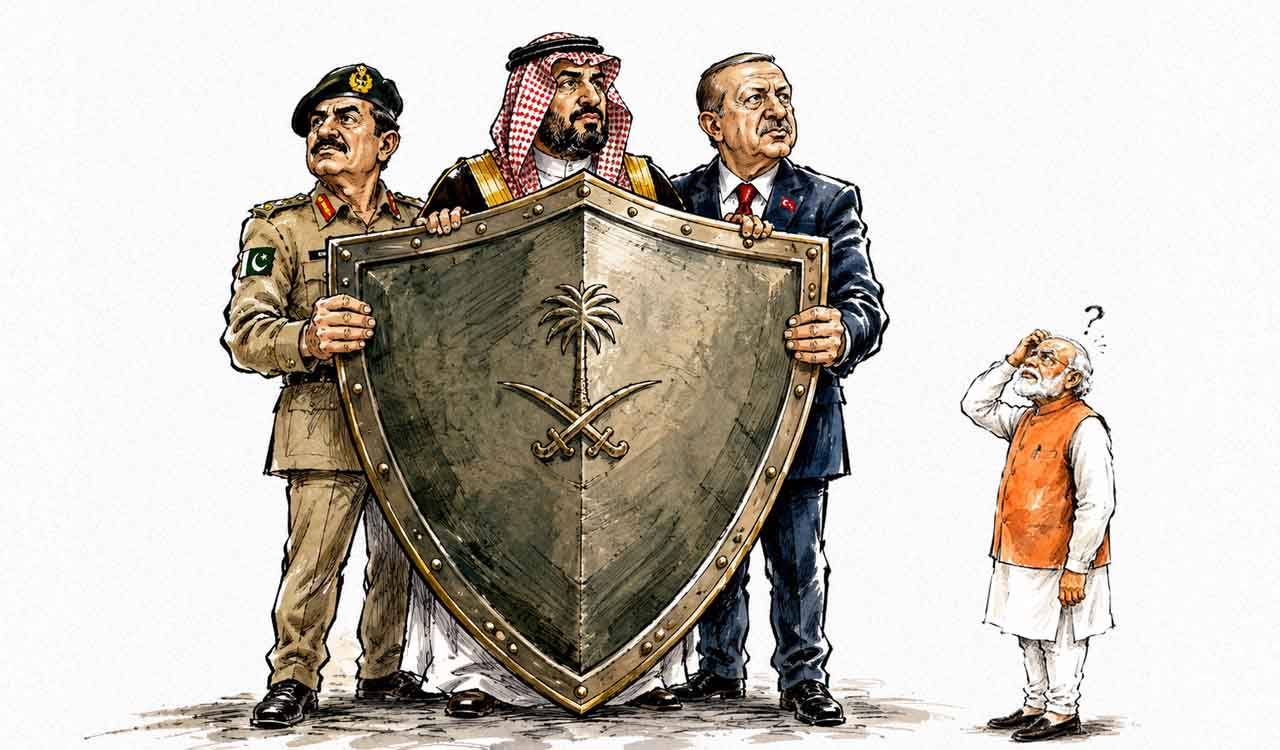
The Mecca pact between Saudi Arabia, Pakistan and Türkiye signals a shift towards regional powers assuming greater responsibility for their own deterrence while retaining multiple external partnerships


By Brig Advitya Madan
The defence agreement signed in Mecca on August 7 by Saudi Arabia, Pakistan and Türkiye is significant not because it creates an entirely new strategic alignment, but because it reveals how the security architecture of West Asia is changing.
Also Read
The three Sunni-majority states have agreed that an armed attack on any one of them will be regarded as an attack on all. They have also committed to expanding defence cooperation, including joint exercises, personnel training, defensive capability development and defence-industry cooperation. No detailed text of the agreement has been made public. Its timing, therefore, may be more revealing than its undisclosed provisions.
Riyadh Angle
The pact comes as the Iran war enters its sixth month, amid missile and drone attacks and strikes by Iran-aligned groups that have exposed vulnerabilities across the Gulf and disrupted shipping through the Strait of Hormuz. For Riyadh, the question is no longer simply whether the United States remains the principal external security provider. It is whether Saudi Arabia can afford to depend on a single security guarantor when the costs of uncertainty are so high. The Mecca pact suggests that Riyadh is seeking layers of deterrence rather than relying on one umbrella.
This process predates the latest agreement. Saudi Arabia and Pakistan signed a mutual defence agreement in September 2025. The Mecca pact now brings Türkiye into a framework that draws upon the three countries’ distinct capabilities. It is therefore best understood as an attempt by Riyadh to diversify its strategic options while leveraging the military strengths of Pakistan and Türkiye.
Striking Complementarity
The complementarity is striking. Türkiye brings extensive NATO experience, one of the alliance’s largest militaries and a growing indigenous defence industry, including Bayraktar drones and naval platforms. Pakistan brings a battle-hardened military, considerable intelligence capabilities and, uniquely among Muslim-majority states, an established nuclear arsenal. Its nuclear capability gives Pakistan a strategic weight that neither of the other partners possesses.
Pakistani military personnel are also already deployed in Saudi Arabia, alongside fighter aircraft, drones and air-defence assets. Saudi Arabia contributes what the other two lack: financial resources, strategic geography and considerable political influence derived from its position in the Muslim world and its longstanding relationships with both Pakistan and Türkiye.
For India, the response should not be to join another camp, but to preserve strategic flexibility, deepen Gulf partnerships and strengthen indigenous defence capabilities
The presence of Pakistan’s Army chief, Field Marshal Asim Munir, at the signing was itself a significant signal. Yet the governments involved have been careful to deny that the agreement constitutes a military axis, a sectarian bloc or a nuclear arrangement directed against any particular country. Türkiye’s President Recep Tayyip Erdoğan invoked Article 51 of the UN Charter, which recognises the right of individual and collective self-defence. These qualifications matter. There is insufficient evidence to describe the arrangement as an “Islamic NATO”, and the agreement does not identify Iran or Israel as an adversary.
Central Purpose
But collective defence arrangements cannot be understood only through their disclaimers. Their central purpose is deterrence: to convince a potential aggressor that an attack on one member will incur a response from the others. In the present regional environment, that logic inevitably has implications for Iran, Israel and other regional actors, even when none is named. The pact’s strategic meaning, therefore, lies less in the identity of a declared enemy than in the message that the three countries intend to develop additional sources of security.
For Riyadh, this amounts to strategic insurance. The Iran war and the vulnerability of Gulf infrastructure and energy routes have reinforced the case for a more diversified security architecture. Tehran has argued that an agreement with Türkiye and Pakistan cannot provide the security that decades of dependence on Washington failed to deliver.
The argument is clearly self-serving, but it points to a broader reality: Gulf states are increasingly interested in multiple sources of deterrence and strategic reassurance. For Washington, there is an additional benefit. Greater regional burden-sharing could allow local powers to assume responsibilities that the United States may increasingly prefer not to carry alone.
The more difficult question is whether the three countries can translate their complementary capabilities into durable collective security. Their threat perceptions are not identical, nor are their strategic priorities.
The Baghdad Pact provides an imperfect historical parallel. Established in 1955 with British and American backing, it brought together Türkiye, Iraq, Iran and Pakistan around a security framework aimed principally at containing Soviet influence. Divergent interests and regional opposition weakened the arrangement, and the 1958 Iraqi revolution led to Iraq’s withdrawal.
The relevant lesson is not that the Mecca pact will meet the same fate, but that defence partnerships become fragile when members disagree over the threats they face and the circumstances in which they are prepared to act.
Implications for India
For India, this distinction is important. Pakistan is likely to emerge as one of the principal beneficiaries of the new arrangement, gaining greater strategic relevance and potentially deeper access to Turkish defence capabilities. Ankara’s growing convergence with Islamabad, therefore, deserves close monitoring.
Yet it would be a mistake to assume that Saudi Arabia’s new security partnership automatically translates into an anti-India alignment. Riyadh has invested substantially in its relationship with New Delhi across energy, investment, technology and security. Its engagement with India has also demonstrated that closer ties with Pakistan need not determine the entire trajectory of Saudi-India relations.
India should consequently avoid viewing the Mecca pact through a binary lens. Its interest lies in deepening its strategic relationship with Riyadh while ensuring that Pakistan-related disputes do not acquire greater space in the Gulf.
New Delhi should continue engaging Ankara even as it accounts for Türkiye’s growing strategic convergence with Islamabad. The changing military environment also underlines the importance of accelerating indigenous capabilities in counter-UAS systems, electronic warfare, drone defence and integrated air defence.
The larger significance of the Mecca pact is, therefore, not that a new bloc has suddenly emerged. It is that West Asia is moving towards a more distributed security order in which regional powers are seeking greater responsibility for their own deterrence while retaining multiple external partnerships.
For India, the response should not be to join another camp, but to preserve the strategic flexibility that has enabled it to maintain productive relationships with Saudi Arabia, the UAE, Israel, Iran and Oman. In a region where old security certainties are giving way to layered and transactional arrangements, India’s influence will increasingly depend on the strength of both its partnerships and its strategic capabilities.
(The author commanded 15 Punjab in Lebanon under the United Nations Flag, commanded 27 Sector as DIG in Churachandpur, Manipur, and was Brigadier Operational Logisitcs, in HQ Western Command. He is currently an analyst on geopolitics, strategic, international and defence affairs)

Related News
-

Indian national injured in Riyadh airport attack dies; EAM Jaishankar expresses grief
-
Opinion: From literacy to livelihood— the missing link in women’s empowerment
-
Saudi-led coalition vows firm response to Houthi attack on Riyadh airport
-
‘Unacceptable’: India condemns attack on Saudi airport, calls for immediate cessation