Opinion: What I don’t know isn’t knowledge!
By Pramod K Nayar In the fact-free, post-truth world, the entrenchment of subjective truth as the only one that counts has become prominent. Relativism of the type ‘you can’t know my pain’, the insistence that only the personal is political — in an inversion of the feminist slogan — lays the foundation for discussing what counts […]


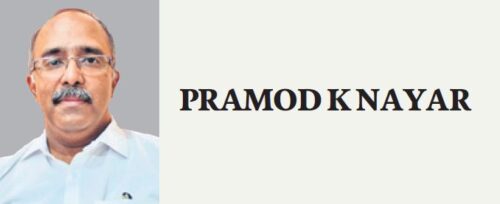
By Pramod K Nayar
In the fact-free, post-truth world, the entrenchment of subjective truth as the only one that counts has become prominent. Relativism of the type ‘you can’t know my pain’, the insistence that only the personal is political — in an inversion of the feminist slogan — lays the foundation for discussing what counts as ‘truth’ may be discerned.
This applies to classrooms, politics, interest-groups and lobbies so that the world matters in so far as it aids, supports or hinders me. As early as the 1980s, worrying about the amplification of individualism, the philosopher Alasdair MacIntyre argued that the self alone as the locus of all truth can become a problem in terms of interpretation of and response to the world.
Official Knowledge
Part of the problem of this inward turn and inward-gazing as the foundation of all responses to the world stems from an increasing unreliability of official and public data. This applies to the state supply of information, the media’s cleverly modified and edited furnishing of details, and the generic mistrust of the information society. Think, for instance, of the contrary and contradictory reportage on Covid-19, vaccinations and variants.
Going back in history, we see official denials of the Armenian Genocide, the ‘rape of Nanking’, the Korean ‘comfort women’, the Ukrainian Holodomor, among others. The Holocaust denialists are as culpable in generating the aura of mistrust around information too. More recently, the sheer tenacity with which specific countries and their leaders — the USA would be a case in point — deny climate change is as startling as anything in history.
In the data deluge that marks our era, perhaps it has indeed become impossible to trust any source of information, and the consequent turn to what is mockingly termed ‘whatsapp university’ is not just accidental.
Know-it-alls
An Oxford limerick went like this (and is often attached to Lord Curzon):
“I am student of Balliol College
What I don’t know isn’t knowledge.”
Nowhere is this borne out better than in the age of what media theorist Liesbet van Zoonen called ‘i-pistemology’ (in contrast to ‘epistemology’), to describe the self-as-origin-of-all-truth.
Speaking from within academia, members of the community with minimal knowledge are able to assume the aura of ‘know-it-alls’ precisely because of what the limerick says. When faced with new and interesting research ideas, such faculty and institutions often find it easier to dismiss these ideas without engaging with them, because ‘what I don’t know isn’t knowledge’. The upshot is: new domains of research or thinking do not find favour in a context where only what I know — however minimal it is — counts. This skews disciplinary and methodological approaches and costs us innovation and expansion.
The second consequence is an emphasis on the experiential mode as the sole route to knowledge-production. A possible extension of the (postmodern) impulse to focus on ‘small narratives’, the i-pistemological turn centres only the ‘I’. Van Zoonen puts it this way:
“the usage of the life history as a metaphor for the candidate’s political program is common to all systems … Personal experience and observations are thus claimed to provide an authoritative position to speak from, for a wide range of different people participating in political and popular culture, in media consumption and in everyday conversations.”
The experiential mode foregrounded at the cost of everything else, turns language, history, politics, academic discourse into a personalised space: ‘I feel, therefore I am…a historian/literary scholar/political scientist’. All public discourse stems, then, from the experiential, to the exclusion of all else.
So what kind of knowledge and public space is created in the i-pistemological era?
Personalised Public
Does solidarity based entirely on personal allegiance trump the affiliation founded on shared concerns? Critics as diverse as Van Zoonen and Saba Mahmood have observed that, in the case of gender critiques of the public sphere, personal preferences in matters such as faith become the foundation for political campaigns and activism. This personalisation of the public — contributed to in no small measure by the social media driven almost entirely on the I-me-my-truth model — generates some problems and questions.
Competitive truth-claims based solely on the experiential makes it almost impossible to adjudicate on. How does one decide whose victimhood is greater, thereby rejecting another’s truth-claim? That is, is there an institutional and public way of negotiating between/among multiple truth-claims that is also equally fair to all of them? How ‘representative’ is any representational process, whether in syllabi or democracy?
If the debate in the public realm, academia and media are driven by i-pistemological concerns and methods, then does all knowledge production hinge solely on identity and identity politics? What then is the nature of the public itself? When, for instance, personal belief systems generate vaccine-hesitancy in numerous countries today (‘vaccination is against my personal faith’), what is the role of the ‘public’ in an age when the pandemic is a public threat?
As identities congeal and become more conscious of blurring boundaries and porosity, commentators like Henry Giroux have found that politics/politicos on both sides of the spectrum — left and right — start ministering to specific identity-groups recast as victims-of-the-moment in their (the politicos’) determination to be seen as more inclusive than their rivals.
This also begs the question: how much does the self or an individual know? Is the individual capacious enough to have expansive knowledge, or is that person’s knowledge severely circumscribed within narrow experiential fields, reading, training and exposure to the world? Can this alone become the determining feature of a response to the world?
When each move, measure or policy is countered with individual articles of faith and belief — ‘this affects me adversely, and so I do not approve of it even if it helps the institution/country’ — then the larger interests of institutions, processes, nations, are lost. I-pistemology, driven by unverified, unverifiable truth-claims — because these are visceral, founded only on my personal views and feelings — is the challenge of the age.
Now you can get handpicked stories from Telangana Today on Telegram everyday. Click the link to subscribe.
Click to follow Telangana Today Facebook page and Twitter .

Related News