SC rules uncle-in-law cannot claim ‘Ghardamad’ adoption without proof of custom
The Supreme Court ruled that an uncle-in-law cannot adopt his niece's husband as a ghardamad for inheritance unless such a tribal custom is proven. Setting aside three lower court rulings, it held that the burden of proving customary practices lies on the claimant
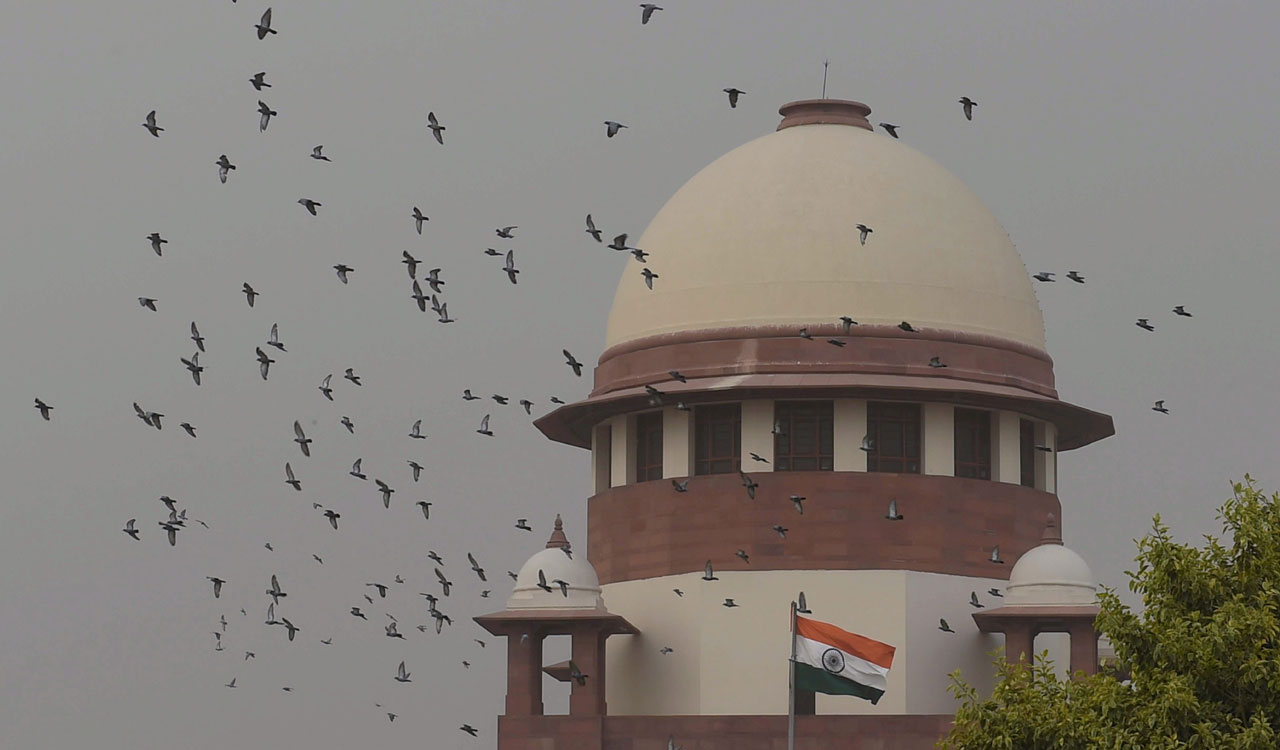


New Delhi: The Supreme Court on Thursday held that an uncle-in-law cannot claim to have adopted his niece’s husband as a ‘ghardamad (resident son-in-law)’ for inheritance purposes unless such a custom is proved, setting aside concurrent judgments of three courts in a property dispute involving members of the Oraon tribal community in Jharkhand.
A Bench of Justices Sanjay Karol and N. Kotiswar Singh allowed an appeal filed by Bejla Oraon after holding that the defendants had failed to establish the existence of such a custom and decreed the plaintiff’s suit.
The apex court said the burden of proving a custom always lies on the party asserting it and rejected the claim that Ledura Oraon could adopt his niece’s husband, Punai Oraon, as a ghardamad to confer inheritance rights over his property.
“It is nowhere established that an uncle-in-law can adopt his niece’s husband as his ghardamad within the prevalent customary law,” the Justice Karol-led Bench observed.
In its judgment, the top court said that although the custom of a ghardamad acquiring rights in the property of his father-in-law stood proved on the evidence, no material was produced to show that such a practice extended to an uncle-in-law.
“Those who allege a custom must be the one to prove it. Merely observing that the opposite to what has been alleged is not clearly stated, cannot be stated to be sufficient,” the Supreme Court observed.
It reiterated that a person relying on a customary practice must not only prove its existence but also establish that he or she is governed by that custom. “He who alleges the custom must prove it. He must also prove that he is in fact governed by said custom,” the judgment said, adding that long usage, prevalence and consistent practice must be established through evidence.
The dispute arose over ancestral property belonging to an Oraon family, where the defendants claimed inheritance through Punai Oraon on the basis that he had been accepted as a ghardamad by childless Ledura Oraon. The plaintiff challenged this claim, contending that no such customary practice existed.
The Supreme Court found that the courts below had accepted the existence of such a custom without any supporting evidence. It also faulted the Jharkhand High Court for framing a substantial question of law on the issue but not deciding it.
“Ordinarily, once a substantial question is framed, the parties have to be heard and issue decided accordingly,” the Justice Karol-led Bench said.
Taking a cumulative view of the evidence and the customary law governing the Oraon community, the apex court held that, apart from the recognised custom enabling a ghardamad to inherit from his father-in-law, the remaining customs pleaded by the defendants had not been proved.
“The customs as alleged, apart from the ghardamad’s eligibility to get property of his father-in-law, could not be proved,” it held, adding that in the absence of a validly established custom, the nearest male agnate would be entitled to inherit the property.
The Supreme Court set aside the judgments of the trial court, the first appellate court and the Jharkhand High Court, decreed the plaintiff’s suit and directed that all consequential reliefs should follow, while leaving the parties to bear their own costs.

Related News
-

Supreme Court clarifies legal route for complaints against elected candidates
-
NEET-PG 2026: Plea seeks permanent copies of question papers and response sheets
-
SC issues notice to ECI on Rahul Gandhi-led plea against Special Intensive Revision exercise
-
Internet shutdown during October 10 CJP protest was necessary: Centre to SC