Spinach callus tissue sent by Amity University grows in space
Has shown signs of growth in POEM-4 module that is orbiting the earth at an altitude of 350 km
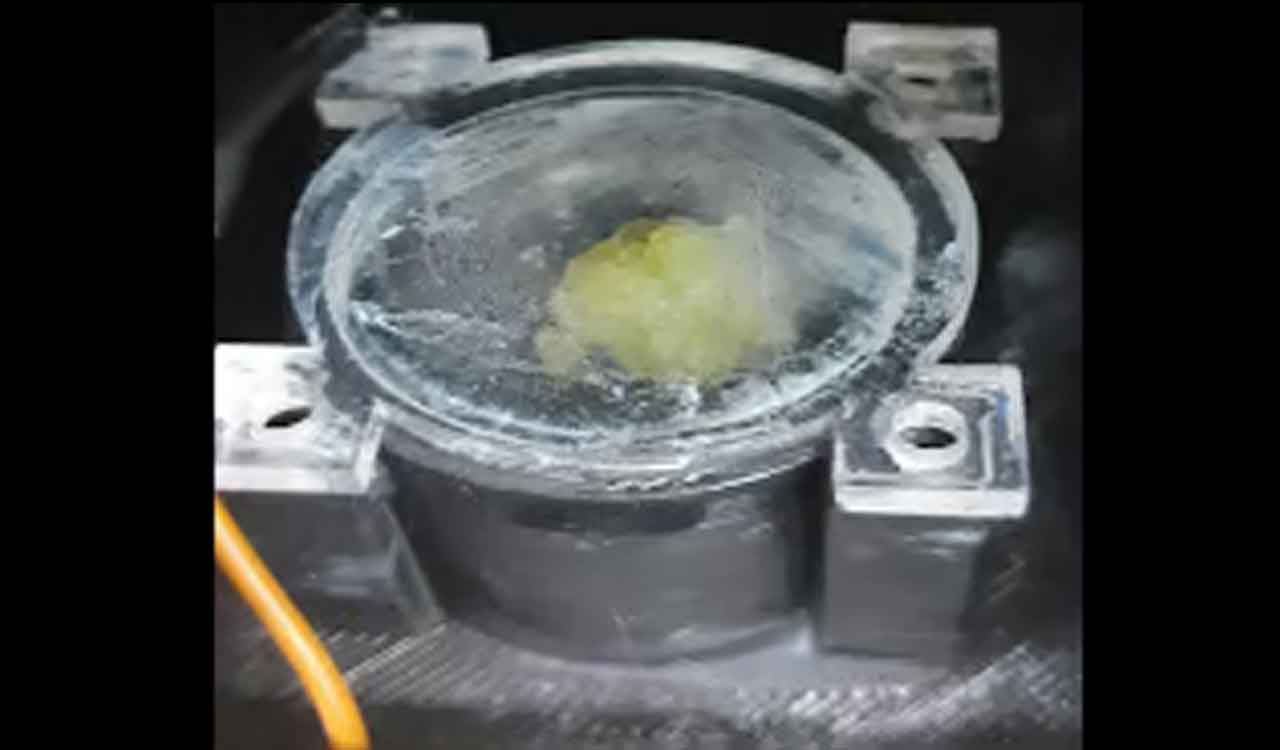


New Delhi: The spinach callus tissue, sent by Amity University-Mumbai to space, has shown signs of growth in the POEM-4 module that is orbiting the earth at an altitude of 350 km, scientists associated with the experiment said.
Growing plants in space under micro gravity is an important milestone for space biological research and as an engaging activity for the astronauts during long duration manned missions.
Also Read
“The initial data received from the POEM-4 platform has shown signs of growth in the spinach callus,” said AW Santhosh Kumar, Vice Chancellor of Amity University, Mumbai. He said the data received from ISRO was promising and the health of the payload was good.
Kumar, the lead scientist at University’s Center for Astrobiology, had sent the Amity Plant Experimental Module in Space (APEMS) on board the PSLV-60 that launched the two SpaDeX satellites on December 30.
He said the decision to grow callus tissue rather than traditional seeds was taken as it allowed researchers to more easily track changes in growth and health through colour monitoring.
“The advantage of using the callus of ‘Spinacia Oleracea’ – known as Spinach – is that it is green in colour and hence any discoloration during growth and death can be captured through the in-built camera,” Kumar said.
He said the spinach callus tissue is fast growing and the growth rate can be measured easily as compared with the seed germination process.
Kumar said an identical module placed at the University campus has shown similar growth of the callus. “The major objective of this experiment is to explore the growth of plants especially through callus on the possibility of food and nutrition during the space missions,” he said.
Kumar said the information gathered from this experiment will provide an understanding how higher plants sense the direction of gravity and light and ameliorate itself to respond to gravitational stress and regulate their direction of growth, a basic need for boosting plant growth on earth as well as prolonged spaceflight missions.
He said the University plans a more intricate real-time experimentation on the Human Space Mission and hopes to be a part of the proposed Bharatiya Antariksha Station in collaboration with ISRO.

Related News
-

Editorial: Diluting institutional autonomy may boomerang
-
Incredible to watch capability ISRO is developing in science missions: Indian-American NASA senior official
-
India, France step up space cooperation with new private-sector deals
-
ISRO says remains at centre of India’s space programme, refutes media reports as ‘baseless’