Telangana’s economic slide under Congress in stark contrast to BRS-era prosperity
Telangana’s economy has slowed sharply with revenue contraction, rising debt, falling growth rates and recurring deflation. Data comparisons with the BRS-era highlight reduced tax performance, widening deficits and weakening demand. Economists warn the State needs urgent corrective measures to prevent prolonged stagnation


Hyderabad: As the calendar turns to December 2025, a sober reality stares at Telangana. The economic engine that roared through the BRS-led years has slowed to a sputter under the current Congress government, with shrinking revenue, mounting debt, decelerating growth and signs of fiscal stress. The latest data deepens the crisis rather than offering comfort.
Under the previous BRS regime, the State’s revenue performance was robust. Between 2016-17 and 2022-23, Telangana consistently posted strong year-on-year revenue growth, often in double digits, including 12.37 per cent in 2016-17, 8.31 per cent in 2017-18, 14.32 per cent in 2018-19, 1.10 per cent in 2019-20, then a dip during the pandemic-hit 2020-21 to (-)2.57 per cent, but a sharp rebound with 27.59 per cent in 2021-22 and 25.01 per cent in 2022-23.
However, revenue growth slowed to 6.11 per cent in 2023-24 after the Congress took over in December 2023 and then slipped into negative territory at (-)0.76 per cent. This is especially grim because the negative number has come without a pandemic.
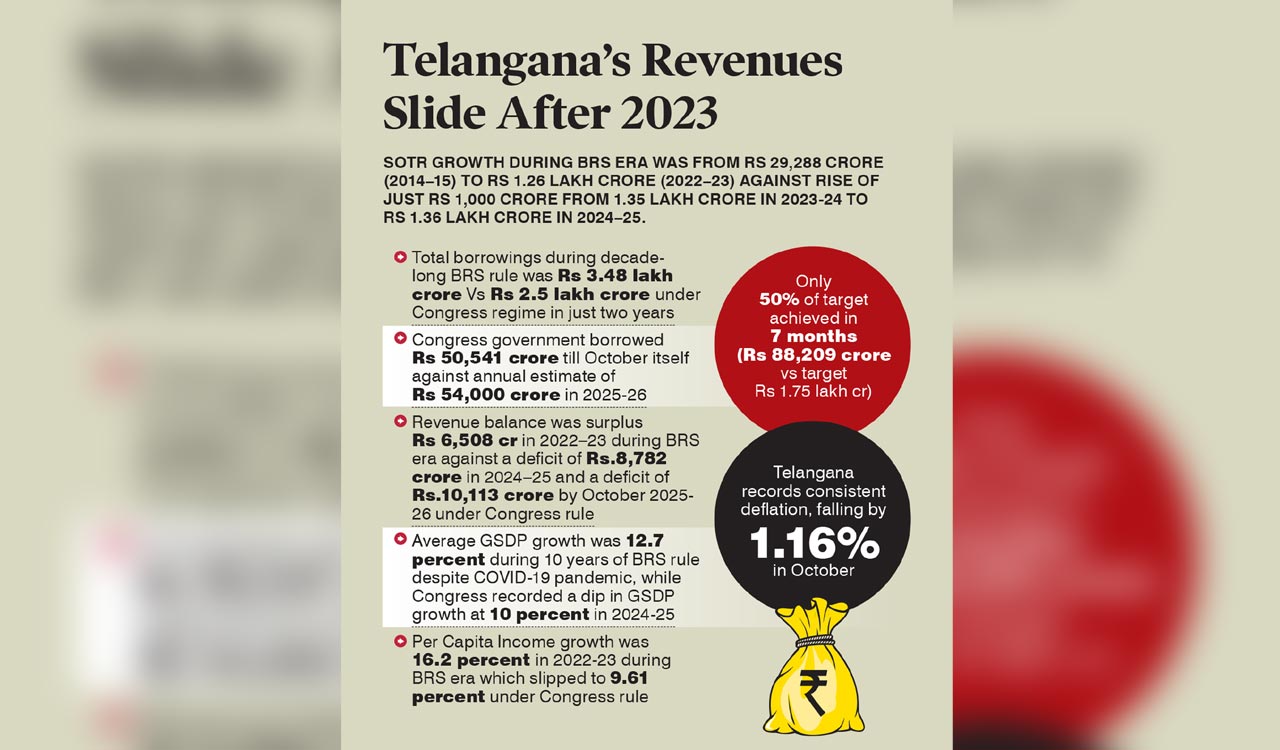
This slump is reflected in the State’s Own Tax Revenue (SOTR) trajectory. As per data, SOTR rose from Rs 29,288 crore in 2014-15 to Rs 1.26 lakh crore in 2022-23 under BRS. On average, SOTR grew at 18.3 per cent annually, significantly higher than the national average of 10.9 per cent. Telangana ranked second in SOTR collection efficiency with 84.2 per cent, just behind Haryana.
By 2023-24, total tax revenue reached Rs 1.35 lakh crore, but that was marred by a decline in the pace of increase. In 2024-25, tax revenue was recorded at Rs 1.36 lakh crore, only Rs 1,000 crore higher than the previous fiscal, despite the ambitious target of Rs 1.64 lakh crore. During the current fiscal, the State accumulated only 50 per cent of its tax revenue at the end of seven months, i.e. Rs 88,209 crore against the targeted Rs 1.75 lakh crore.
Several major tax heads including stamps and registrations and GST collections have under-performed, indicating a contraction of economic activity and a shrinking tax base.
Debt Surge, Deficit Return
The contrast in fiscal prudence could not be sharper. Under BRS, the State’s strategy prioritised capital expenditure while expanding tax revenues. Under Congress, debt has mounted. Against Rs 3.48 lakh crore borrowings during the decade-long BRS rule, the Congress government amassed debt of over Rs 2.5 lakh crore within two years.
In 2023-24, market borrowings touched Rs 49,440 crore, amounting to 129 per cent of the original budget estimate of Rs 38,235 crore, compared to Rs 32,119 crore raised by the previous BRS government in 2022-23. In 2024-25, the Congress government borrowed another Rs 48,322 crore through auction of State securities in addition to borrowings from the Centre. By October this fiscal, the State raised a massive Rs 50,541 crore and is scheduled to obtain another Rs 9,000 crore by the end of December as against Rs 54,000 crore loan estimates.
Correspondingly, the 2024-25 accounts show a reverse trend. The revenue surplus evaporated, replaced by a steep revenue deficit of Rs 8,782.42 crore, while the primary deficit widened sharply. The State, which witnessed a revenue surplus of Rs 6,508 crore in 2022-23, recorded a steep fall to a revenue deficit of Rs (-)8,782 crore in 2024-25. Under the Congress regime, the State registered a revenue deficit of Rs (-)10,113 crore by October in the current fiscal of 2025-26.
In effect, while the BRS era managed to combine capital expenditure with growing revenue and maintain fiscal balance, the current government has reversed the trend, borrowing heavily even as revenues shrink, resulting in fiscal stress.
Growth Losing Momentum
Under BRS, the State’s Gross State Domestic Product (GSDP) rose from roughly Rs 5.05 lakh crore in 2014-15 to over Rs 14.49 lakh crore in 2023-24, a nearly 200 per cent increase in less than a decade. The growth was broad-based, with industry, services and agriculture contributing. In 2022-23, the agriculture-allied sector grew 11.9 per cent, industry 10.5 per cent and services 17.5 per cent.
But in 2024-25, under Congress, momentum slowed. Recent official data show that for the fiscal year 2024-25, the State’s GSDP at current prices was estimated at Rs 16.12 lakh crore, marking a nominal growth rate of 10 per cent. As a result, the State ranked 14th among States in GSDP growth. Real growth at constant prices also decelerated to 6.79 per cent in 2024-25, down from 7.4 per cent in 2023-24.
While a 10 per cent nominal growth may appear healthy, it is a decline compared to previous years under BRS, where average annual growth from 2014-15 to 2022-23 stood around 12.7 per cent, and in 2023-24 GSDP growth was reportedly 11.9 per cent.
Per capita income (PCI) followed a similar downward trend, with PCI growth sliding to 9.61 per cent in 2024-25 compared to 16.2 per cent in 2022-23 and 14.1 per cent in 2023-24. While absolute PCI still increased due to past momentum, the State lost its top position as the decade-long boom hit a speed breaker.
Inflation Turns to Deflation
Perhaps the most worrying indicator has been the shift from inflation to recurring deflation. For the first time since Statehood, Telangana recorded negative inflation in 2025: (-)0.93 per cent in June, (-)0.44 per cent in July, (-)0.15 per cent in September and (-)1.16 per cent in October.
Although there was a brief rise to 0.94 per cent in August, the persistent negative or low inflation in consecutive months suggested weak demand, weak consumption and possibly a decline in business activity.
While lower prices may appear beneficial to consumers, economists warned that sustained deflation can trigger a cycle of falling demand, falling production, job losses and reduced investment, which ultimately drags the economy into stagnation. They said this was a deeply unhealthy sign for any growing economy.
Telangana at Crossroads
The contrast is stark. Under the BRS regime, Telangana built an enviable record with robust revenue growth, disciplined fiscal management, high capital expenditure, rapid GSDP and PCI growth, and strong sectoral expansion. The State emerged as a model of development and economic governance.
Under the current Congress regime, the story has been reversed. Revenue growth has declined, borrowings have surged, the fiscal balance has deteriorated, growth has slowed, per capita income gains have weakened and economy-wide deflation has set in.
Unless corrective measures are taken through structural reforms, revival of demand, encouragement of private investment and fiscal discipline, Telangana risks sliding from temporary slowdown to sustained stagnation.
The action or inaction of the Congress government over the next few quarters will determine whether this is a temporary speed breaker or the beginning of a long descent.

Related News