The horse that didn’t need a rider: NDA lessons not taught in classroom
Marlboro did not falter or look back, galloping to the finish line without me—leaving a lasting lesson: preparation matters, but so does accepting the unexpected with grace


By Brig Advitya Madan
At the National Defence Academy (NDA), certain lessons are not taught in classrooms. They are learnt the hard way — through mud, bruises and, occasionally, a fall from a horse. Boxing, swimming jumps and horse riding were designed not merely as activities, but as tests of nerve. For many of us, they were rites of passage.
Horse riding, in particular, had its own rituals. At dawn, after a brisk roll call, a shrill whistle would send cadets sprinting towards the equitation lines. It looked like enthusiasm, but was in fact a survival instinct—everyone wanted the most docile horse. I was rarely that fortunate. More often than not, I was left with the “green” ones—untrained, unpredictable, and unforgiving. One such horse, Edward, was a magnificent beast—powerful, restless, and entirely indifferent to the limitations of a novice rider.
The results were predictable. I was thrown off more times than I care to remember. The image of a horse bucking—hind legs kicking up, back arched—is etched permanently in memory. Yet, those falls taught balance, resilience and, above all, respect for forces larger than oneself. By the fourth term, persistence paid off. I earned my spurs and graduated with a ‘Blue’ in riding—proof that endurance, more than elegance, defines competence.
Years later, at the Defence Services Staff College in Wellington, the Nilgiris offered a different setting but familiar lessons. Horseback outings through misty slopes became a welcome respite from staff duties. So when a circular invited volunteers for a two-mile race across undulating terrain, the decision was instinctive. It promised both nostalgia and challenge.
On race day, the atmosphere was electric. Officers and their families gathered, wagers were quietly placed, and expectations—curiously—rested on me. My mount, however, was Marlboro, a notoriously jittery horse. As we lined up at the start, the tension was palpable. The gunshot rang out, and the horses surged forward in a thunder of hooves.
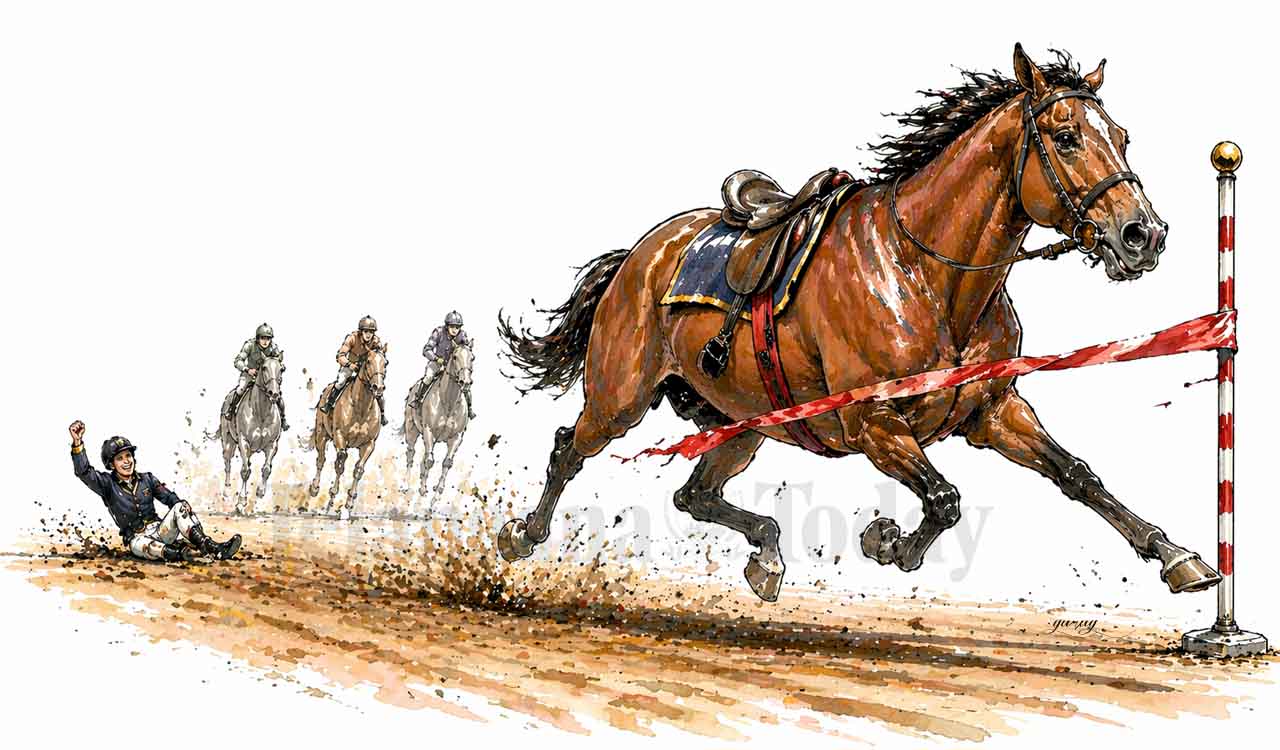
For the first hundred metres, I stayed on. Then Marlboro leapt over a bush with a flourish that was entirely his own. I, unfortunately, was not part of that manoeuvre. Thrown unceremoniously into the undergrowth, I watched, momentarily stunned, as my horse continued the race—without me.
What followed was surreal. Marlboro did not falter, hesitate or look back. He knew the course, the turns and the finish. As the race progressed, the crowd’s anxiety turned into disbelief and then into exhilaration. A riderless horse was leading the pack. By the final stretch, Marlboro galloped ahead with unrelenting energy, crossing the finish line well before the others—alone, but triumphant.
There was laughter, applause and no small measure of irony. The bets placed on me were redeemed, though not quite in the manner expected. Marlboro had no concern for conventions; he had run his race, rider or not.
For me, the lesson was familiar, yet sharper in its clarity. In uniform, one often learns that control is an illusion. Preparation matters, but so does the ability to accept the unexpected with grace. Sometimes, despite best intentions, events acquire a momentum of their own.
Marlboro was declared the fastest horse of the year. I, meanwhile, spent the next few days nursing bruises—and a story that would outlast them.
(The author commanded 15 Punjab in Lebanon in 2007 and Brigade/Sector in Manipur as DIG in 2013, and was Brigadier Operational Logistics Western Command in 2014)

Related News