To SIR, with(out) love—a voter’s experience with electoral roll revision
Electoral rolls must be cleaned, but technology and paperwork should never make genuine voters repeatedly prove their right to vote


By N Nagarajan
Let me say this categorically at the outset: I am not against the Special Intensive Revision (SIR) of electoral rolls. A periodic exercise to clean up electoral rolls, identify duplicates and deceased or shifted voters, and ensure that only eligible citizens remain on the rolls is both legitimate and necessary. My concern is not the objective, but how it is being implemented.
Electoral rolls have, of course, been revised periodically. But after many years, and with technology having transformed almost every aspect of public administration, a more comprehensive exercise may well be justified. Technology has also made elections faster and, in many respects, more transparent. My own experience illustrates both the possibilities and pitfalls of the system.
After moving to Hyderabad from Delhi in 1982, I enrolled myself and my spouse as voters online in 2014. The process was remarkably simple. Within minutes of submitting the application, we received the voter information slip with the relevant details. About two months later, our photographs and voter cards were hand-delivered by an election staff member.
Linkage with 2002
There was, however, a small error. Our door number was correct, but the name of the colony mentioned was actually the locality where our polling station was situated. When we pointed this out, we were told that it would not create a problem because the voter ID number and photograph were what mattered at the time of voting. Unfortunately, we did not pursue the correction.
There was another curious episode. I received two voter cards in my name. Most likely, when I did not receive an update after submitting my first online application, I submitted another application. Both appear to have been processed, although only one voter ID number was active and I never used the duplicate.
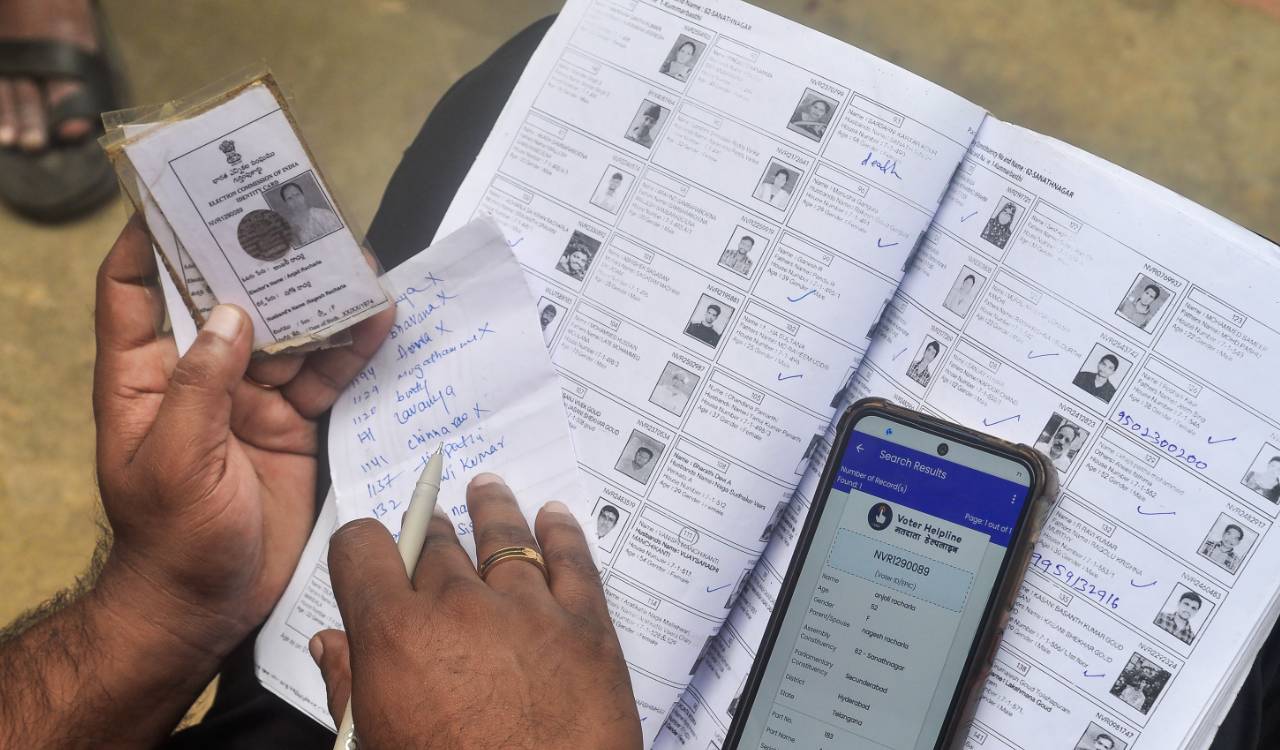
None of this caused us any difficulty for years. The real problem began only when we were asked to establish our linkage with the 2002 electoral roll for SIR.
My spouse, who had moved to Hyderabad in 1989, did not have a voter ID for a considerable period. During the late 1990s and again between 2005 and 2007, her work required transfers to locations outside Hyderabad. Because of these movements, professional responsibilities and our own failure to appreciate the future importance of old electoral records, we did not pay sufficient attention to voter registration at the time.
That history illustrates one of the fundamental difficulties with asking present-day voters to establish their connection with an electoral roll from 2002. Not every genuine voter will have a neat documentary trail extending back more than two decades. People moved for employment, married, changed cities, changed addresses and, in some cases, simply did not obtain voter IDs when they were younger.
When the distribution of SIR enumeration forms began in our locality in 2026, another complication arose. A BLO associated with the GHMC sanitation set-up gave me my form after searching for it, but told me that another BLO would provide my spouse’s form. Although we lived under the same roof and were assigned to the same polling station, we were in different rooms and apparently fell under different BLO arrangements.
The form I received was in Telugu. Since neither of us can read or write Telugu, I initially opted for the online route. I then discovered that my name had a missing letter compared with my Aadhaar record. Because of the mismatch, I could not complete the online submission and had to seek a neighbour’s help to understand the form and complete the process with the BLO.
My spouse, whose name did not have this particular mismatch, was able to submit her SIR-related information online on July 4 and received an acknowledgement. We thought the matter was over. It was not.
When the draft SIR electoral roll was published, my name appeared, but my spouse’s name was missing. Later, when the Election Commission uploaded the lists of persons classified as “permanently shifted” or deceased, we eventually located her name there, with “permanently shifted” shown against it. Imagine the surprise: a husband and wife, living in the same house, appearing to be treated differently by the electoral system.
My spouse subsequently had to use Form 6 to seek fresh enrolment, rather than merely correcting an existing entry. She did not approach the BLO seeking a new enrolment; she followed the prescribed Form 6 route after finding her name excluded from the draft roll.
Meanwhile, I had a separate problem. Since my name required correction, I submitted Form 8 online to correct the spelling and link my mobile number. I received an acknowledgement on June 30. Yet it was only on August 31 that I received an SMS asking me to contact the BLO. When I did so, I was told that the Election Commission had not authorised the BLO to verify the Form 8 application.
Troubling questions
As an ordinary voter, I had assumed that once Form 8 was submitted and acknowledged, the correction would eventually be reflected in the electoral roll. The draft roll showed otherwise: my name still carried the incorrect spelling.
This raises a simple question: what exactly does an acknowledgement mean to a voter if the correction cannot even be verified within the relevant revision process?
There is another aspect that troubles me. My spouse has performed election duty three times, including as a Presiding Officer. She therefore has some practical understanding of how polling arrangements work. Yet after this SIR process, she found herself outside the electoral roll and having to seek fresh enrolment.
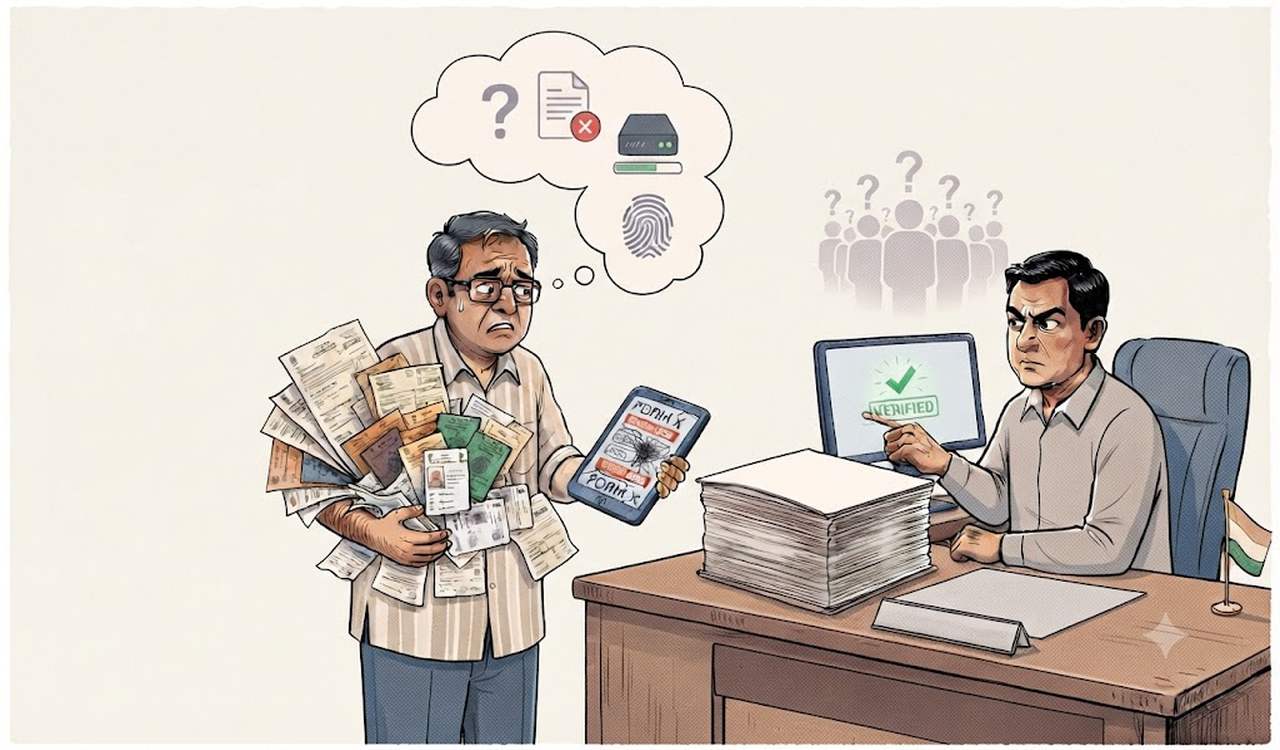
If this can happen to two ordinary, reasonably educated voters living at the same address, one can only imagine the difficulties faced by elderly people, migrant workers, people in remote areas, those unable to read the local language, and citizens who do not have access to the internet or someone who can help them navigate the process.
This is why the recent observations of RS Sharma, one of the architects of India’s Aadhaar and digital-governance infrastructure, deserve attention. His criticism was not that electoral rolls should not be cleaned. His larger point was that India has already created sophisticated digital public infrastructure and yet appears to be relying on a document-heavy process instead of making meaningful use of information already available to the State.
The Election Commission’s decision not to treat Aadhar as credible address proof for SIR has therefore raised legitimate questions about whether India’s digital capabilities are being adequately utilised.
My concern is similar. Why should a genuine voter who has lived at the same address for years be required to repeatedly establish his or her identity through layers of documentation merely because an old electoral record cannot be mapped easily? I also wonder whether the present system gives too much importance to automated matching of voter ID numbers, names and family details.
Names can have spelling variations. Addresses can change. Transliteration between English and Indian languages can produce differences. Family relationships may not always be recorded consistently. A computer can flag a mismatch in seconds, but a genuine voter can be left trying to prove what should have been obvious from the circumstances.
Outcome matters
I am not suggesting that software is necessarily responsible for every deletion. Nor am I suggesting that BLOs or election officials deliberately discriminate against anyone. There may be administrative, procedural or technical explanations for individual cases.
But the outcome matters. If a voter who has submitted the required form is nevertheless placed in a “permanently shifted” category, there must be a clear and accessible explanation of how that decision was reached and an equally simple mechanism to correct it.
The larger question is whether the process is designed primarily to identify fraudulent or duplicate voters, or whether the burden is gradually shifting towards making genuine voters prove that they deserve to remain on the electoral roll.
There is also an uncomfortable asymmetry. When a well-known person discovers that his or her name has disappeared, the matter may receive attention and get corrected quickly. But what happens to an ordinary voter in a village, a distant town or a low-income neighbourhood who does not know where to complain, cannot read the language in which the list is published, has no internet access, or cannot afford repeated trips to an election office? For such a person, deletion may effectively mean losing the opportunity to participate in the next election.
I therefore believe the Election Commission owes voters more than an assurance that the process is intended to “purify” electoral rolls. It should also demonstrate that the process itself is transparent, accurate, accessible and capable of protecting genuine voters from wrongful exclusion.
The government and the Election Commission have spent substantial public money creating sophisticated digital systems. Why not use that technology more intelligently?
Existing voter records, Aadhaar-linked information where legally permissible, photographs, current addresses, mobile numbers and other available databases could potentially help identify genuine voters before placing their names in exclusion categories. Human verification should be used where technology throws up inconsistencies—not the other way around.
Most importantly, a mismatch should trigger verification, not automatic suspicion. My experience has taught me that cleaning electoral rolls is not merely about deleting names. It is equally about protecting the names that belong there. I have shared this experience not because my spouse and I are worried about missing one election. We know how to pursue the matter. We have the education, access to technology and the confidence to approach the authorities. But millions of ordinary voters may not.
Counting genuine voters
The strength of Indian democracy ultimately lies not in how efficiently names can be removed from a database, but in how confidently every genuine voter can remain on the electoral roll.
SIR may have a legitimate objective. But if genuine voters are made to feel that they have to prove themselves all over again, the exercise risks losing the trust it is supposed to strengthen.
That is why this is my modest submission to the Election Commission: Clean the rolls, by all means. Remove duplicates, deceased and genuinely shifted voters. But please do not allow technology, paperwork or administrative shortcomings to turn genuine voters into non-voters.
The Election Commission is the custodian of our electoral democracy. It must ensure that while cleaning the rolls, it does not inadvertently clean out the confidence of the very voters whose faith sustains the system.
That is my concern with SIR. And that is why, respectfully, I call this experience: to sir with(out) love.

Related News