Weaver suicides, loom closures mark two years of Congress rule in Telangana
Telangana’s weaving sector is facing severe distress with loom closures, rising debts, migration and suicides. Weavers blame the government for unfulfilled pension promises, scrapping Bathukamma saree orders and a stalled loan waiver, causing job losses and pushing thousands out of the profession
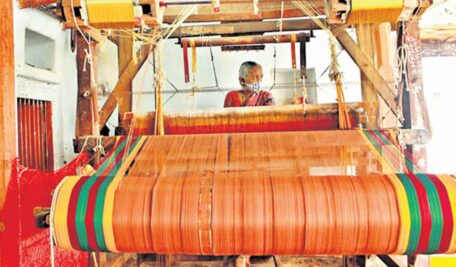


Hyderabad: Insufficient livelihood, mounting debts, closure of looms, migration of weavers in search of survival and even suicides sum up the deep crisis in the weaving community over the last two years in the State.
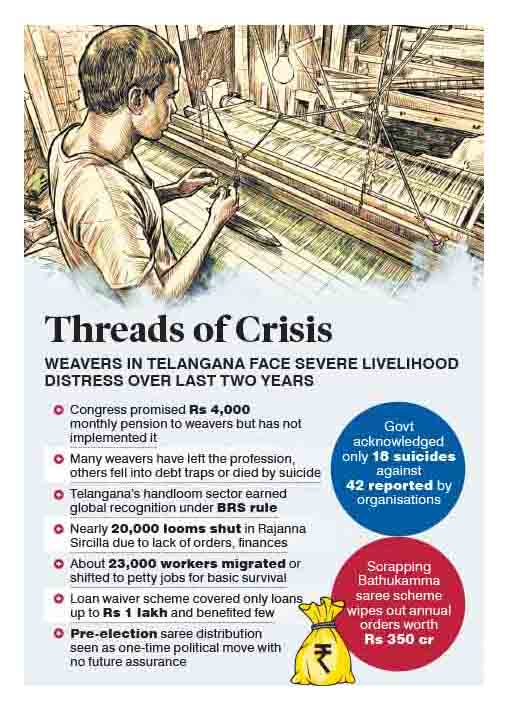
The Congress party had promised a monthly pension of Rs 4,000 to weavers in its election manifesto. After two years in power, with not even a trace of that promise being fulfilled, thousands of weavers have quit the profession, while a few have taken extreme steps, ending their lives after falling into debt traps.
This collapse comes despite the handloom sector having earned global recognition under the previous BRS regime. In 2021, the United Nations World Tourism Organisation honoured Pochampally, famous for its unique silk and Ikat weaving style, as the Best Tourism Village. The weaving community, expecting even better days ahead, is instead witnessing a downward spiral. In Rajanna Sircilla, many powerloom units have been forced to pull down shutters due to lack of orders and financial constraints.
Loom closures
There were about 70,000 looms in Rajanna Sircilla district, but nearly 20,000 have now been shut. Unable to bear rising debts, many weavers have died by suicide and almost 23,000 workers have been forced to become vegetable vendors, security guards and daily wagers, while thousands have migrated to Solapur, Bhiwandi, Mumbai and other cities just to earn a basic livelihood, said CITU State secretary K Ramesh.
The series of suicides in Rajanna Sircilla, Karimnagar and Khammam had triggered protests across the State by weavers’ organisations, ancillary workers and opposition parties, yet the government remained indifferent.
Weaver suicides
While weavers’ organisations and media reports put the toll at 42 suicides in the last two years, the State government has admitted to only 18. When public pressure mounted, a committee was constituted to verify the ‘genuineness’ of suicides, reducing the tragedy into a bureaucratic exercise.
Of the 18 suicides acknowledged, ex gratia was paid to the families of only 11. The remaining families were denied compensation on the grounds that the deaths were due to family disputes, liquor consumption and other reasons, exposing the government’s apathy towards a sector that was thriving till recently, Ramesh said.
Scrapping Bathukamma sarees orders
Adding to the distress, the Congress government scrapped the free Bathukamma sarees scheme after coming to power, even though the programme launched by the BRS government in 2017 helped women celebrate the State’s festival proudly in locally woven sarees. It also ensured steady employment in the weaving sector, with nearly one crore sarees ordered every year.
Ancillary workers too benefitted, including those involved in packing, transport and stock shifting. According to weavers, the Bathukamma saree orders worth Rs 350 crore alone kept them employed throughout the year. In addition, the previous government placed orders for school uniforms, KCR Kits, Christmas and Ramzan gifts and sarees for Anganwadi teachers and Aayahs, with total annual orders worth Rs 500 crore to Rs 550 crore.
Weavers who used to earn Rs 16,000 to Rs 20,000 per month are now finding it hard to secure any work due to the Congress government’s decision to scrap the scheme over the last two years, depriving women of new sarees for the festival and robbing weavers of their livelihood.
The lack of orders has hit both those running powerlooms and those working on them, forcing many units to shut down.
Loan waiver scheme
With mounting criticism from all sides, the government last September announced a weavers’ loan waiver scheme. It covered loans of up to Rs 1 lakh taken between April 1, 2017 and March 31, 2024. But the scheme came with a condition that any amount above Rs 1 lakh had to be cleared by the weaver before July this year, exposing how poorly the scheme was designed.
CPM State secretary John Wesley pointed out that around 17,600 weavers availed loans across the State, but technical rejections and exclusions left many deprived of support. A year after the scheme was announced, only Rs 33 crore has been released, which works out to a meagre Rs 10,200 per weaver. Weavers say that not a single loan has been waived so far, making it a hollow claim.
Local body elections and saree distribution
With local body elections approaching, the Congress government has now announced distribution of one crore sarees to women in the State. Initially, two sarees were promised to each self-help group member, but now only one is being given. About 65 lakh sarees are being distributed in the first phase alongside gram panchayat elections, and the rest are likely to be given in March during International Women’s Day.
Though this has provided some work this year, weavers fear the orders will end once elections are over. The Congress government did not distribute Bathukamma sarees for the last two years, and the present move is widely seen as a last-minute election gimmick with no guarantee of continuity.

Related News