Criminal case against widow can’t bar son’s compassionate appointment claim: SC
The Supreme Court ruled that criminal proceedings against a deceased employee's widow cannot be used to deny their son's claim for compassionate appointment. The court held that Haryana's rules apply only to compassionate financial assistance and directed authorities to consider the son's application on merits
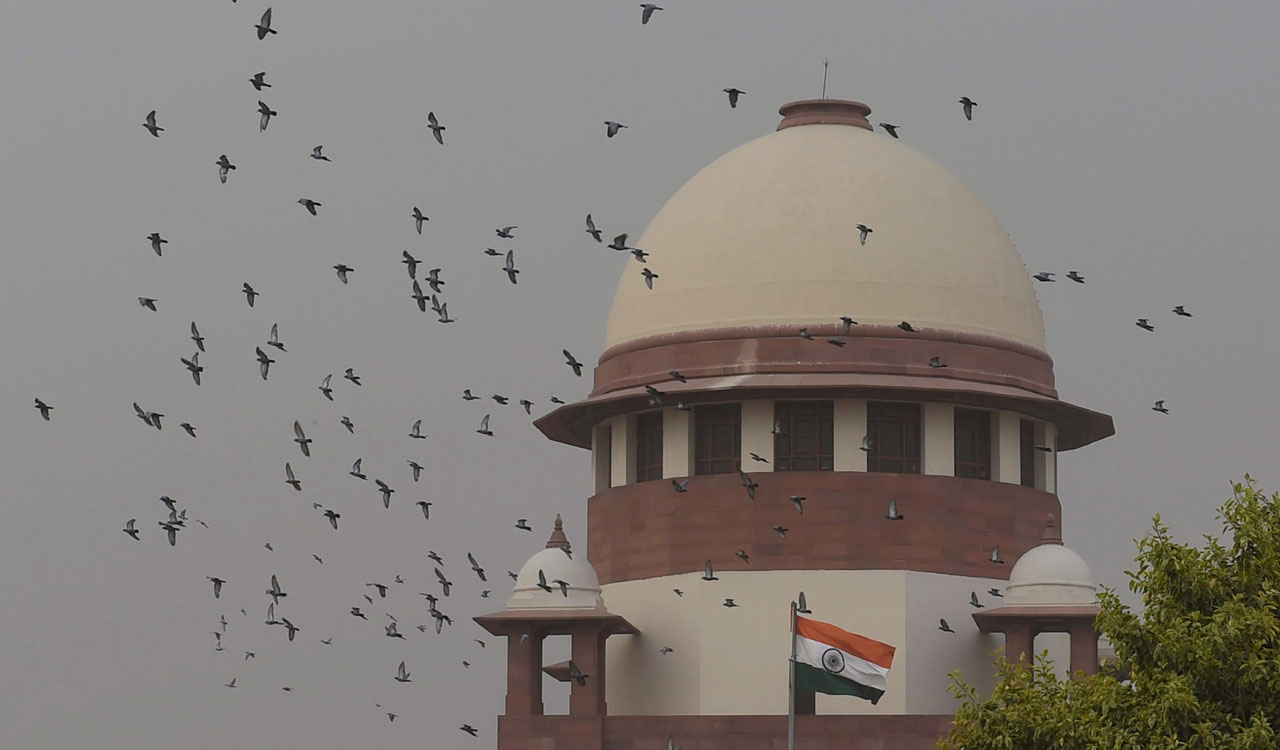


New Delhi: The Supreme Court on Thursday while referring to Haryana government’s rules held that criminal proceedings against a deceased employee’s widow cannot be used to deny their son’s claim for compassionate appointment.
A bench of Justices Sanjay Karol and Nongmeikapam Kotiswar Singh allowed the appeal of Atul Chauhan, whose request for compassionate appointment was kept in abeyance after his mother was accused of conspiring in the murder of his father, a government school teacher in Haryana.
In an order, the top court said, “No legal impediment to the Respondents considering and deciding the Appellant’s claim for compassionate appointment on its own merits, strictly in accordance with the eligibility conditions and requirements prescribed under the Rules of 2019.”
It said that a Haryana rule suspending benefits during such proceedings applies only to financial assistance and not to appointments.
The apex court set aside a Punjab and Haryana High Court judgment which had upheld the application of Rule 23(1) of the Haryana Civil Services (Compassionate Financial Assistance or Appointment) Rules, 2019, to the appellant’s case and directed the state authorities to consider his claim on merits within three months.
Atul’s father, Gajender Singh Chauhan, a junior basic teacher, died in September 2021 in a road accident. Gajender’s wife, Pushpa Devi, was later charged with conspiring in his murder. Though she was acquitted by a trial court in October 2024 on the benefit of doubt, an appeal against her acquittal remains pending.
The authorities had refused to process Atul’s claim for compassionate appointment, citing Rule 23(1), which suspends compassionate financial assistance where a family member is accused of murdering or abetting the murder of the deceased employee.
Interpreting the provision, the apex court held that its language was confined exclusively to “compassionate financial assistance” and could not be extended to compassionate appointments.
“The language of Rule 23(1) is unambiguous and admits of only one reading. The provision employs the expression ‘compassionate financial assistance’, and that expression alone throughout,” the bench said.
The top court upheld the constitutional validity of Rule 23(1), saying the provision was preventive and regulatory in nature and had a rational nexus with the objective of ensuring that a person potentially responsible for the employee’s death does not immediately receive compassionate financial benefits.
It suggested that the Haryana government consider amending the rules to address the legislative gap. Clarifying that compassionate appointment is not a vested right, the bench said the authorities would still have to examine the appellant’s eligibility and other requirements under the rules before taking a decision on his claim.

Related News
-

NEET-PG 2026: Plea seeks permanent copies of question papers and response sheets
-
SC issues notice to ECI on Rahul Gandhi-led plea against Special Intensive Revision exercise
-
Internet shutdown during October 10 CJP protest was necessary: Centre to SC
-
Owaisi moves Supreme Court against SIR, alleges irregularities in EC decision-making