Editorial: Burdening the States
Financial liability of VB-G RAM G Scheme will be shared between the Centre and the State govts in the ratio of 60:40
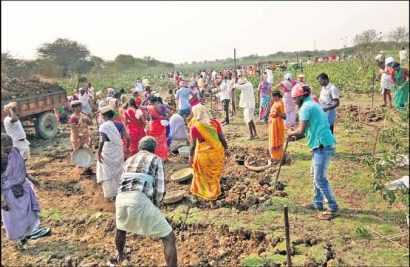


Despite some flaws in implementation, the national rural employment guarantee scheme has served as a beacon of hope for the rural poor for nearly two decades. The NDA government’s proposal to overhaul the programme, without holding any consultations with the States, has raised legitimate concerns over the future of the rights-based guarantee law. It is not just about erasing Mahatma Gandhi’s name and renaming it as the Viksit Bharat Guarantee for Rozgar and Ajeevika Mission (Gramin) (VB-G RAM G) Bill, 2025; the problem runs much deeper. The most important fallout is that the States would be burdened more once the new law comes into force. Not surprisingly, the opposition parties have described the Bill as an attack on the soul of the rights-based guarantee because it seeks to snatch away the rights of millions of poor people and defy the ideals of Mahatama Gandhi. The new legislation promises to provide a statutory guarantee of 125 days of wage employment in every financial year to every rural household whose adult members volunteer to undertake unskilled manual work. Within six months from the date of commencement of the scheme, States will have to make a scheme consistent with the provisions of the new law. The financial liability would be shared between the Centre and the State governments in the ratio of 60:40. The fear is that it would end up replacing a rights-based guarantee law with a conditional, centrally controlled scheme opposed to the interests of both the States and the working class.
The MGNREGA’s bottom-up demand-based employment approach, guaranteeing 100 days of work per household by legislation, has been replaced by an allocation-based scheme, where the Centre will be at liberty to alter and determine the quantum of allocations. Under the existing programme, the Centre is required to meet the full cost of wages for unskilled manual work, and up to three-fourths of the material cost of the scheme, as well as three-fourths of the wages for skilled and semi-skilled workers. However, under the rechristened scheme, the State governments will have to bear the cost partially. Under RAM G, the Centre will determine the state-wise normative allocation for each financial year, based on “objective parameters” as may be prescribed by the central government itself. Any expenditure incurred by a State in excess of its allocation will be borne entirely by the State government. Experts have warned that a legal employment guarantee is now sought to be reduced to a centrally managed publicity scheme, at the expense of the States. Despite the Centre’s claim of increasing guaranteed employment from 100 to 125 days, the Bill, in reality, opens the door to the exclusion of large sections of rural households in the name of the “rationalisation” of job cards. The rebranded avatar resorts to cost-shifting and restrictive conditions that run counter to the spirit of federalism.
Also Read

Related News