Editorial: Lives of life-savers in danger
The recent assault on medical professionals in Thane has renewed calls for a comprehensive central law to safeguard healthcare workers
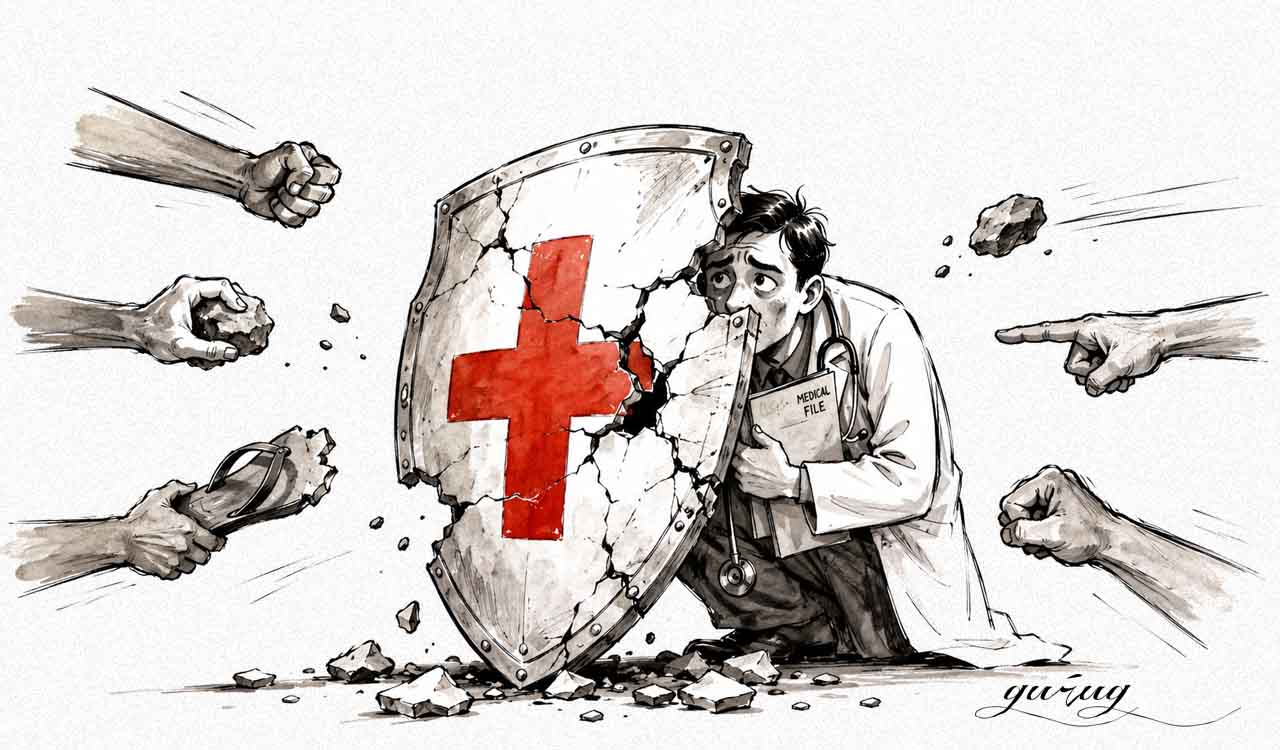


Violence against doctors, nurses, and other healthcare workers has become a recurring concern in India. Such incidents often occur after the death of a patient, alleged medical negligence, delays in treatment, or disputes over hospital bills. While these attacks undermine the safety of healthcare professionals, they also disrupt emergency medical services and discourage doctors from serving in high-risk settings. Recently, a Shiv Sena corporator assaulted a resident medical officer and a woman gynaecologist at a hospital in Maharashtra’s Thane district. This triggered statewide protests by resident doctors’ and nurses’ associations. A few months ago, doctors were attacked by patients or their relatives at hospitals in Bidar, Karnataka, and Bikaner in Rajasthan in what has become a depressingly familiar pattern. The lifesavers have no protection for their own lives. A nation cannot expect its healers to serve fearlessly while leaving them defenceless. The absence of a strong central law to ensure the safety and security of healthcare professionals is a glaring gap. There is an urgent need for a stronger legal framework to curb such violence. Though as many as 19 States have laws aimed at protecting medical professionals and healthcare facilities, none has proven an effective deterrent, with very few complaints reaching courts and poor conviction rates. There is, however, no dedicated central law. Parliament did amend the Epidemic Diseases Act during the Covid-19 pandemic to make violence against healthcare personnel treating epidemic patients a cognisable, non-bailable offence — but that protection applies only during notified epidemics, not to routine incidents of hospital violence.
The Thane episode reveals the vulnerability of medical staff to political intimidation. The attack was carried out in a fit of rage over the non-availability of a neonatal ICU bed. An FIR was registered only after widespread public outrage, video evidence that went viral and sustained pressure from the medical fraternity. The Shiv Sena led by Maharashtra Deputy Chief Minister Eknath Shinde has condemned the corporator’s misconduct and promised disciplinary action. However, justice will largely depend on whether the police are allowed to complete their probe without political interference. Inadequate hospital security, especially in government hospitals, overcrowding, staff shortages, long waiting times, and poor communication with patients’ families often trigger conflicts. Experts and doctors’ associations have advocated a comprehensive central protection law that can be made applicable across India. The Indian Medical Association (IMA) drafted a model law in 2017, and two years later, a government-prepared Healthcare Service Personnel and Clinical Establishments (Prohibition of Violence and Damage to Property) Bill was floated after the Kolkata hospital attacks, but it never reached Parliament. After the August 2024 rape and murder of a trainee doctor at Kolkata’s RG Kar Medical College, this demand resurfaced strongly but the Centre’s stated position is that the Bharatiya Nyaya Sanhita (BNS) already covers grievous hurt/assault adequately and that law and order is a State subject under the Constitution.
Also Read

Related News