Harish Rao calls out Revanth Reddy govt for sabotaging Telangana’s water rights
BRS leader T Harish Rao accused the Congress of historically betraying Telangana’s river water rights, alleging the Revanth Reddy government restored an unfair Krishna water-sharing formula and surrendered the State’s interests to Andhra Pradesh and the Centre.
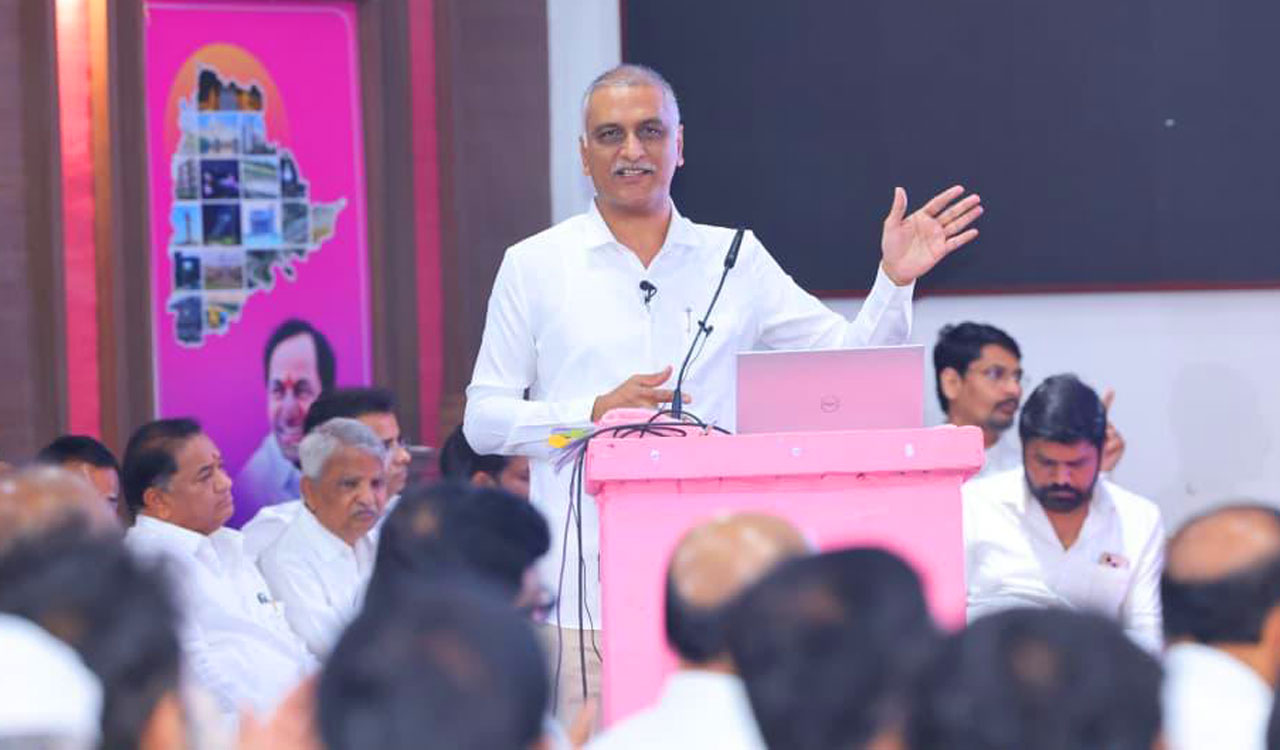


Hyderabad: BRS deputy floor leader and former Irrigation Minister T Harish Rao tore into the ruling Congress party’s allegations, accusing it of systematically undermining Telangana’s river water rights and reversing the gains secured after Statehood.
The Revanth Reddy administration had revived Congress-era injustices in the Krishna River basin through policy drift, political submission and administrative inaction, he charged.
Warning that continued silence would amount to complicity, he said the BRS was prepared to launch a renewed people’s movement to defend Telangana’s water rights.
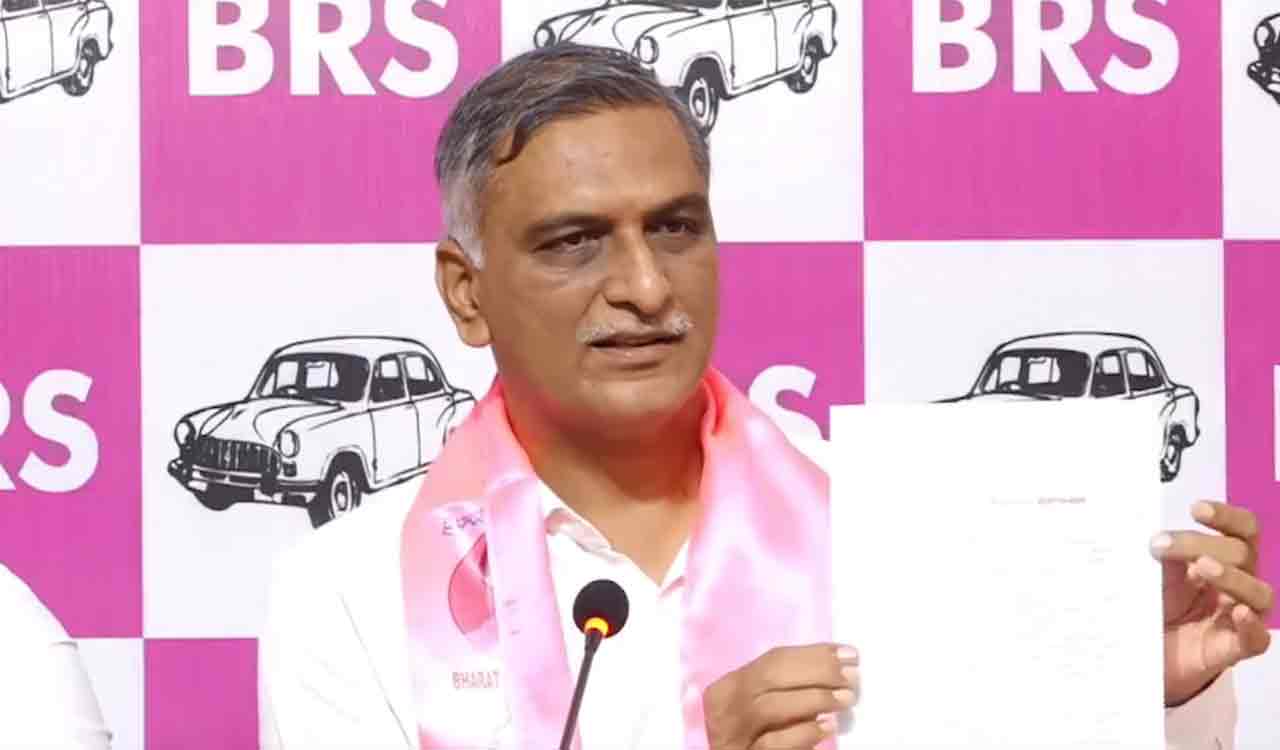
In a detailed three-hour presentation on “River Waters and Congress Betrayals” at Telangana Bhavan on Sunday, Harish Rao refuted the allegations made by the Congress government in the Assembly, terming them misleading. He slammed the successive Congress and TDP governments in erstwhile Andhra Pradesh for systematic injustice to Telangana.
Despite Telangana accounting for nearly 68 per cent of the Krishna River basin area, it was allotted only 34 per cent (299 TMCft) of the assured water, while Andhra Pradesh which has 32 per cent of the basin, received 66 per cent (512 TMCft).
“This skewed 66:34 ratio was a Congress legacy that condemned Telangana to decades of drought, distress migration and agrarian hardship, affecting erstwhile Mahabubnagar district,” he said.
The previous BRS government had resisted this formula, only for the present Congress regime to quietly restore it in 2024, he said, adding that by doing so, the Revanth Reddy government had surrendered Telangana’s interests to appease Andhra Pradesh and the Centre.
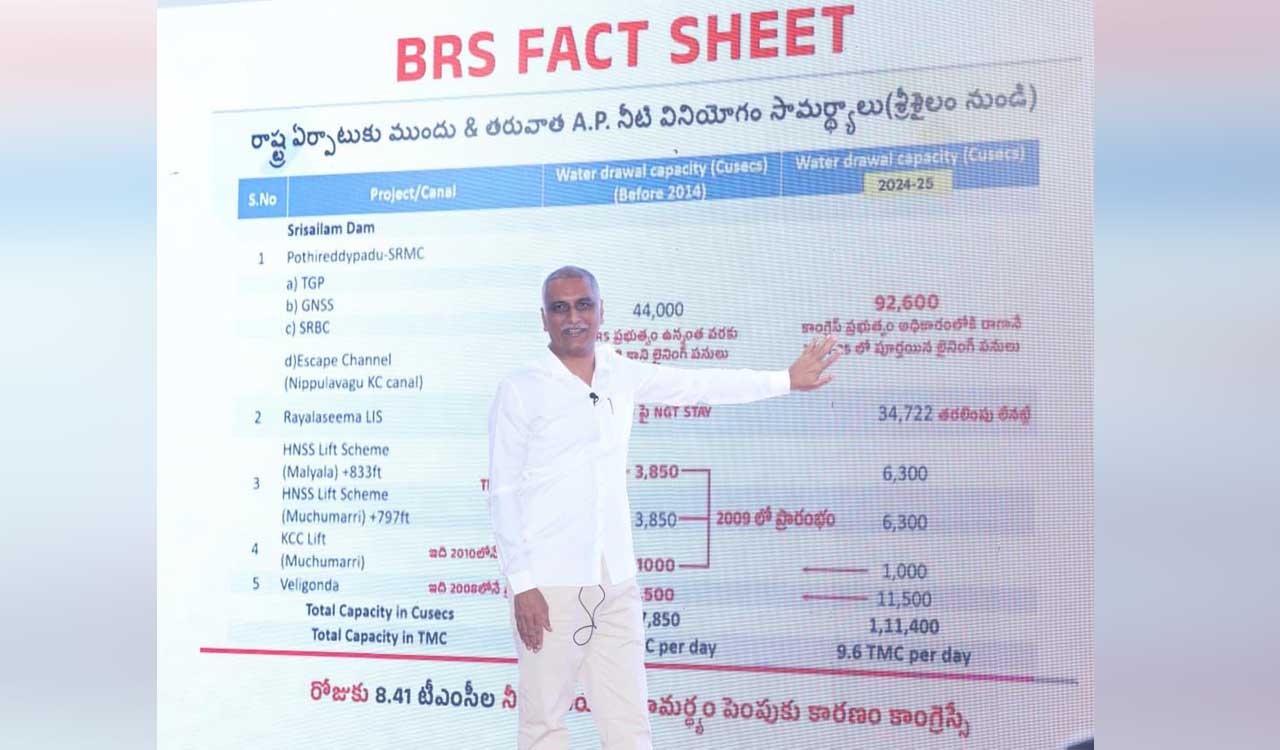
The BRS leader took strong exception to claims made by the Chief Minister in the Assembly that the BRS had accepted the 299 TMCft allocation. He said only select portions of official correspondence were cited by Revanth Reddy, while suppressing the operative clause that termed the arrangement a temporary measure. By doing so, the Chief Minister had not only misled the Assembly, but also the people of Telangana, he said, demanding that Revanth Reddy resign if he had any moral values left.
Tracing the roots of the dispute, Harish Rao stated that ignoring the Fazal Ali Commission’s warning against the merger of Telangana with Andhra Pradesh, the Congress betrayed the people of Telangana.
He said irrigation projects inherited from the Hyderabad State era were cancelled or diluted under Congress rule, with projects such as Itchampally and Devanur scrapped and Nagarjuna Sagar’s benefits diverted. He said Telangana was reduced to a supplier of water without rights, with canals left unfinished and farmers neglected.
The former Irrigation Minister explained the injustice which continued even after bifurcation. He said the Andhra Pradesh Reorganisation Act failed to provide for Krishna water reallocation under Section 3 of the Inter-State River Water Disputes Act, forcing Telangana into prolonged legal and tribunal battles. Key projects like Palamuru-Rangareddy, Dindi and SLBC, were excluded from statutory protection, leaving them vulnerable to political neglect.
Contrasting this with the period between 2014 and 2023, Harish Rao said Telangana witnessed an unprecedented irrigation push. In nine-and-a-half years under BRS, irrigation facility was achieved for 48.74 lakh acres ayacut including 17.24 lakh acres of new ayacut and 31.51 lakh acres of stabilisation. This was higher than 42 lakh acres of ayacut created in Telangana of erstwhile Andhra Pradesh in over six decades. Mission Kakatiya revived tanks across the State, restoring irrigation to nearly 25 lakh acres.
He also highlighted statutory consolidation of Telangana’s rights, pointing to Central Water Commission clearances secured for 933 TMC of the 968 TMC allocated to the State in the Godavari basin. He said these approvals gave Telangana legal and technical strength that the present government was now squandering.
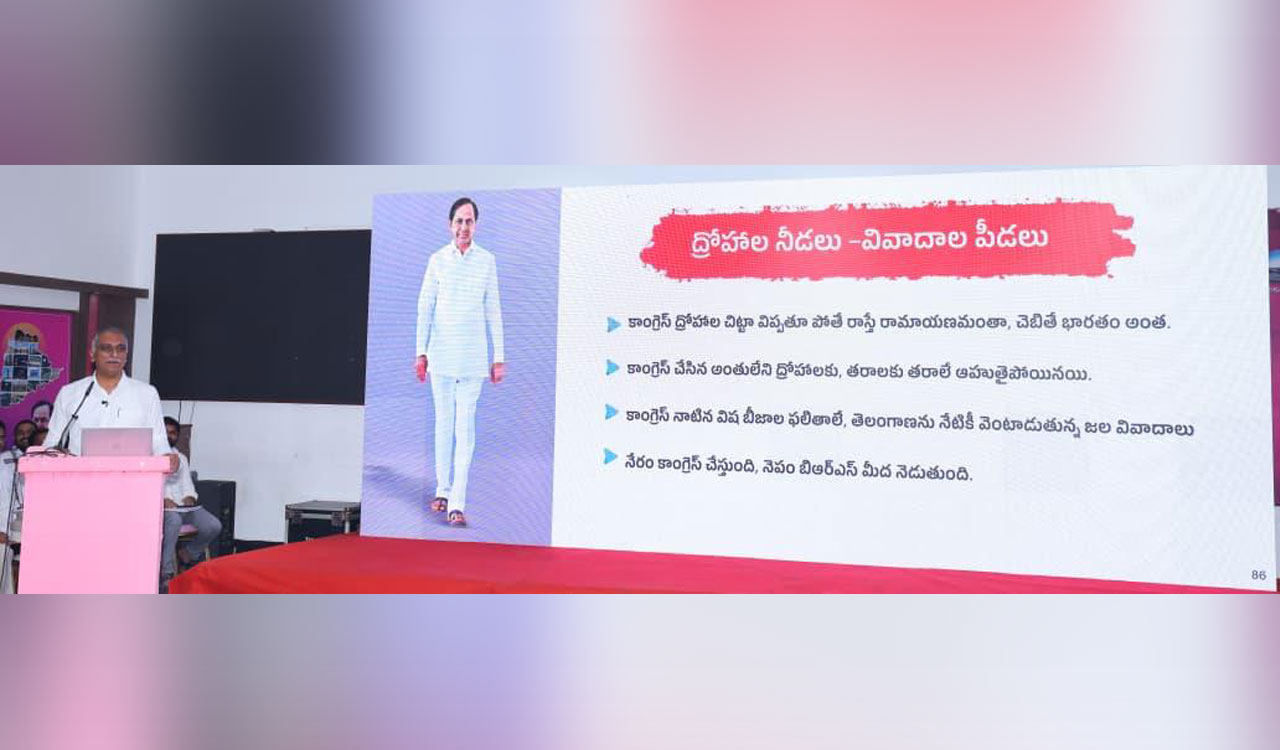
Criticising the Congress government’s handling of ongoing projects, the BRS leader accused it of surrendering Krishna projects to the Krishna River Management Board, resulting in Telangana recording its lowest-ever utilisation of Krishna waters. In 2024–25, Andhra Pradesh drew over 71 per cent of the river’s waters, leaving Telangana with just 28.49 per cent which is an outcome he described as unprecedented and indefensible.
He also questioned stalled works and policy flip-flops, citing the collapse of SLBC works, shifting positions on Palamuru-Rangareddy project capacity, and tacit acceptance of the contentious projects in Andhra Pradesh including Polavaram backwaters and the Rayalaseema Lift Irrigation Scheme, which he said posed a direct threat to Telangana’s allocations.
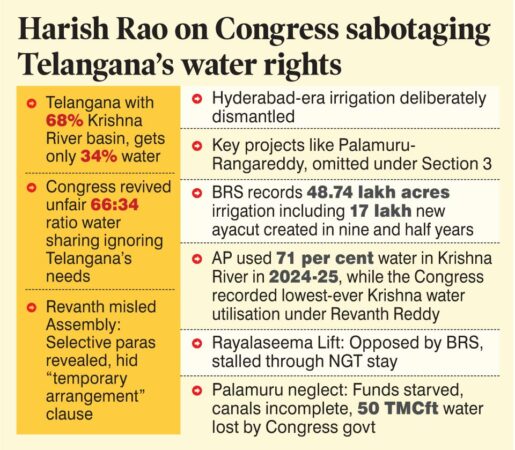
Ridiculing claims that the Rayalaseema Lift project was halted due to Revanth Reddy’s intervention, Harish Rao said Telangana had opposed it from the outset. He reminded that objections were formally raised in January 2020, months before Andhra Pradesh issued a government order, followed by firm opposition in the Apex Council and a case in the National Green Tribunal. He said the stay obtained in February 2021 effectively halted the project well before the change of government.
On Palamuru-Rangareddy Lift Irrigation Project, Harish Rao accused the Congress of perpetuating historical neglect by excluding the project from the 11th Schedule at the time of state formation and now starving it of funds.
He stated that the failure to complete canals under Package-3 alone, cost Telangana the chance to store nearly 50 TMC this year. He felt that shutting down Kaleshwaram project entirely after structural damage, instead of undertaking limited repairs, was another evidence of deliberate obstruction.
Dismissing allegations that the Palamuru-Rangareddy project capacity was reduced or that no work was done, he said the project was launched with Rs 27,000 crore from State funds in anticipation of allocations under Section 3 which was secured by the Chandrashekhar Rao government after sustained pressure through Apex Council interventions and a Supreme Court battle.

Related News