Rewind: Pricey South: Why is inflation rising faster in Southern India?
While prices have risen across India, southern States, particularly Telangana, have consistently recorded inflation rates above the national average in recent months. What is fueling this gap?


By Dr Kedar Vishnu, Dr Vaishnavi Sharma, Dr Suresh Gopal
Inflation has once again emerged as a major concern amid heightened global uncertainty. A weaker rupee (at Rs96/$ by the end of May) has increased the cost of imports, while surging crude oil prices (from $71 to $108 per barrel) are placing additional pressure on India’s import bill and widening the Current Account Deficit (CAD).
Last week, crude oil prices fell nearly 5% to $78.96 per barrel, their lowest level since March, as easing geopolitical tensions between the US, Israel, and Iran improved expectations of global oil supply. Even though crude prices declined in the third week of June 2026, inflation concerns persist.
However, not all States are experiencing the impact of inflation equally. Several southern States have recorded inflation rates higher than the national average in the past four months. But first, what is driving inflation higher across India?
Supply Shocks
Due to the global uncertainty amid the West Asia crisis, India’s WPI inflation has shown a clear upward trend over the past four months of 2026, increasing from 1.19% in January 2026 to 2.18% in February, then 8.26% in April, and a sharp 9.86% in May, compared to the corresponding months of the previous year (2025). These global supply shocks have significantly contributed to the increase in WPI inflation for manufactured products, fuel, and power.
Primary articles — food and non-food — inflation (year on year) rose sharply to 3.78% in April 2026 and further to 4.99% in May 2026. This increase was mainly driven by a steep rise in non-food articles, particularly oilseed inflation. Under WPI, food inflation remained below 2% over the past five months, except in May, when it reached 3.60%.
Fuel and power inflation showed a sharp reversal in early 2026, moving from –3.37% (deflation) in February to +3.20% in March, then rising further to a staggering 24.89% in April and 30.33% in May, compared with the corresponding months of the previous year. Compared to developed countries, many developing countries are experiencing high inflationary pressures largely due to their heavy reliance on oil imports. India imports about 90% of its crude oil and nearly 50% of its natural gas requirements.
Declining foreign direct investment (FDI), coupled with oil supply shocks, has left developing nations in a difficult position. In addition, certain policies adopted by developed countries restricting trade with many developing nations have further exacerbated these challenges, widening the imbalance between developed and developing economies.
The rise in wholesale inflation has also gradually translated into higher retail inflation in recent months. Consumer Price Index (CPI) inflation has also risen sharply in recent months, steadily from 1.33% in December 2025 to 3.93% in May 2026. Here, food inflation, which had briefly turned negative (-2.71% in December—an anomaly driven largely by a good harvest), rebounded sharply: 2.13% in January, 3.47% in February, 4.2% in April and 4.78% in May 2026. The average Indian consumer has been hit hard.
Why Kerala Pays More
Kerala recorded significantly higher inflation in December 2025, driven by sharp year-on-year increases in key commodities. The surge was primarily led by silver (97.07%), gold (68.66%), coconut oil (61.70%), and coconut copra (59.33%), along with moderate rises in food items such as chicken (6.22%), eggs (4.76%), and fish & prawns (4.94%).
In recent months, however, the State’s inflation has moderated substantially. It stood at 3.77% in April, 4.30% and in May 2026. One of the major reasons for this moderation can be attributed to the West Asia conflict, which has cut remittances from the Gulf nations, where a major diaspora from the State is employed.
Costly Telangana
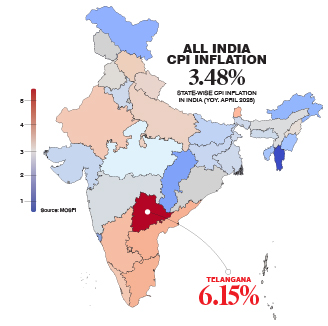
Telangana consistently recorded the highest CPI inflation in recent months, rising from 5.81% in March 2026 to 5.88% in April 2026 and 6.16% in May 2026. This is partly because the State imposes 35.2% VAT on petrol and 27% on diesel. According to the latest data from the Petroleum Planning and Analysis Cell, the State ranks first in India in terms of fuel taxation. Inflationary pressures have also been aggravated by higher fertilizer prices, which have adversely affected the State, with rural areas recording even higher inflation (6.6%).
It was followed by Tamil Nadu (4.18% in April and 5.11% in May), Andhra Pradesh (4.20% in April and 4.90% in May), and Karnataka (4% in April and 4.59% in May). These inflation rates were significantly higher than the national average CPI inflation rate of 3.48% in April 2026 and 3.93% in May 2026. It is also worth noting that inflation rates increased further in all four States in May. What factors can be attributed to this phenomenon?
Consumption, Migration, Services
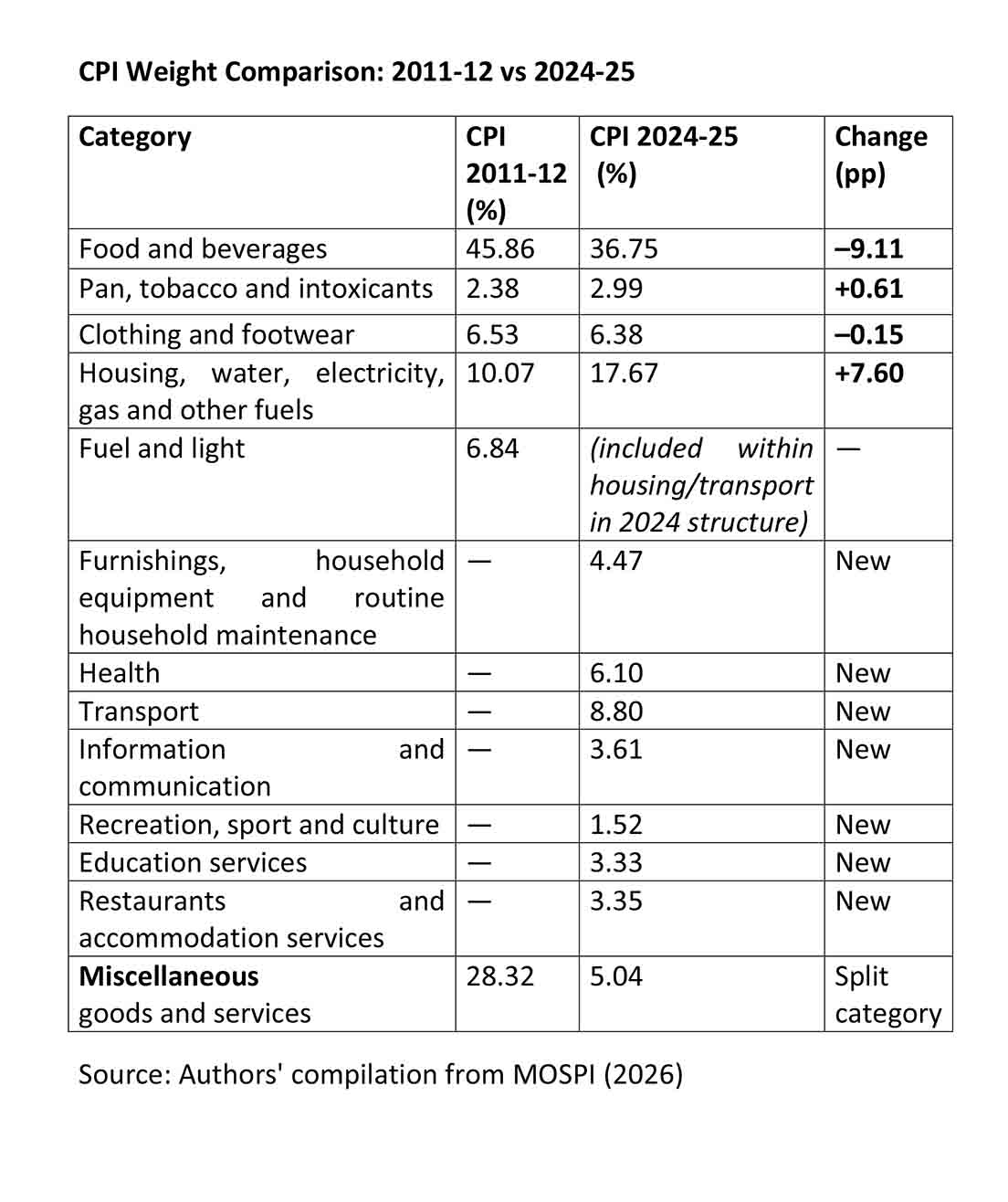
Inflation is higher partly due to changes in the weight of the recent CPI series, which have had a greater impact on the southern States. The weight of food items has declined significantly from 46% to 37%, while the weight for services such as housing, transport, and other non-food categories has increased. Since the share of expenditure on these items is relatively higher in the southern States than in the northern States, inflation has remained elevated.
Inflationary pressures remained high in April 2026, largely driven by persistently high prices of precious metals and coconut products. While overall inflation showed slight moderation compared to March, prices of silver jewellery (148.6%, up from 144.9%), gold, diamond, and platinum jewellery (45.8%, up from 40.7%), and coconut or copra (45.5%, up from 44.5%) continued to exert significant upward pressure, keeping inflation elevated.
Expenditure on these items is relatively higher in the southern states. In May 2026, higher prices of silver jewellery (155.23%), tomato (48.43%), and gold jewellery (40.93%), along with rising fuel and education costs, were key drivers of inflation in southern India.
Furthermore, increased migration from Bihar, Uttar Pradesh, Jharkhand, and Odisha to southern States has boosted consumer spending and consequently demand for consumer goods. An SBI study published in 2025 documented that the southern States experience higher retail inflation for food commodities, especially due to migrant-led demand growth. This is a typical example of how inflation is inevitable in a growing economy.
Another significant factor intensifying inflation in these states is the higher literacy levels and the service-oriented nature of the workforce. Household spending patterns, therefore, differ considerably from those of a typical household in the north. Expenditure is relatively higher on professional services and lifestyle amenities such as schools, healthcare facilities, gyms, and premium services. From a fiscal perspective, relatively higher debt-to-GDP ratios and fiscal deficits in several southern states have supported increased public spending, which, while growth-enhancing, has also contributed to elevated price levels.
Cooling Inflation
To address inflation, the RBI has so far adopted a cautious, balanced approach. In its June 2026 meeting, the Monetary Policy Committee decided to keep the repo rate (rate at which it lends to banks) unchanged at 5.25%.
Even as the rupee has depreciated and inflationary pressures remain elevated, the RBI may continue keeping interest rates unchanged for at least a few more months. But in the long run, a contractionary monetary policy may become necessary to address inflation. Otherwise, labour may begin to expect higher wage rates, and once wage rates rise, inflation becomes far more difficult to control.
To reduce the impact of supply-side shocks in fuel and oil, states with higher inflation, particularly southern States such as Telangana and Karnataka, may need to reconsider the relatively high VAT imposed on diesel and petrol to mitigate the impact of rising crude oil prices.
At the same time, the government should gradually shift its focus away from temporary support measures, such as free electricity and direct cash transfers, towards building and promoting environmentally sustainable alternatives. Electric and hybrid vehicles continue to witness limited adoption in India.
Containing inflation will also require a sharper focus on supply-side resilience amid growing global uncertainty. With the India Meteorological Department warning of a possible rainfall deficit this agricultural year, policymakers must act early to protect agricultural output. Cutting post-harvest losses, strengthening storage and logistics infrastructure, and encouraging diversification in consumption can help ease pressure on key commodities.
Key Revisions in CPI and WPI
The revised WPI series (Base Year 2022–23) expands the commodity basket from 697 to 957 items. Renewable energy sources such as solar, wind, and nuclear power have been added, while crude petroleum and natural gas have been moved to the Fuel and Power category to better track energy prices. The new series also adopts Gross Value of Output (GVO)-based weights (share of total production value contributed by a sector, product, or industry) and improved estimation methods. WPI will be published alongside the newly introduced Producer Price Index (PPI) for five years before being gradually phased out.

(Dr Kedar Vishnu is Associate Professor of Economics at Department of Liberal Arts, Humanities & Social Sciences, Manipal Academy of Higher Education, Bengaluru. Dr Vaishnavi Sharma is an economist with a PhD from Indira Gandhi Institute of Development Research [IGIDR], Mumbai. Dr Suresh Gopal is Associate Professor of Finance, Symbiosis Institute of Business Management, Bengaluru)

Related News