Hyderabad’s new Burj at Masab Tank set to become iconic landmark
Hyderabad’s new Burj at Masab Tank, built by Deccan Terrain Heritage, combines ancient Deccan architecture with modern design, featuring a hexagonal structure, chiming tower clocks, and a Madras terrace roof. It marks 157 years of municipal administration.
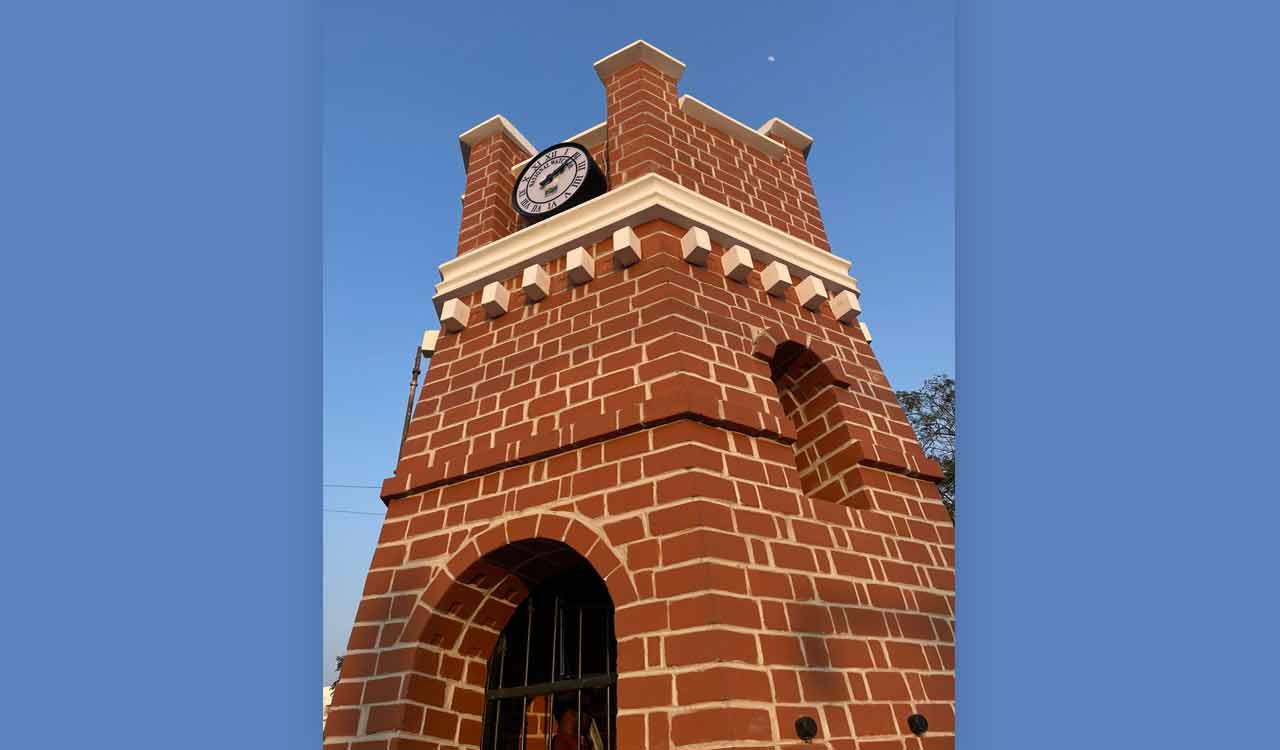


Hyderabad: Hyderabad now has a new landmark with the construction of the new Burj (a watchtower) or Bastion, at Masab Tank, which will shortly be inaugurated.
The Deccan Terrain Heritage, which designed and built the Burj for GHMC, has revived the ancient construction techniques, with a hexagonal design. The sides of the structure are 10 feet wide at the base and taper as the tower reaches a 20-foot height.
The top parapet and crenellations follow a straight line, with offsets designed to house chiming tower clocks on three sides. The inclined parapet design is inspired by the Public Gardens entrance gate and Yousuf Tekri in Tolichowki.
A Burj, or bastion, is a strategically placed tower with a stable platform that serves as a standalone watchtower or as part of a line of towers built at intervals along a fortification wall.
Prominent bastions include the 87 bastions of Golconda Fort in Hyderabad, Shah Burj at the Red Fort in Delhi, Diya Burj at Jaigarh Fort in Rajasthan, and Hyder Burj in Bijapur. At Golconda Fort, the Musa Burj and Petla Burj were built at strategic locations to provide vantage points for guards and stable platforms for mounting cannons during battle.
This structure has been built using pure lime mortar and compressed stabilised earth blocks. Roofing and structure features a Madras terrace roof at a height of 14 feet, resting on double-packed inverted brick and lime load-bearing masonry. Arched doors and windows are strategically placed to utilise natural airflow while providing a scenic viewpoint.
“A modern tribute to heritage, this modern Burj project by Deccan Terrain Heritage aims to showcase the heritage fabric and the legacy of the city by integrating traditional art, craft, and ancient architecture of Deccan Plateau into the modern urban landscape, including crossroads, medians, and public areas. It serves as a landmark marking 157 years of municipal administration service, spanning from 1869 to 2025,” said Mir Khan, conservator in chief, Deccan Terrain Heritage.

Related News