India–EU Free Trade Agreement: Key benefits, and what it means for Indian exports
India has safeguarded sensitive sectors, including dairy, cereals, poultry, soymeal, certain fruits and vegetables, balancing export growth with domestic priorities
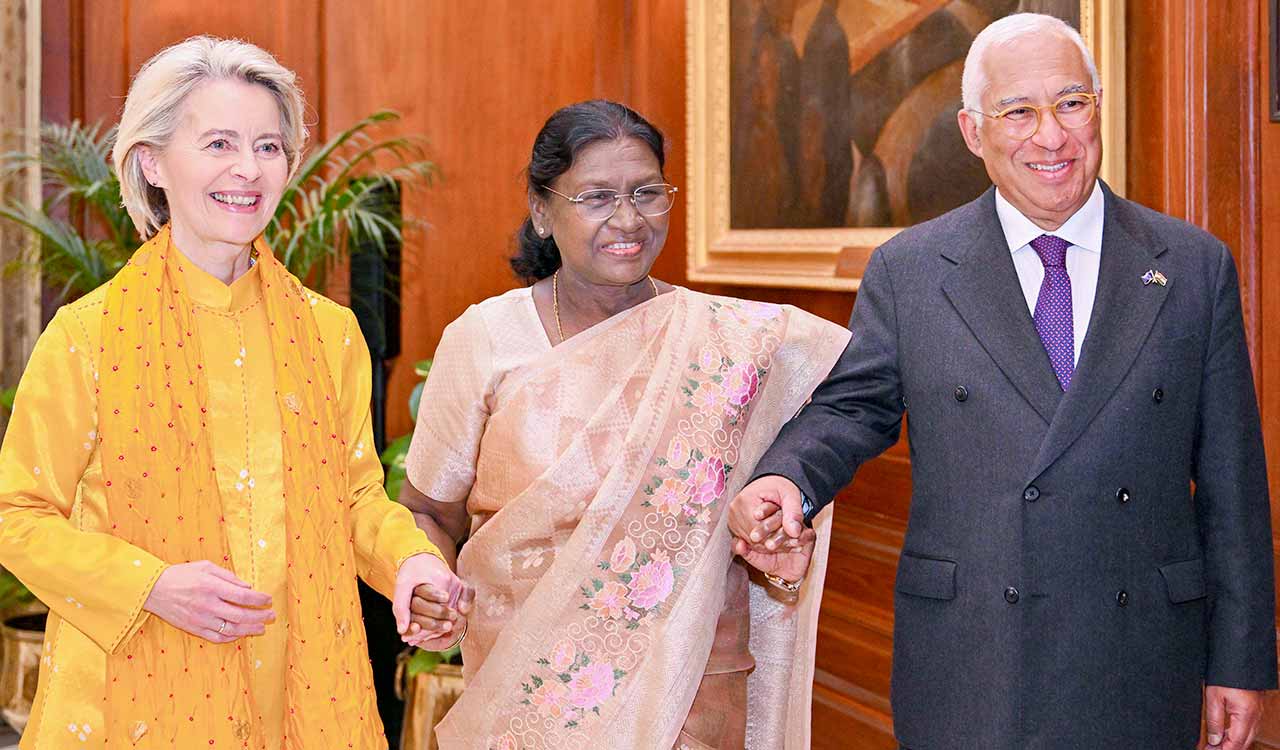


New Delhi: India and the European Union (EU) on Tuesday announced the conclusion and finalisation of negotiations for the proposed free trade agreement (FTA). This will be the 19th trade deal for India. The FTA will help boost the country’s exports to the 27-nation bloc.
Since 2014, India has finalised seven trade pacts — Mauritius (April 2021 implemented), Australia (December 2022 implemented), UAE (May 2022 implemented), Oman (signed in December 2025), UK (signed in July 2025), EFTA (implemented in October 2025 – Switzerland, Iceland, Liechtenstein, Norway), and New Zealand (talks concluded in December 2025).
The imposition of high tariffs by the US has disrupted the global flow of goods. India is facing steep 50 per cent tariffs. The FTA is expected to help Indian exporters diversify their shipments. It will also help reduce dependence on China. The EU is also facing a threat of high US tariffs.
Benefits for India
- India has gained preferential access to the European markets across 97 per cent of tariff lines, covering 99.5 per cent of trade value.
- 70.4 per cent tariff lines covering 90.7 per cent of India’s exports will have immediate duty elimination for labour-intensive sectors, such as textiles, leather and footwear, tea, coffee, spices, sports goods, toys, gems and jewellery and certain marine products.
- 20.3 per cent tariff lines covering 2.9 per cent of India’s exports will have zero duty access over 3 and 5 years for certain marine products, processed food items, arms and ammunition
- 6.1 per cent tariff lines covering 6 per cent of India’s exports will have preferential access by way of tariff reduction for certain poultry products, preserved vegetables, and bakery products, among others or through tariff rate quotas (TRQs) for cars, steel, and certain shrimps.
- USD 33 billion worth of exports that are currently subjected to import duty between 4-26 per cent in the EU will enter at zero duty from the entry into force of the FTA.
- Preferential market access for agricultural products like tea, coffee, spices, grapes, gherkins and cucumbers, dried onion, fresh vegetables and fruits, as well as for processed food products, will make them more competitive in the EU.
- India has safeguarded sensitive sectors, including dairy, cereals, poultry, soymeal, certain fruits and vegetables, balancing export growth with domestic priorities.
Benefits for EU
- Overall, India is offering 92.1 per cent of its tariff lines, which cover 97.5 per cent of the EU exports.
- 49.6 per cent of tariff lines will have immediate duty elimination.
- 39.5 per cent of tariff lines are subject to phased elimination over 5, 7, and 10 years. *3 per cent of products are under phased tariff reductions, and a few products are subject to TRQs for apples, pears, peaches, and kiwi fruit.
- Imports of the EU’s high technology goods are expected to diversify India’s import sources, thereby reducing input costs for businesses, benefiting consumers.
- Duty will be eliminated for olive oil, margarine and other vegetable oils, fruit juices and non-alcoholic beer, processed food (breads, pastries, biscuits, pasta, chocolate, pet food) and sheep meat.
- Duty will be reduced for wines, beer, spirits, kiwi, pears, and sausages and other meat preparations.
Bilateral Trade
India’s bilateral trade in goods with the EU was USD 136.53 billion in 2024-25 (exports worth USD 75.85 billion and imports worth USD 60.68 billion), making the EU India’s largest goods trading partner.
The EU market accounts for about 17 per cent of India’s total exports, and the bloc’s exports to India constitute 9 per cent of its total overseas shipments.
India’s Exports and Imports
Major exports are petroleum products (diesel and ATF), electronics (including smartphones), textiles, machinery and computers, organic chemicals, iron and steel, gems and jewellery, pharmaceuticals, and auto parts.
Main imports are machinery, computers (including turbojets), electronics (including mobile phone parts and integrated circuits), aircraft, medical devices, scientific instruments, rough diamonds, organic chemicals, plastics, iron and steel, cars, and auto parts.
India’s key services exports to the EU are business services, telecommunications and IT, and transportation services, while imports are intellectual property services and telecommunications and IT.
Alcohol Trade
Both regions are key players in this segment. India’s exports to the EU in 2023-24 included wines (USD 1.5 million), blended whiskeys, vodka, brandy, and liqueurs (USD 64.9 million). Imports included wines (USD 412.4 million), blended whiskeys, brandy, gin, tequila, vodka, and liqueurs (USD 22.3 million).
FDI Inflows
India’s cumulative FDI inflows from the EU from April 2000 to September 2024 totalled USD 117.4 billion, with about 6,000 EU firms operating in India. FDI from the EU accounted for 16.6 per cent of the cumulative FDI equity inflows from all countries, which stood at USD 708.6 billion.
India mainly receives FDI from the Netherland (USD 55 billion) during April 2000 and September 2025), Germany (USD 15.4 billion), France (USD 12 billion), Spain (4.3 billion), Belgium (USD 4.1 billion), Italy (3.65 billion), Sweden (USD 2.8 billion), Denmark (USD 1.44 billion), and Poland (USD 788.75 million).
Long Negotiations
The India-EU FTA negotiations began in 2007. Initially, from 2007 to 2013, multiple rounds of negotiations took place but were hindered by disagreements over market access, intellectual property rights, labour standards, and sustainable development.
By 2013, the talks hit a standstill, particularly due to differences over tariffs on automobiles, wine, spirits, data security for Indian IT firms, and public procurement. Despite efforts to revive negotiations between 2016 and 2020, substantial progress remained elusive. However, post-2020, both India and the EU showed renewed interest in resuming talks.
In June 2022, negotiations were relaunched for a Free Trade Agreement, an Investment Protection Agreement, and an Agreement on Geographical Indications (GIs). Talks for the GI pact and a bilateral investment treaty are going on.

Related News