Milestones in Indian Constitution
Long before independence, our leaders engaged intensely with constitutional thought—experimenting, rejecting, and refining multiple legal and political frameworks


By Manish Narwade
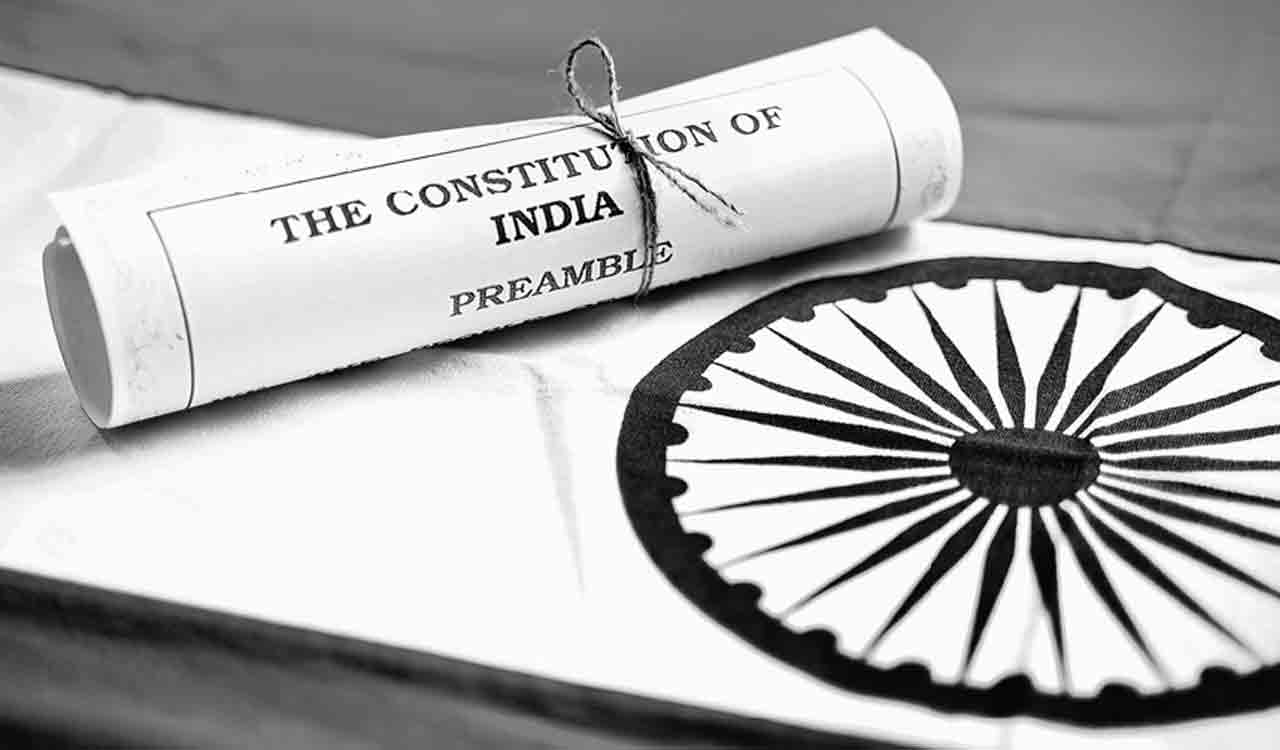
Indian democracy did not begin on the morning the Constitution came into force. The Constitution, in its final shape, went through many phases—it was thoroughly argued, debated, and crafted over decades of dissent. The ideals India adopted in 1950—sovereignty, socialism, secularism, democracy, and the promise of justice, liberty, equality, and fraternity—were not merely borrowed but emerged from a long and layered process that blended India’s social realities and political traditions with global constitutional ideas.
Today, many of these ideals are being tested. Debates over majoritarian politics, protectionist economic choices, migration, state finances, the role of governors, and the balance of power between the Centre and the States reveal persistent constitutional anxieties. At a time when shifting global political and economic pressures are prompting many nations to rewrite their constitutions, India’s constitutional journey offers a contrast. Long before independence, our leaders engaged intensely with constitutional thought—experimenting, rejecting, and refining multiple legal and political frameworks. As the country marks its 77th Republic Day, revisiting this constitutional evolution is not merely commemorative. These earlier laws and drafts shaped the Constitution adopted in 1949 and remain essential to understanding India’s struggle for self-governance and democratic principles.
The origins of the Indian Constitution can be traced to the Constitution of India Bill of 1895, popularly known as the Swaraj Bill, which is believed to have been written by Tilak. It was the first articulation of a constitution by Indians and the first non-official attempt to draft a constitution for India.
Indian Councils Act, 1909
The Indian Councils Act, popularly known as the Morley–Minto Reforms (named after the Viceroy and the Secretary of State), was the first step towards including Indians in government. The Act consisted of eight articles and two schedules. Scholars like Gokhale welcomed the provisions of the 1909 Act and regarded it as a step forward from colonial rule towards parliamentary self-government. When the Act was introduced, it brought some representation, but by 1915, it had disappointed many Indian leaders. The idea of separate electorates received institutional expression in the Act; however, this idea was not adopted in the Constitution of India, where provisions for reserved seats were made instead. The Lahore session of the Congress in 1909, presided over by Madan Mohan Malaviya, expressed strong disapproval of the Act. Even though the Act introduced representation, the franchise was extremely restricted. The Act conceived electoral representation through a corporatist understanding of Indian society, representing special interests.
Government of India Act, 1919
Popularly known as the Montagu–Chelmsford Reforms, the Act consisted of 47 sections and five schedules. During its drafting, greater emphasis was placed on ensuring community rights rather than on the distribution of powers. Its provisions were built upon the movement initiated by the Morley–Minto Act (1909). The Act sought to ensure parliamentary responsibility for good administration and a gradual transfer of authority towards responsible government, leading to the development of a bicameral legislature. This arrangement later continued in independent India through the Lok Sabha and the Rajya Sabha, giving states a role in lawmaking at both the central and state levels and promoting diversity and inclusion. Montagu described this Act as the “progressive realisation of responsible government in India as an integral part of the British Empire.”
Annie Besant dismissed the reforms as “unworthy of England to offer and India to accept.” Ambedkar, in a lecture to his students in 1923, referred to the Government of India Act, 1919, as the “British Constitution of India.” The Act remained ambiguous and reflected India’s colonial status. However, the parliamentary system at the provincial level turned politics into the exclusive domain of “a class of intermediaries.”
Nehru Report
The Nehru Report was one of the documents that defined the goal of a future constitution in terms of advancing India’s unity through democratic institutions based on universal suffrage. It marked an important moment in the evolution of Indian nationalism’s relationship with mass politics and was one of the first constitutional visions of a free India under the guidance of Pandit Motilal Nehru. The Nehru Report was also an attempt by Indians to address the challenges of communalism, an issue that India continues to face today in debates around the CAA, NRC, mob lynching, and growing majoritarianism. Some of the rights in the Nehru Report bear resemblance to the American Constitution. The rights included in this predominantly liberal constitution were extraordinary for their time. Although it was also known as an anti-separatist manifesto, the report was widely debated.
Karachi Resolution
The Karachi Congress met at a time when Gandhi had called for a truce with the British and sought to negotiate a pact with the Viceroy, Lord Irwin, in February 1931. The Fundamental Rights Resolution adopted at Karachi remained a significant document for the drafters of the Indian Constitution and was later incorporated into the Fundamental Rights and the Directive Principles of State Policy (DPSP). Mohammad Tahir, during the Constituent Assembly debates, noted that the Karachi Resolution had provided for state control over key industries and mineral resources and argued that the same provision should have been included in the DPSP. This economic radicalism of the Karachi Resolution was not abandoned. Its spirit lived on in the minds of India’s constitutional makers and was absorbed, in moderated form, into Articles 39(b) and 39(c) of the Directive Principles of State Policy.
However, all the rights from the Karachi Resolution—except the right to bear arms—were incorporated into Parts III and IV of the Constitution of 1950. Both Nehru and Gandhi played prominent roles in editing the document and guiding it through Congress committees to its final form. The Fundamental Rights Resolution represented a landmark, as it not only guided the anti-colonial struggle but also forged a compromise among nationalist, liberal, and socialist ideologies, which is visible in the original Constitution.
Government of India Act, 1935
The Government of India Act, 1935, was at the time the longest piece of legislation passed by the Parliament of the United Kingdom. The Act brought a measure of stability to colonial India by placing the Princes, the Muslim League, and the Congress in architectural opposition to one another. Its importance is evident from the fact that it was referred to more than 500 times in the Constituent Assembly debates. In Communal Deadlock and a Way to Solve It, Dr BR Ambedkar argued that there was no need to form a Constituent Assembly, as the Constitution of India had already been written in the Government of India Act, 1935, requiring only the removal of provisions inconsistent with Dominion status.
The Act greatly expanded the powers of the Governor-General, prompting Winston Churchill to remark that it would arouse Mussolini’s envy. Scholars like Andrew Muldoon have argued that it was “arguably the most significant turning point in the history of British administration in India.” Madan Mohan Malaviya described it as “somewhat democratic in appearance but completely hollow from inside,” while Muhammad Ali Jinnah termed it “thoroughly rotten, fundamentally bad and totally unacceptable.” Viceroy Lord Linlithgow noted that the Act was the best way to maintain British influence in India. At the same time, leaders like Nehru saw it as a prelude to greater disunity, famously calling it “all brakes, no engine.”
Constitution of Free India: A Draft (M.N. Roy, 1944)
Published in 1944, MN Roy’s draft Constitution is often compared with the Gandhian Constitution of Free India and represents a more radical vision of a new India. Though largely academic in nature, Roy’s proposals avoided appeals to ancient constitutions or premodern traditions and instead articulated a modern democratic vision.
Sapru Committee
The Sapru Committee aimed to resolve issues relating to minorities. Its 343-page report offered detailed reflections on India’s constitutional future. Norman Brown described it as one of the most reflective presentations of constitutional issues, summarising its discussions on Hindu–Muslim relations, Pakistan, and federal structure. VP Menon noted that the absence of Muslim members may have contributed to hostility towards the report. The Committee also advocated a strong Centre. Several of its key ideas—particularly minority safeguards, judicial review, and a strong Centre—were later incorporated into the Constitution of independent India.
Gandhian Constitution for Free India (Shriman Narayan Agarwal, 1946)
The Gandhian Constitution was drafted not by Gandhi himself but by Shriman Narayan Agarwal, though Gandhi wrote its foreword, stating that it was “based on his study of my writings” and was “not inconsistent with what I would like to stand for.” Principles such as the right to a minimum living wage, rest, and medical freedom were emphasised. The draft was based on self-sufficient village panchayats and reflected Gandhian ideas of decentralisation and non-violence. Similarities existed between the Gandhian Constitution and the Radical Democratic Party’s Constitution of Free India, particularly in their emphasis on local citizen assemblies, recall, referendum, and succession. Parts of this vision influenced the Directive Principles of State Policy.
Draft Constitution of the Republic of India (Socialist Party, 1948)
In the foreword, Jayaprakash Narayan stated that the draft had “failed to enthuse the country” due to its cautious and conservative approach, though it placed strong emphasis on the Directive Principles. However, little scholarly work exists on this draft.
The Constitution of India, 1949
The Constitution of India of 1949 was the outcome of a long and contested constitutional struggle rather than a single founding moment. Shaped by sustained debate and compromise, it was designed not as a static legal document but as a framework capable of creative reinterpretation to meet changing social, political, and economic needs. Its evolution has depended on a continuing partnership between the legislature, the executive, and the judiciary. BR Ambedkar, the architect of the Constitution, emphasised constitutional morality, stating that “constitutional morality is not a natural sentiment. It has to be cultivated.” On January 26, 1950, India became a Republic, completing its transition from colonial subjugation to independence and finally to constitutional self-rule. This moment did not mark the end of India’s constitutional journey, but the beginning of a demanding democratic experiment grounded as much in moral commitment as in legal form.

(The author is with MIT Vishwaprayag University. Views are personal)

Related News