New study may help make spinach leaf look like lettuce
New Delhi: A new study could help introduce innovations in the food industry as it could help change the shape of the salad leaves as one desires. Plants have either ‘simple’ or ‘compound’ leaves. A mango tree, for example, is considered to possess ‘simple’ leaves because they have a single, intact leaf blade. A Gulmohar […]
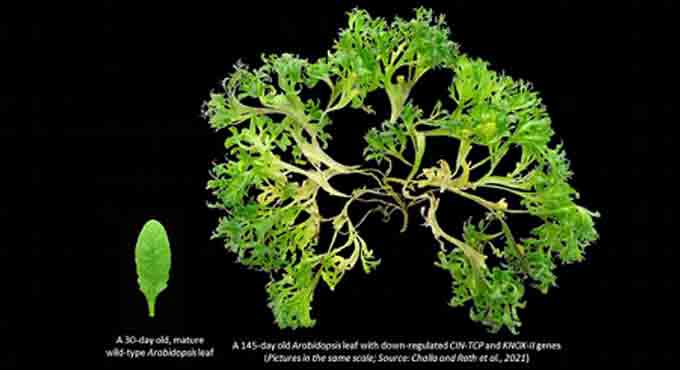


New Delhi: A new study could help introduce innovations in the food industry as it could help change the shape of the salad leaves as one desires.
Plants have either ‘simple’ or ‘compound’ leaves. A mango tree, for example, is considered to possess ‘simple’ leaves because they have a single, intact leaf blade. A Gulmohar tree, on the other hand, has ‘compound’ leaves where the leaf blade is dissected into multiple leaflets. Both types of leaves start out as rod-like structures budding out from the meristem, the tip of the stem where stem cells are present. But, they take different shapes as they grow. The question as to how this happens has been a subject of much investigation.
The new study was conducted to help unscramble the puzzle. It has shed light on how `simple’ leaves develop in a plant. It has identified two gene families that regulate the development of `simple’ leaves in a plant called Arabidopsis thaliana – a popular model organism in plant biology. These gene families – CIN-TCP and KNOX-II – encode proteins called transcription factors that suppress the formation of new leaflets at the margin, thereby giving rise to `simple’ leaves.
The researchers simultaneously suppressed multiple members of the two gene families. This caused the `simple’ leaves to become `super compound’ leaves that gave rise to leaflets indefinitely. However, when they independently suppressed either of the two gene families, the leaves did not turn into compound leaves. This suggests that the genes work in concert.
In addition, the mutant leaves continued to stay young and grow for as long as they had the necessary growing conditions. While Arabidopsis leaves typically mature in around 30 days and withers by 60 days, the leaves of these mutant plants with suppressed CIN-TCP and KNOX-II gene families grew for as long as the researchers followed them (175 days) – and could potentially go on for months or years given the necessary conditions.
The study was conducted by researchers from the Department of Microbiology and Cell Biology (MCB) at the Bengaluru-based Indian Institute of Science (IISc) and their collaborators from Shodhaka Life Sciences, Bengaluru.
“While other scientists have been able to convert compound leaves to simple leaves by manipulating the expression of certain genes, our report is the first one to go the other way around,” Utpal Nath, Associate Professor at MCB and senior author of the paper, said, in an IISc press release.
The press release noted that the findings could initiate and nurture innovations in the food industry in the long run. Krishna Reddy Challa, a former Ph.D. student at MCB and co-lead author of the study, said, “One could use this technique to alter the shape of the salad leaves as one chooses or increase their biomass. For instance, you could change the shape of a spinach leaf to look like lettuce.”
Monalisha Rath, a Ph.D. student at MCB and another co-lead author of the study, said “Since the leaves don’t mature once the CIN-TCP and KNOX-II genes are suppressed, you can also control the longevity of the plant and thereby extend its shelf-life”.
The study team included A.N.Sharma, A.K.Bajpai, S.Davuluri, and K.K.Acharya. They have published a report on their work in Nature Plants.
Now you can get handpicked stories from Telangana Today on Telegram everyday. Click the link to subscribe.
Click to follow Telangana Today Facebook page and Twitter .

Related News