Nifty Next 50 vs Nifty Smallcap 250 – Understanding Their Index Construction and Portfolio Exposure
The Nifty Next 50 gives investors exposure to 50 companies that are part of the Nifty 100 but are not included in the Nifty 50. It can therefore be viewed as the segment of the Nifty 100 that comes immediately after the Nifty 50 in the index structure.
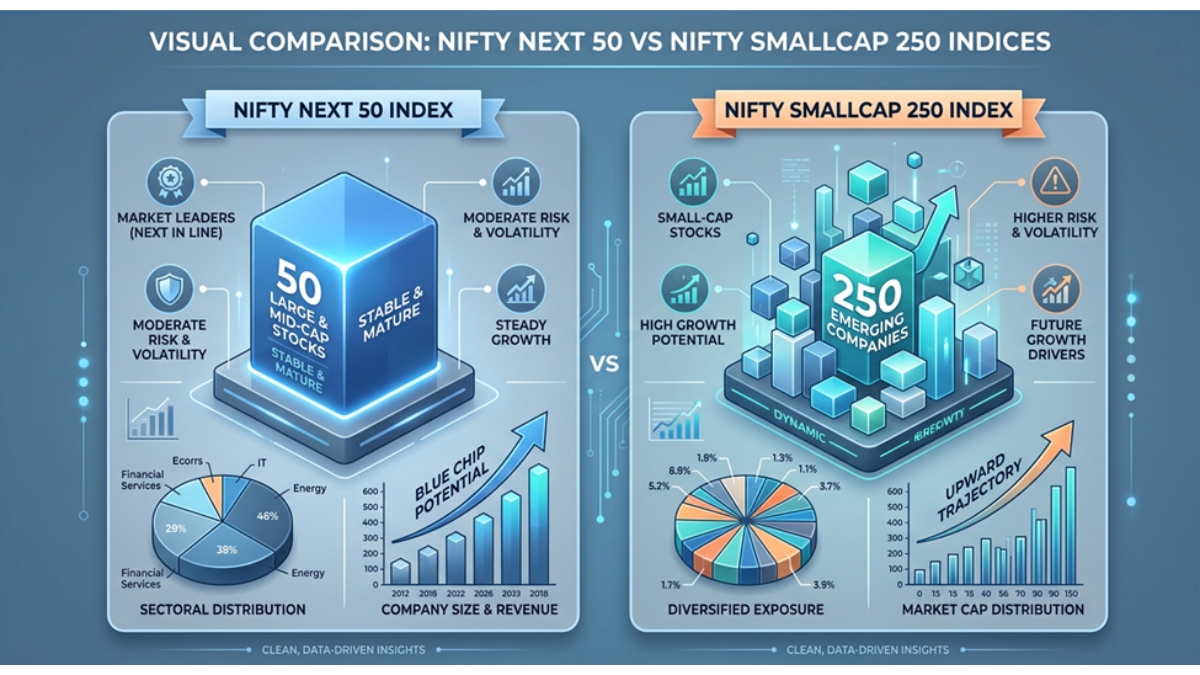


The Nifty Next 50 and Nifty Smallcap 250 represent different segments of the Indian equity market, even though both are broad based indices. Their constituent selection, market capitalisation range and weighting framework create differences in the companies they cover and the way those companies contribute to the index.
What Is the Nifty Next 50?
The Nifty Next 50 gives investors exposure to 50 companies that are part of the Nifty 100 but are not included in the Nifty 50. It can therefore be viewed as the segment of the Nifty 100 that comes immediately after the Nifty 50 in the index structure. As of March 30, 2026, these companies together accounted for around 11.22% of the free float market capitalisation of stocks listed on the NSE. The index was launched in 1997, with November 3, 1996 as its base date and a base value of 1,000. Since May 2009, the index has followed a free float market capitalisation based approach for assigning weights to its constituents. In practical terms, a company’s representation in the index depends on the market value of the shares that are available for public trading, relative to the other companies in the index.
What Is the Nifty Smallcap 250?
The Nifty Smallcap 250 is an index designed to represent the small cap segment of the Indian equity market. It comprises 250 companies ranked from 251 to 500 within the Nifty 500 universe, based on the index methodology. This gives the index exposure to a broader set of companies beyond the large cap segment. As of March 30, 2026, the Nifty Smallcap 250 accounted for around 8.92% of the free float market capitalisation of stocks listed on the NSE. The index therefore represents a meaningful, though smaller, portion of the overall listed equity market when measured by free float market capitalisation. For investors, the key point is that the Nifty Smallcap 250 offers a broad representation of the small cap segment, covering 250 companies across the 251 to 500 rank range of the Nifty 500.
How Their Underlying Universes Differ
The Nifty Next 50and Nifty Smallcap 250 draw their constituents from different parts of the broader Nifty index structure. This is the primary reason their portfolio characteristics can differ.
- The Nifty Next 50 is formed from the Nifty 100 after excluding the Nifty 50 constituents. Its universe therefore consists of 50 companies that are part of the Nifty 100 but fall outside the Nifty 50.
- The Nifty Smallcap 250 draws 250 companies ranked from 251 to 500 within the Nifty 500. It is therefore built around a substantially broader universe of companies belonging to the small-cap segment. Nifty Indices Methodology Document
This creates a clear difference in the size and breadth of the underlying universes. The Nifty Next 50 covers 50 companies from the upper end of the Nifty 100 outside the Nifty 50, whereas the Nifty Smallcap 250 extends across 250 companies within the 251 to 500 range of the Nifty 500. The difference in these starting universes can also lead to variations in company size, sector representation and constituent weights. Therefore, although both are broad based equity indices, they represent distinctly different portions of the Indian equity market.
How Weighting Can Affect Portfolio Characteristics
The way stocks are weighted can influence how strongly individual companies affect an index. Both the Nifty Next 50 and Nifty Smallcap 250 use the free float market capitalisation weighted methodology, so the index weight of a constituent is linked to the value of its shares that are available for public trading. This means the index does not assign the same weight to every company. A constituent with a higher free float market capitalisation will generally have a greater representation than a constituent with a lower free float market capitalisation. As a result, changes in the market value of larger constituents can have a relatively greater impact on the movement of the index.
The weighting approach also means that portfolio exposure can change as the market values of individual companies change. A stock whose free float market capitalisation rises relative to other constituents may account for a larger share of the index, while its weight may decline if its relative market value falls.
Why Sector Composition Can Differ
The Nifty Next 50 and Nifty Smallcap 250do not follow predetermined sector allocations. Their sector exposure is a result of the companies that qualify for each index and the weight assigned to those companies under the respective index methodology. Since the two indices draw constituents from different parts of the market, the industries represented in each index can vary. A sector with several companies meeting the eligibility criteria for one index may have a relatively smaller presence in the other. The size of companies within a sector and their free float market capitalisation can further influence the sector’s overall weight. Sector weights are also not permanent. As constituent companies move through the market capitalisation rankings or as their relative free float market capitalisation changes, the composition and weight of sectors within an index can change during periodic reviews and rebalancing.
Conclusion
The distinction between the two indices is relevant because their different market segments can lead to different portfolio behaviour. The Nifty Next 50 represents companies from the Nifty 100 outside the Nifty 50, while the Nifty Smallcap 250 represents companies ranked 251 to 500 within the Nifty 500. This difference matters when assessing the role of an index in a portfolio. An investment tracking the Nifty Next 50 and one tracking the Nifty Smallcap 250 may both provide diversified equity exposure, but the underlying company size, sector mix and stock weights can be different. Investors can therefore compare the current portfolio composition, largest holdings and sector weights before treating the two as alternatives. Looking at these characteristics alongside the index methodology provides a clearer picture of the exposure each index offers.
Disclaimers:
Investors may consult their Financial Advisors and/or Tax advisors before making any investment decision.
These materials are not intended for distribution to or use by any person in any jurisdiction where such distribution would be contrary to local law or regulation. The distribution of this document in certain jurisdictions may be restricted or totally prohibited and accordingly, persons who come into possession of this document are required to inform themselves about, and to observe, any such restrictions.
MUTUAL FUND INVESTMENTS ARE SUBJECT TO MARKET RISKS, READ ALL SCHEME RELATED DOCUMENTS CAREFULLY.

Related News