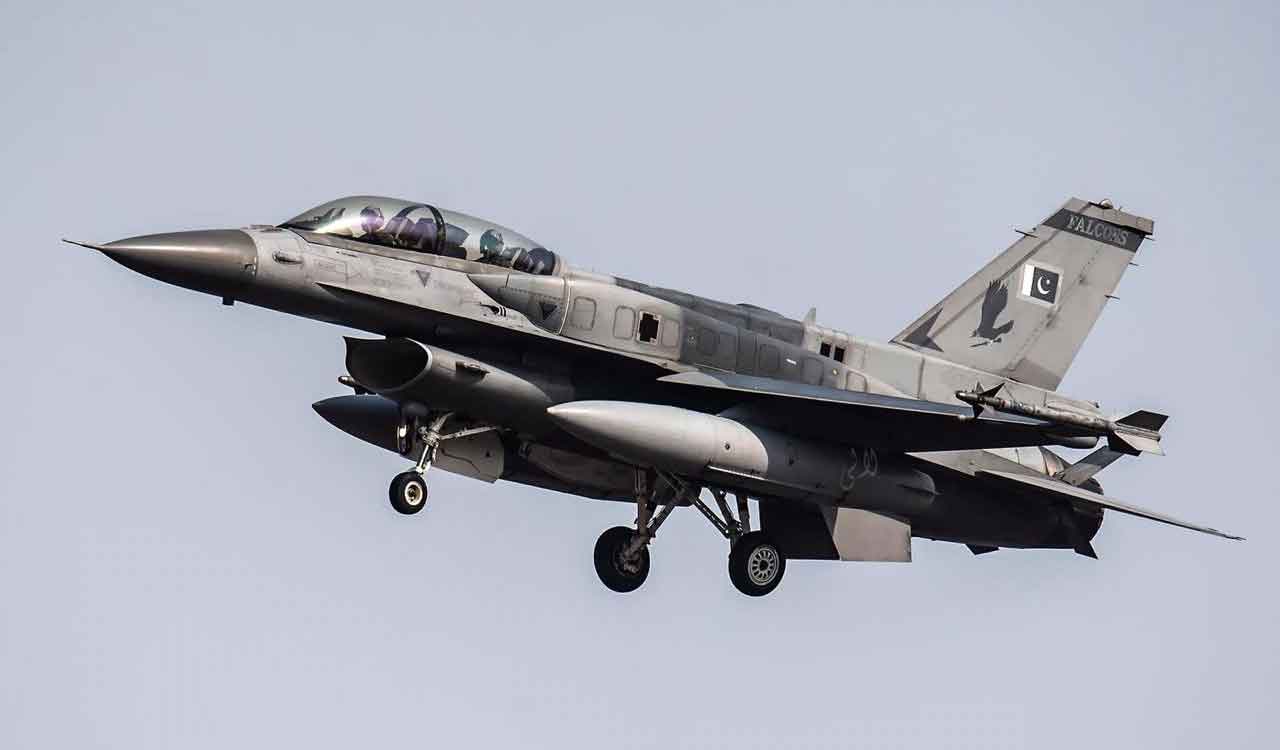
Opinion: Behind Pak’s F-16 upgrade
For the Pakistan Air Force, the upgrade signals US willingness to keep the F-16 central to South Asia's air balance


By Brig Advitya Madan (retd)
In the shifting theatre of global geopolitics, few relationships swing as dramatically as that between Washington and Islamabad. The latest evidence came on Dec 12, when the US Defence Security Cooperation Agency (DSCA) quietly forwarded a fresh military-upgrade proposal for Pakistan’s ageing F-16 fleet to the US Congress.
Also Read
The notification, valued at $686 million, seeks approval to supply 92 sets of the Link-16 secure data-communication system, along with a bouquet of associated avionics, cryptographic upgrades, simulators, training packages and maintenance support.
If Congress raises no objection over the next 30 days, Pakistan will receive a capability it has long coveted — a modern, encrypted, networked communication backbone that significantly enhances the tactical effectiveness of its 75 operational F-16s, while keeping them integrated into the US ecosystem till at least 2040.
With Link-16 installed, a Pakistani F-16 pilot can — at least in principle — exchange live tactical information with US or NATO pilots, or even with ground controllers during joint missions
The move has surprised many in India, partly because it comes despite Pakistan’s chequered reputation in counter-terrorism and partly because it signals yet another cycle of renewed American indulgence toward Islamabad. What has surprised Indian observers even more is the timing. The upgrade comes barely a year after Pakistan’s alleged diplomatic push in Washington — ranging from lobbying efforts involving former Trump-world associates to reports of economic “sweeteners” such as mineral-resource proposals. While these allegations remain unverified and certainly contested, what is undeniable is that Pakistan has once again caught Washington’s attention at a sensitive geopolitical moment.
Why Link-16 Matters
For those unfamiliar with the jargon, Link-16 is not a weapon but a force multiplier. It is essentially a secure, jam-resistant, encrypted digital network that allows aircraft, drones, ships and ground commanders to share real-time battlefield data, imagery and targeting information. With Link-16 installed, a Pakistani F-16 pilot can — at least in principle — exchange live tactical information with US or NATO pilots, or even with ground controllers during joint missions.
The package being sought also includes six inert Mk-82 500-pound bombs for integration testing, AN/APX-126 Identification-Friend-or-Foe (IFF) systems, mission-planning tools, and updated navigation equipment. While no new weapons or missiles are part of this deal, history suggests that capability upgrades often open the door for follow-on requests. Pakistan has, in the past, received US-supplied AIM-120 AMRAAMs, and many in India expect that Islamabad may eventually seek longer-range air-to-air or anti-radiation missiles to complement its aircraft.
For the Pakistan Air Force (PAF), this upgrade signals US’s willingness to keep the F-16 line alive in South Asia. The aircraft, long the jewel of Pakistan’s fleet, has seen two major US-supported enhancements in the past — once in 2006 and again in 2016. The new proposal effectively gives Islamabad a third life extension, allowing the F-16s to remain central to PAF strategy for the next decade and a half.
Why Now?
The most puzzling aspect is not the technology itself, but the American justification for supplying it. According to the State Department, the sale “supports Pakistan’s counter-terrorism capability” and enhances interoperability with the US and partner forces. This explanation has raised eyebrows in New Delhi, largely because Pakistan’s record in combating terrorism remains deeply problematic.
For decades, Pakistan has been accused — by India, by Afghan authorities and even by segments within the US system — of giving safe haven to extremist elements. The discovery of Osama bin Laden in Abbottabad years ago dramatically illustrated this contradiction. Yet Washington continues to oscillate between punitive phases and cooperative phases with Islamabad, depending on its strategic needs of the moment.
Today’s global context provides some clues. The US is increasingly preoccupied with competition against China, volatility in the Middle East, and disruptions in supply chains for rare earth minerals and defence components. In such an environment, even a limited relationship with Pakistan — geographically strategic, militarily experienced and diplomatically pliable — can offer Washington tactical advantages. Meanwhile, Pakistan is grappling with an economic crisis and a shifting power balance within the region. An upgrade for the F-16 fleet gives it both symbolic reassurance and operational strength.
Implications for India
Does this upgrade meaningfully change the military balance across the western border? Not immediately. India’s Air Force (IAF) remains technologically superior across most parameters — sensor fusion, radar sophistication, weapons range, air-defence integration and electronic-warfare capability. India today fields a diverse combat fleet that includes Su-30MKIs, Mirage-2000s, upgraded MiG-29UPGs, the indigenous LCA Tejas and the Rafale platform, which outclasses the F-16 across most modern combat metrics.
Yet capability is not the only factor. Preparedness and adaptability matter just as much — perhaps more. The PAF is highly trained, extremely disciplined and historically adept at extracting maximum performance from limited assets. With Link-16, Pakistan will acquire better situational awareness, faster target-cueing and more seamless interaction between airborne and ground controllers. This can improve reaction speed and battlefield coordination — factors that matter in modern air combat.
India cannot overlook these shifts. Even if the upgrade is defensive on paper, the operational reality is that Pakistan will end up with a more networked, more survivable and more interoperable F-16 fleet than it possessed during earlier crises — whether Kargil, Balakot or other flashpoints.
India Must Stay Ahead
Fortunately, India’s defence modernisation in the past few years has focused heavily on precisely the areas where Pakistan is now catching up—network-centric warfare, secure datalinks, airborne early-warning systems, and integrated air-defence command structures. The IAF already possesses its own secure communication architecture and is expanding its satellite-based capabilities.
However, the lesson from this US-Pakistan dynamic is not alarm — it is alertness. Pakistan will eventually seek longer-range missiles for its upgraded F-16s. It may further lean on China for complementary upgrades. The PAF will continue refining tactics and joint operations, especially those incorporating drones and precision munitions. India must factor these possibilities into planning cycles, war-games and procurement priorities.
In the end, what stands out is the irony: the US State Department cites “counter-terrorism cooperation” as the motivation for the sale, even though Pakistan’s mixed record on this front is well documented. Yet Washington’s geopolitical priorities often supersede historical inconsistencies. When great powers make strategic decisions, their reasoning is usually less about morality and more about calculus — and Pakistan, once again, finds itself useful in America’s evolving equation.
India must respond not with indignation, but with clarity. New Delhi must continue engaging Washington while voicing its security concerns firmly. Simultaneously, India must accelerate defence indigenisation, strengthen joint military capability, deepen partnerships with like-minded nations, and maintain the technological edge that deters adventurism.
The F-16 upgrade for Pakistan is not a crisis — but it is a reminder. In geopolitics, there are no permanent friends, only permanent interests. And the nations that best understand this truth are the ones that stay secure.

(The author is a retired Army Officer)

Related News