Opinion: Telangana must increase public spending on education to build human capital
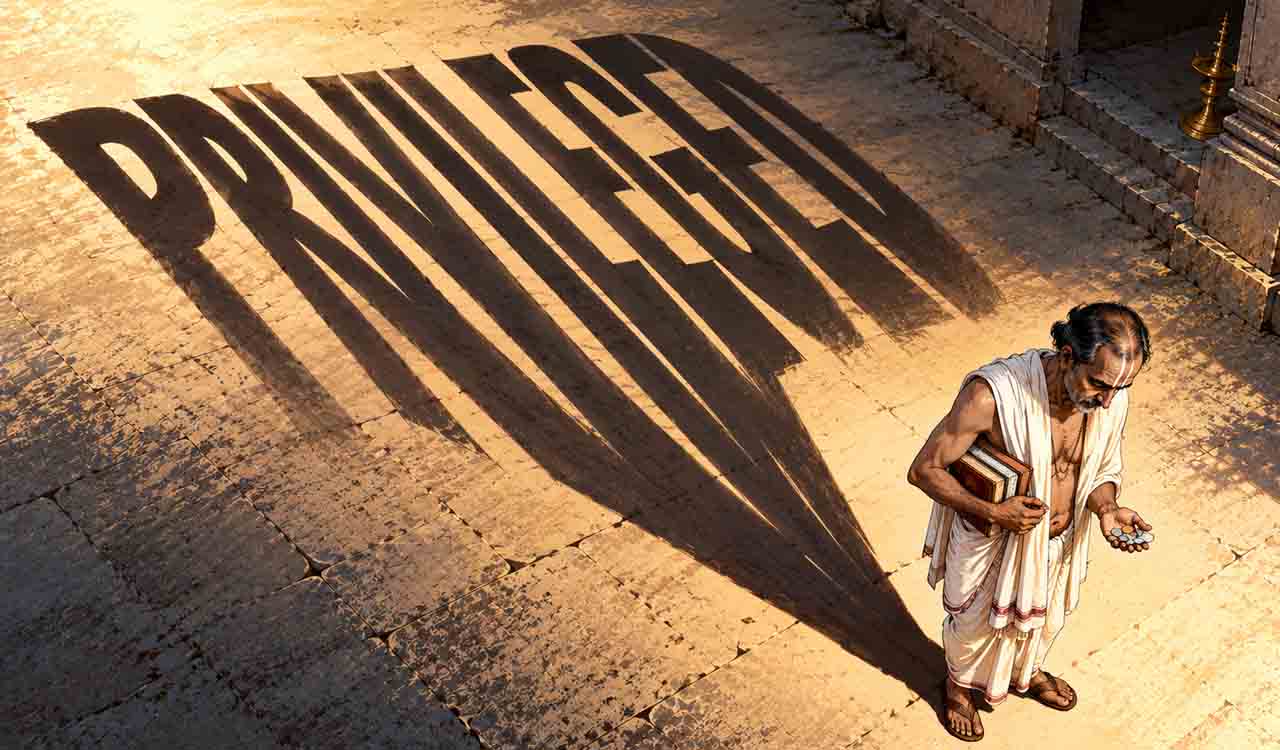
Reliance on private institutions and targeted subsidies may expand access for disadvantaged groups, but it does little to strengthen educational institutions


By Venkatanarayana Motkuri and E Revathi
Financial resources are central to educational development in any society. The question of who should finance education — the state or households — reflects differing philosophical and economic perspectives. School education is widely regarded as a public good because its social benefits are universal and long-term.
Also Read
Higher education, however, occupies a more contested position. It is viewed either as a public good due to its contributions to innovation, productivity, and social mobility, or as a merit good because it generates substantial private returns through higher earnings and improved life opportunities. In practice, most countries treat higher education as a mixed good: individuals benefit privately, but society gains collectively, justifying public support.
Affordability, Access
Even where higher education is seen primarily as a merit good, governments remain deeply involved through subsidies, scholarships, and financial aid. These mechanisms enhance affordability and expand access for disadvantaged groups. Thus, regardless of theoretical classification, sustained public investment is widely considered necessary to ensure equity, inclusiveness, and long-term economic development.
The historical evolution of higher education systems illustrates continuous state involvement. In the United States, federal intervention played a decisive role in expanding access. The Morrill Land-Grant Acts established agricultural and mechanical colleges, broadening educational opportunities beyond traditional elites. The GI (Govt Issue) Bill further democratised higher education by enabling millions of returning veterans to enrol in colleges and universities. Although the market-oriented reforms associated with Ronald Reagan reduced the relative growth of public funding, the United States continues to devote 5–6% of GDP to education overall, with a significant share directed to higher education. Tuition fees are high, and student loans are central to financing, yet public subsidies remain substantial.
In contrast, Nordic countries such as Sweden, Norway, and Finland treat higher education largely as a public good. Tuition fees are minimal or non-existent, and institutions are predominantly state-funded. These countries consistently spend more than 7% of GDP on education and maintain strong participation rates alongside relatively low inequality. Many European nations follow intermediate models, combining public funding with moderate cost-sharing. Global practice, therefore, reflects a combination rather than a rigid public-versus-private divide.
TG’s Financing Pattern
Against this international backdrop, the financing pattern of education in Telangana presents a distinctive case. Public expenditure on education in the State remains relatively low. Education spending accounts for about 2% of Gross State Domestic Product (GSDP), placing Telangana among the lower-spending Indian States and well below global averages. The State allocates less than 15% of its total budget to education overall and under 4% specifically to higher education.
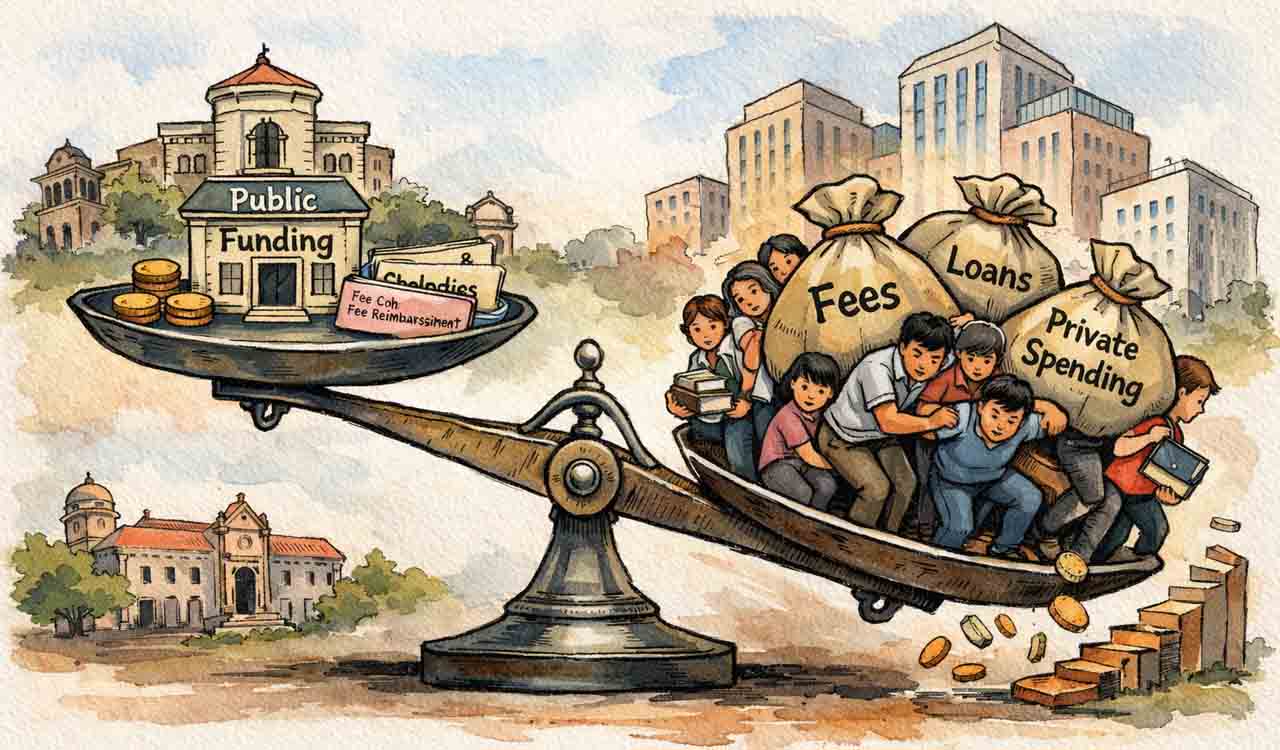
At the same time, the State government has implemented large-scale scholarship and tuition-fee reimbursement schemes aimed at economically and socially disadvantaged students. Nearly half of the total public educational expenditure is devoted to these transfers. This indicates a policy preference for demand-side subsidies — supporting students directly rather than strengthening public institutions through sustained capital and operational investment.
Despite such subsidies, household private expenditure on education in Telangana is among the highest in India. Per capita private spending per student across all levels stands at Rs 14,913, about 1.5 times the national average of Rs 9,948. Although the State accounts for roughly 3 per cent of India’s total enrolment, it contributes 4.6 per cent of total private educational expenditure nationally. Private spending, therefore, is disproportionately high relative to its enrolment share.
The pattern is similar in higher education. In 2017–18, public expenditure on higher education amounted to Rs 4,798.9 crore, with average public spending per student of Rs 33,795. Household private expenditure per higher education student was Rs 30,423, exceeding the national average of Rs 26,423. Total private expenditure on higher education reached Rs 4,320.1 crore. Combined public and private expenditure totalled Rs 9,118.9 crore, with per-student spending of Rs 64,218. Household out-of-pocket payments constituted nearly 48 per cent of total higher education expenditure. Thus, almost half of the financing is borne directly by families.
This financing structure reflects extensive private participation. More than half of school enrolment in the State is in private institutions, and nearly three-quarters of higher education institutions and enrolments are privately managed. Expansion has occurred largely through private initiative, with the public sector playing a supportive but fiscally limited role.
International Benchmark
When compared internationally, Telangana does not approximate the Nordic model of strong public provision. Nor does it match the United States in terms of aggregate public commitment, even though the US relies heavily on tuition fees. International averages further underscore the gap: OECD and European Union countries spend around 5% of GDP on education, the global average is about 3.5%, and even many low-income countries spend nearly 3%. At roughly 2%, Telangana’s expenditure falls significantly below these benchmarks.
With a per capita GSDP of Rs 3.87 lakh (2024–25 estimate), translating to roughly $18,180 in purchasing power parity terms, Telangana stands near the middle of the global income distribution and well above the Indian average. At the market exchange rate, per capita income is about $5,500 — placing Telangana close to the upper-middle-income threshold under the World Bank income classification framework. Yet this relatively strong economic position has not translated into proportionate public investment in human capital.
The reliance on private institutions supplemented by targeted subsidies has improved access for disadvantaged groups, but it does not substitute for systemic institutional strengthening. Public colleges and universities face challenges, including faculty shortages, infrastructure gaps, and limited research capacity. Without sustained capital expenditure and operational support, quality concerns may persist. Heavy dependence on household financing also risks reinforcing inequality, particularly when private spending is high relative to income levels.
The evidence, therefore, points to a structural imbalance: high private participation, substantial household expenditure, and relatively low public fiscal commitment. While scholarships mitigate access barriers, they do not reduce overall dependence on private provision. A recalibration towards stronger institutional investment is necessary to ensure quality, affordability, and long-term sustainability.
Increasing public expenditure — particularly in higher education — would enable faculty recruitment, improved student–teacher ratios, infrastructure development, and enhanced research support. Strengthening public institutions could reduce household financial burdens and promote more equitable access. Given the State’s economic growth trajectory, expanding education spending appears both feasible and strategically prudent.
In conclusion, higher education in Telangana is financed through a mixed model tilted heavily toward private participation and household expenditure. Although demand-side subsidies promote access, overall public investment remains modest by national and international standards. Aligning fiscal commitment with the State’s income levels and development ambitions requires a stronger public role. A balanced financing structure — combining adequate institutional funding with targeted student support — would better position higher education as a driver of inclusive and sustained socio-economic progress.
(The authors are with the Centre for Economic and Social Studies, Hyderabad)

Related News