Opinion: Dictatorial delimitation of GHMC
Congress government’s forced GHMC expansion and hurried ward delimitation reflect a dictatorial imposition bulldozed onto the people of Hyderabad, scuttling their democratic aspirations


By Dr Sravan Kumar Dasoju
Urban governance reforms demand proper planning, legality, and democratic participation of people. What they do not permit is haste masquerading as efficiency or executive fiat disguised as democratic reform. Yet that is precisely what Telangana is witnessing today in the expansion of the Greater Hyderabad Municipal Corporation (GHMC) and the hurried delimitation of its wards.
Also Read
Following in the footsteps of Prime Minister Narendra Modi, Telangana Chief Minister and Congress leader Revanth Reddy has parroted the slogan of a “$10 trillion economy by 2047,” hastily unveiling an equally grandiose — but utterly hollow — promise of a “$3 trillion Telangana economy by 2047.” This borrowed rhetoric is being propped up by flashy, headline-hunting mega projects, such as the so-called ‘Future City’ and the ‘Musi revival’ — initiatives driven more by political spectacle, land politics, and real estate ambitions than by serious economic planning, fiscal prudence, or democratic accountability.
The 74th Constitutional Amendment is undermined as executive overreach distorts electoral equality, weakens municipal autonomy and threatens Hyderabad’s social harmony
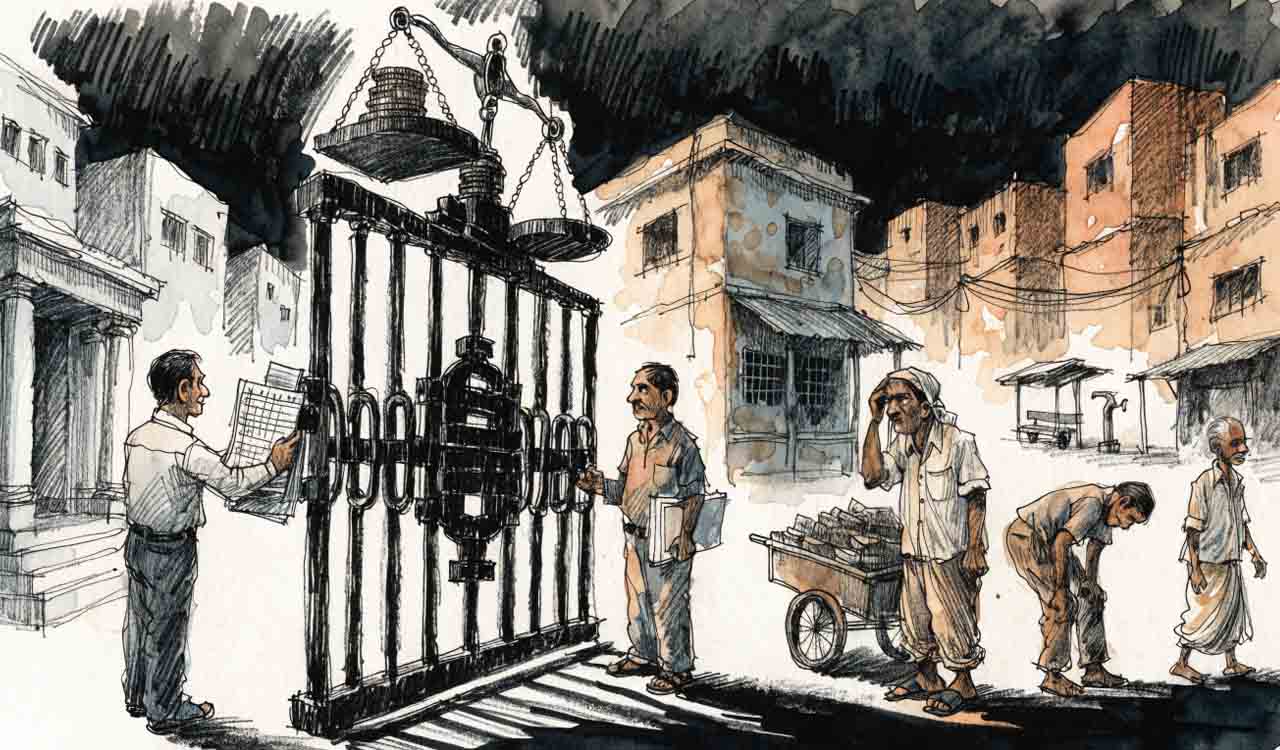
Behind this inflated economic narrative lies a far more disturbing political design. As part of a concealed agenda to fracture the GHMC into multiple municipal corporations — Hyderabad, Secunderabad, and Cyberabad — the State government has, in an overnight display of executive arrogance, forcibly swallowed 20 municipalities and 7 municipal corporations into the civic body. Within days of this coercive merger, the government proceeded to redraw Hyderabad’s political map through a rushed, opaque, and legally suspect delimitation exercise that reeks of authoritarian desperation rather than constitutional discipline or democratic transparency.
A Forced Merger
The first rupture came with the forced merger of 27 urban local bodies into the GHMC through the ordinance route. These municipalities and corporations — each governed by elected councils — were summarily removed from the Telangana Municipalities Act, 2019, and brought under the GHMC Act, 1955. There was no prior public consultation, no consent of the affected municipal councils, no legislative debate, and no institutional dialogue.
The result was a sudden territorial expansion of the GHMC to nearly 2,000 square kilometres, fundamentally altering governance structures, taxation regimes, and civic entitlements for lakhs of citizens without their consent.
Such centralisation strikes at the heart of the 74th Constitutional Amendment, which was enacted precisely to prevent State governments from swallowing local self-governments through executive convenience. However, the spirit and substance of the 74th Constitutional Amendment are being wilfully sacrificed at the altar of political ambition, converting decentralised municipal democracy into a casualty of executive arrogance and calculated electoral engineering.
Rajiv’s Vision Undermined
Part IX-A of the Constitution recognises municipalities as institutions of self-government, not as subordinate offices of the State Secretariat. Articles 243-R, 243-W, and 243-ZA mandate democratic composition, decentralised governance, and elections conducted strictly “in accordance with law.”
What unfolded in the GHMC reflects the opposite impulse: first, abolish municipal autonomy by ordinance; then, redesign political representation through a rushed delimitation. This sequence alone reveals that the exercise was pre-engineered, not reform-driven.
Delimitation in Six Days
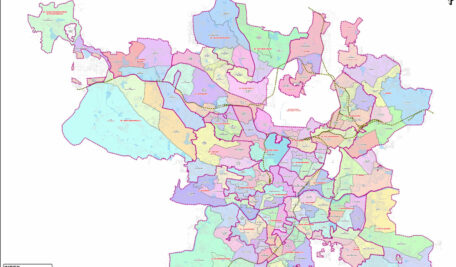
On December 2, GHMC limits were expanded. By December 9, a city-wide delimitation of 300 wards was notified. Any administrator acting in good faith would concede that in six days it is humanly impossible to analyse census data, ensure population parity, redraw boundaries with geographical coherence, align reservations, conduct ground verification, and consult stakeholders meaningfully.
The haste is not incidental; it is incriminating. It points unmistakably to non-application of mind and a colourable exercise of power, aimed at shaping the electoral landscape rather than improving governance.
Violating Law, Rule by Rule
The Telangana Municipal Corporations (Delimitation of Wards) Rules, 1996, are not advisory in nature. They are mandatory. The present exercise of the Centre for Good Governance, the GHMC, and the State government violated them systematically.
• Rule 5: Population equality abandoned
This rule mandates approximate population equality between wards, with deviation not exceeding ±10%, based on the latest census. Yet, no ward-wise population figures were published, no census basis was disclosed, and no justification was recorded for deviations. Independent scrutiny reveals a gross population imbalance. When wards carry unequal populations, votes carry unequal weight. That violates Article 14’s guarantee of equality and hollows out Article 243-R’s democratic promise. Elections built on such foundations cannot satisfy Article 243-ZA. A dictatorial delimitation that violates Rule 5 is a democratic distortion and the constitutional right of equality itself.
• Rules 6 & 7: Territorial coherence destroyed
Under these, clear boundary descriptions, geographical contiguity, uniform mapping, and intelligible territorial demarcation are a must. What emerged instead was cartographic chaos: no authenticated ward maps, vague and contradictory boundary descriptions, non-contiguous and fragmented wards, habitations split without administrative logic, and wards cutting across multiple Assembly constituencies. A citizen cannot identify her ward. A representative cannot map accountability. Such a delimitation is unintelligible, arbitrary, and legally indefensible.
• Rule 8: Consultation reduced to ritual
This rule mandates prior consultation, full disclosure of material, and meaningful consideration of objections from citizens and the GHMC General Body. Instead, a “preliminary” Gazette was issued before consultation, essential data was withheld, objections were invited without information, and the General Body was summoned after decisions had already been taken.
To legitimise this exercise, the government has leaned on the Centre for Good Governance (CGG). But CGG is neither a constitutional nor a statutory authority. It has no jurisdiction under the GHMC Act and no democratic mandate. An advisory council that functions under the control of a political executive, ie, the CM’s office, cannot substitute constitutional satisfaction. Democracy cannot be outsourced to consultants.
Assault on Social Harmony
The consequences of hasty delimitation extend beyond statutes. By fragmenting cohesive neighbourhoods and redrawing boundaries without social logic, the delimitation fractures Telangana’s centuries-old Ganga-Jamuni tehzeeb, its lived tradition of pluralism and coexistence. Hindu and Muslim communities that grew together are being pulled apart, not by necessity but by political design.
This episode fits a troubling pattern: data withheld, commissions ignored, legislatures sidelined, and ordinances preferred over debate. From caste census to reservations to urban governance, the method is consistent: speed over substance, power over process.
The 74th Constitutional Amendment was born of a simple idea: power must be decentralised and flow downwards. What is unfolding in the GHMC reverses that logic. A merger imposed by fiat, followed by a delimitation rushed in six days, riddled with rule violations, and cloaked in procedural symbolism, cannot survive constitutional scrutiny.
Democracy cannot be redrawn by executive urgency. The Constitution cannot be bent to meet political timelines. And Hyderabad cannot become a laboratory for electoral engineering. If urban governance reform is truly the objective, the answer is simple and constitutional: withdraw, disclose, consult, and redo strictly in accordance with the law.
Jai Samvidhan…Jai Telangana.
(The author is an MLC)

Related News