Opinion: Fish, freebies, and the death of development politics in Bengal
The 2026 Assembly elections signal a shift from development-driven politics to identity and welfare narratives, dominated by fish, allowances, and slogans


By Dr Tuhinsubhra Giri
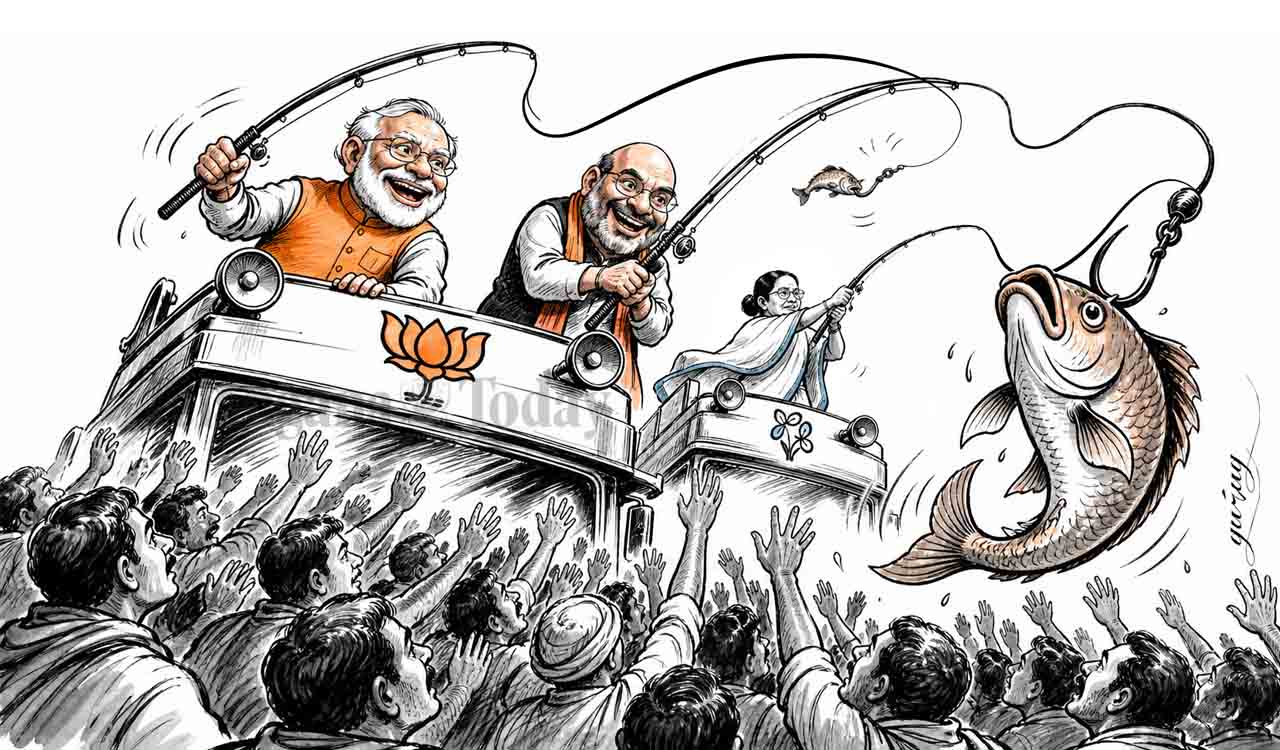
‘We will eat both fish and meat. I have come out with fish today to stop this propaganda.’ This was Bengal’s election discourse in 2026. A BJP candidate in Bidhannagar goes door to door, dangling a five-kg Katla and trying to assure voters that his party will never interfere in their dinner plates. Union Minister Sukanta Majumdar, another former BJP State president, along with the party’s local candidate Bidyut Kumar Roy, launched his campaign from the fish market in Balurghat on April 8, 2026.
Also Read
Between rallies, the Chief Minister announces a Rs 500 hike in Lakshmir Bhandar allowances. The BJP responds by serving dim-bhaat (egg curry and rice) at some rallies. And so the campaign season passes in a State with over 10 million young people without stable employment, only talking about fish and allowances. Not about employment, closed factories, transport corridors, or why Bengal’s engineering graduates leave for Bengaluru or Pune every year. Fish and allowances. That is the full menu.
Slogan War
And then there was the other theatre — the slogan war. Step into any constituency during campaign season, and you would find BJP and TMC supporters screaming ‘Jai Shree Ram’ and ‘Joy Bangla’ at each other like rival war cries, faces contorted, fingers pointed, each side trying to drown the other out. Jai Shree Ram was barely heard in Bengal before 2017; Joy Bangla was adopted by the TMC as a counter.
In the last 35 years of watching Bengal’s elections, this is new — politics reduced to a screaming match between two slogans, neither of which contained a single word about policy, employment, infrastructure, or which scheme worked and which one failed. No one asked what the government built. They asked which slogan you shout.
This is not accidental. It is economically manufactured. The shift from development-based elections to identity-based ones is the product of deindustrialisation, welfare dependency, and the shared refusal of both the TMC and the BJP to fight on the ground where they would actually have to deliver.
The same BJP that enables cow vigilantism in Uttar Pradesh paraded Katla fish in Kolkata constituencies. The dinner plate became a proxy war over whose Hinduism is real
Start with the factory. Or rather, the absence of one. When Tata Motors pulled the Nano project out of Singur in October 2008, Mamata Banerjee rode the agitation to power. But what was left was not just one car plant; rather, it lost an entire ecosystem of firms, and also created a damaging perception of Bengal’s business environment. No major manufacturer has since committed at a comparable scale. Bengal’s industrial base, already hollowed by decades of Communist-era trade union militancy, received its final blow not from the Left but from the movement that replaced it.
Welfare Cheques
What replaced the factory is the welfare cheque. ‘Lakshmir Bhandar’, ‘Kanyashree’, ‘Yubashree’, ‘SwasthyaSathi’. TMC’s transfer schemes reach over 2.15 crore women beneficiaries (https://wb.gov.in/pdf/report_card/WBGovRC_English.pdf) and put real money where the formal economy cannot. But they create a loyalty economy.
The monthly stipend becomes a political relationship; the beneficiary is grateful not to an institution but to a party. Development builds capacity; welfare, when it substitutes for economic opportunity, builds dependence. So when election season comes, the Chief Minister does not talk about new factories. She talks about raising the allowance by Rs 500.
On the other hand, the BJP could be arguing for industrial revival. It has found something cheaper than factories, ie, identity. The Hindutva project in Bengal is not a grassroots spiritual revival but an imported political instrument. Ram Navami processions with saffron flags and DJ-mounted trucks, cow-protection rhetoric — these are North Indian aesthetics transplanted into a Bengali Hindu culture that never organised itself along these lines. Its ethos runs through the Baul tradition, through Durga, Kali, Ramakrishna and Vivekananda, through a religiosity that sees no contradiction between praying to the goddess and eating fish curry after the puja the same afternoon.
The same BJP that enables cow vigilantism in Uttar Pradesh now parades the Katla fish in Kolkata constituencies. The dinner plate became a proxy war over whose Hinduism is real, and unfortunately, neither party’s position on it has anything to do with development.
Hollow Claims
This reveals the hollowness beneath the BJP’s Bengal project. No campaign to revive jute, build logistics corridors, or fix employment exchanges. What it offered was belonging. The Ram Navami procession through a mixed neighbourhood is not primarily about devotion; it is a choreographed performance that gives unemployed young people a sense of purpose that a job would otherwise provide.
According to the Periodic Labour Force Survey, India’s youth unemployment rate among graduates is around 13%. A young person with a degree and no job is not merely poor; he is humiliated with no economic identity, no social standing, no path to marriage or household formation or trying to do some petty informal business like a tea shop or ‘chop-erdokan’.
Into that vacuum, Hindutva offers a ready-made identity — you are a Hindu, your community is under threat, and here is a brotherhood that will give you standing. The unemployed man’s economic despair is alchemised into communal anger.
And even the one escape route that middle-class India still believes in — the ‘sarkarinaukri’ (Government job) — is a mirage. According to reports, nearly 10 lakh posts in central government ministries remain unfilled; railways alone account for close to three lakh vacancies. Include state-level gaps, and estimates cross 60 lakh posts sitting empty. Recently, recruitment itself has become a theatre of corruption. One of the ugliest recent examples — the SSC scam, in which the entire 2016 recruitment of over 25,000 teachers and staff was declared void by the Supreme Court in April 2025.
But Bengal is not exceptional. In Bihar, the BPSC teacher exam was cancelled after confirmed paper leaks. The UPPSC review officer exam faced similar allegations. Most of the government jobs have become a broken promise, and the rage of the aspirant who spent five years preparing for a rigged exam is combustible. Those aspirants are politically available to whoever offers the most satisfying target for that anger.
The TMC benefits from this dynamic just as much as the BJP. If elections are fought on identity, on who is the real Bengali, on whose procession was stopped by the police, then the TMC never has to answer for its development record. Like, why is the Deocha Pachami coal block still not operational? Why does Bengal’s per capita income trail Gujarat and Tamil Nadu, or why does Kolkata’s infrastructure groan under neglect, while Hyderabad and Bangalore sprint ahead? Identity politics is a shield for those with weak records.
Degradation of Discourse
There is mutual complicity in the avoidance of these facts, indicating a degradation of political discourse in total. The BJP does not fight on development because Hindutva is cheaper and emotionally more potent than a 10-year industrialisation plan. The TMC does not fight on development because its record cannot survive scrutiny. The voter is caught between a welfare trap and an identity trap — a monthly allowance or a saffron flag. What they actually need is a job.
None of this is anti-Hindu. It prioritises Bengal, rejecting both the empty catchphrases of the opposition and the transactional politics of the establishment. What Bengal needs is an honest contest over economic futures with industrial policy, higher education, and why the State that once produced India’s managerial elite now exports its young to Karnataka and Maharashtra for entry-level work.
Until one party is forced to contest elections on that ground, the pattern will repeat. Factories will remain closed. Procession will keep marching. Allowance will keep rising before every election. And the young man at the back of the procession, shouting slogans he was given, will continue to mistake identity for dignity, because no one has offered him the economy that would make the difference clear.
(The author is Assistant Professor of Economics, Christ University, Bengaluru)

Related News