Opinion: From encounters to custodial deaths: Is India finding new ways to hide extrajudicial killings?
The death of Assam man Ramanuj Goswami in police custody raises wider questions about extrajudicial killings, accountability and due process. A constitutional democracy must ensure that every death in police custody or police action is independently investigated


By Geetartha Pathak
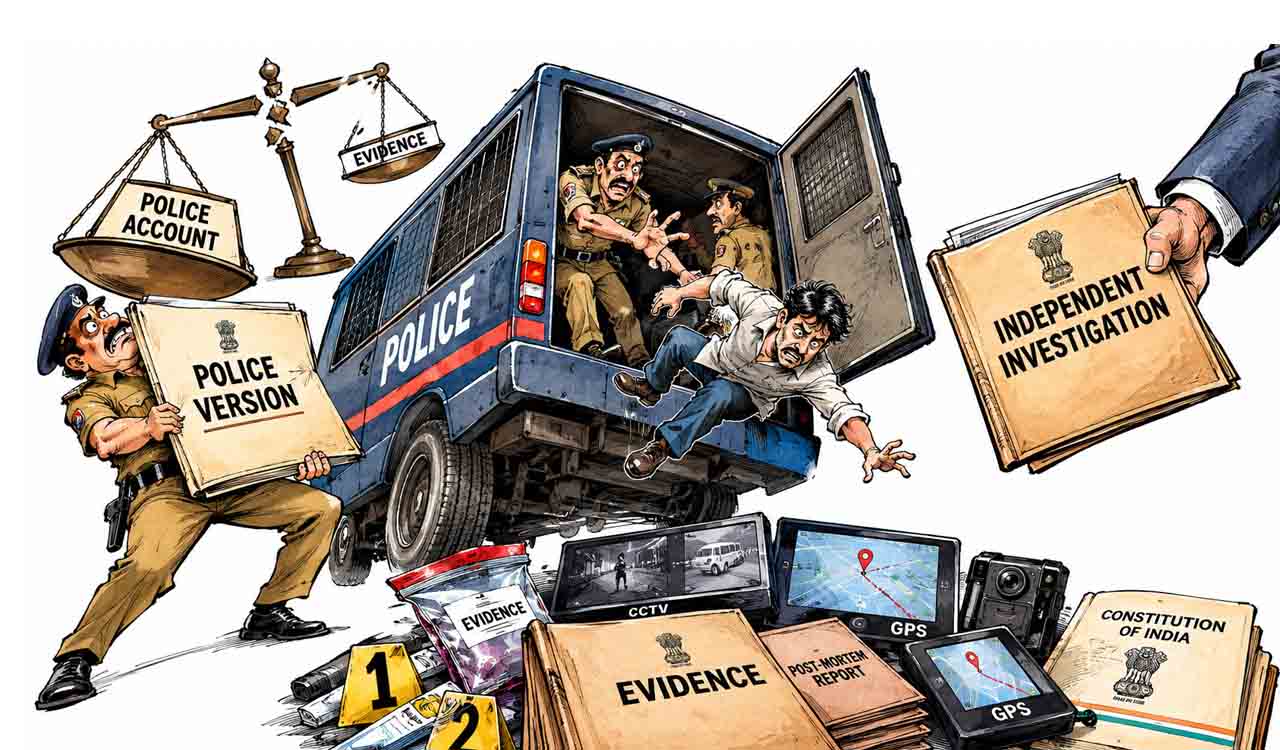
The death of Ramanuj Goswami in Guwahati has raised questions that go beyond the murder case in which he was an accused. Goswami, accused of killing his wife Riya Talukdar, died on September 14 after, according to the police, he attacked an escorting constable, opened the rear door of a moving vehicle and jumped near Narakasur Hills while being taken for a medical examination. He was declared brought dead at Gauhati Medical College and Hospital. The hospital reportedly found no bullet wound in its preliminary examination.
Also Read
The police account is now subject to investigation. Goswami’s death cannot currently be conclusively described as an extrajudicial killing. His family has questioned the circumstances, while the authorities have offered their version. A post-mortem and an independent investigation must establish what actually happened. Yet the case raises a larger and uncomfortable question: has the vocabulary and methodology of extrajudicial killing changed?
Encounter Vocabulary
The old vocabulary was “encounter”. A suspect would allegedly attempt to escape or open fire, and the police would kill him in retaliatory firing. Increasingly, however, deaths in custody can acquire other explanations: an accused allegedly jumps from a moving vehicle, falls from a building, is injured while escaping or dies during a police operation.
The important question is not whether every such death is a fake encounter. It is whether every death occurring in police custody or as a result of police action is investigated independently enough to establish the truth.
Goswami was reportedly in police custody and was due to be produced before a court. That makes the circumstances of his death particularly deserving of scrutiny. If he jumped from the vehicle, investigators must establish how and why he was able to do so. If he was pushed, the evidence should establish that. If police personnel were responsible for his death, those responsible must face the law. If the police account is correct, an independent investigation should establish that as well.
The image that comes to mind is Tipu’s Drop at Nandi Hills near Bengaluru, traditionally associated with the belief that condemned prisoners were pushed from the cliff. The historical details surrounding the site should not be confused with established fact. But as a metaphor, it is striking: when the method of death changes, can the appearance of legality change with it?
Article 21 protects life and personal liberty. An accused person may be charged with a horrifying crime and condemned by public opinion, but an accusation does not extinguish constitutional rights
Supreme Court Ruling
The Supreme Court made this principle explicit in People’s Union for Civil Liberties v. State of Maharashtra (2014) 10 SCC 635. The court prescribed procedures for investigating deaths resulting from police encounters, including registration of an FIR, independent investigation, preservation of evidence, post-mortem examination and reporting to the National Human Rights Commission or the State Human Rights Commission. It also cautioned against rewards or promotions for police officers involved until their conduct had been established.
These principles recognise a fundamental democratic reality: the police cannot be both the subject of an investigation and the institution that determines whether their own actions were lawful.
The normalisation of “encounter justice” is dangerous. It can reverse the relationship between citizen and state. Instead of collecting evidence and presenting it before a court, the police effectively determine guilt, punishment and death. A democracy cannot permit such a transformation. Wherever political rhetoric celebrates the killing of alleged criminals rather than their prosecution, the distinction between policing and punishment becomes blurred.
Constitutional Systems
Other democracies and constitutional systems illustrate the dangers of allowing police power to expand without effective accountability. In the Philippines, Rodrigo Duterte’s “war on drugs” became internationally prominent because of killings associated with anti-drug operations. Human Rights Watch, in its World Report 2025, reported continuing killings linked to the drug war and limited domestic accountability.
According to the Brazilian Public Security Forum’s Anuário Brasileiro de Segurança Pública 2025, police killed 6,243 people in Brazil in 2024. Mexico offers yet another lesson, where organised-crime violence has coexisted with weak investigations, allegations of torture and failures of due process.
India is not identical to any of these countries. The comparison is useful for one reason: police power becomes dangerous when it grows faster than independent accountability.
Institutional Safeguards
The solution is not more rhetoric about encounters. It is stronger institutional safeguards. Every death caused by police action, every suspicious custodial death and every death during police transportation should automatically trigger an investigation independent of the officers involved. The police unit whose actions are being examined should have no control over that investigation.
Evidence should be secured immediately. CCTV footage from police stations and escort vehicles should be preserved automatically. Body cameras should be used during custodial transportation wherever feasible. GPS records, vehicle data, call records and medical records should be secured. Where circumstances are disputed, post-mortems should be video-recorded in accordance with forensic standards.
There must also be institutional independence in prosecution and forensic examination. States should regularly publish data on custodial deaths, deaths resulting from police action, encounter deaths, departmental inquiries, prosecutions and their outcomes. A democracy cannot effectively supervise what it refuses to count.
The Supreme Court’s 2006 judgment in Prakash Singh v Union of India (2006) 8 SCC 1 prescribed important police reforms, including State Security Commissions, fixed tenure for senior officers, separation of investigation from law-and-order functions, Police Establishment Boards and independent Police Complaints Authorities. Almost two decades later, implementation remains uneven.
The issue ultimately comes down to a simple constitutional principle. Riya Talukdar’s family deserves justice, society deserves protection from violent crime, and the police deserve the authority and resources necessary to investigate serious offences. But justice for the victim cannot mean abandoning due process for the accused.
If Goswami committed the crime, a court should establish his guilt and impose the lawful punishment. If he died before trial, society lost the opportunity for a judicial determination of guilt and for a complete account of the circumstances surrounding his death.
The greatest danger lies in accepting that some accused persons are so dangerous that ordinary judicial process is unnecessary. Once normalised, this principle can expand to protesters, dissenters, journalists, minority youths or inconvenient witnesses.
India does not need disguised encounters. It needs a system in which every death in police custody or action leaves an unmistakable forensic, judicial and institutional trail. That is the difference between a police state and a constitutional democracy: the police, too, must be accountable for their version of events before an independent authority. The ultimate test of democracy is whether the State can bring a criminal to justice without itself becoming lawless.
(The author is a senior journalist based in Assam)

Related News