Opinion: The force that keeps Indian Constitution alive
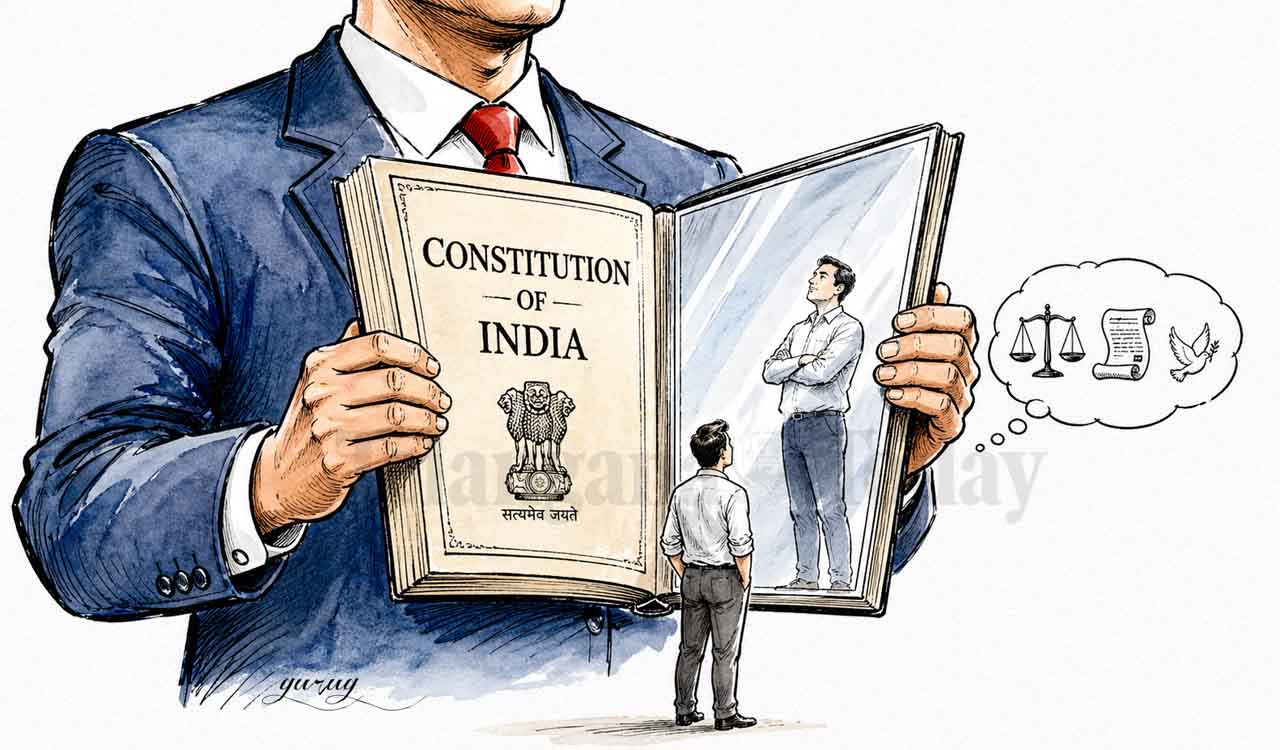
With an increasingly aware citizenry, constitutional morality should now be instinctive rather than cultivated


By P Pratibha Shekar
While the Constitution is one of Dr BR Ambedkar’s most distinguished accomplishments, he also conceptualised a notion that would ensure the efficiency of the document — the principle of constitutional morality. It is this very idea that, to quote Dr Ambedkar, makes the Constitution “not just a legal document but a transformative instrument”
Roots and Rationale
Propounded by British classicist George Grote in the 19th century, constitutional morality is the “paramount respect for the forms of the constitution of the land”. It is the constant force that drives and guides the actions of the government and citizenry to respect and revere above all, the ideals enshrined in the Constitution.
The principle is simple yet cardinal. Constitutional morality, coupled with the flexibility of the Constitution in coherence with natural justice, has kept it relevant and alive. For what use would the lengthiest Constitution in the world have been if it were not respected above everything else in serving the cause of rights and justice?
Now that we know what constitutional morality is and its significance, a question naturally arises: what does it take to sustain it? Is it instinctive or something that must be enforced? Babasaheb answers this when he states, “Constitutional morality is not a natural sentiment, it must be cultivated.”
This leads to another question — How do we cultivate it? The makers of the Constitution prudently incorporated certain essential safeguards for the survival of constitutional morality within the document itself. The principle of rule of law is central in this regard. Supporting it are the doctrines of checks and balances, separation of powers, and judicial interpretation, which ensure that the three organs of the government limit each other, preventing any from becoming superior to the Constitution.
Constitutional morality requires institutions to collaborate and society to prioritise constitutional values over tradition, making justice, equality, and liberty instinctive
When the Supreme Court of India, in the landmark Kesavananda Bharati (1976) case, propounded the principle of “basic structure”, it rightly stated that the law of the land must prevail above all else. A similar sentiment was echoed in Maneka Gandhi v/s Union of India (1978), where the court interpreted the words “procedure established by law” to emphasise that such law must uphold principles of natural justice. Here, it was not merely the text but the intent of the Constitution that was given prominence.
Morality in Motion
What began with 395 Articles, 22 parts and 8 schedules has now expanded to over 470 Articles and 12 schedules. The Indian Constitution remains a living document, and one may wonder how numerous amendments have not altered its spirit entirely. The answer lies in the proactive role of the judiciary and its custodianship of constitutional morality.
The ideals that inspired the Constitution also drive its continual reinterpretation. Constitutional morality ensures this relevance by upholding the principles of natural justice. This is evident in Shayara Bano v/s Union of India (2017), or more famously, the Triple Talaq case, where the rule of law prevailed above personal law, eliminating arbitrariness and reinforcing the principle of audi alteram partem.
In a country marked by ethnic, religious and regional diversities, majoritarian tendencies are inevitable. The Constitution counters this through Articles 25 to 30, which safeguard the freedom of religion, cultural and educational rights of minorities. While these protections exist in letter, only constitutional morality sustains them in spirit.
Protecting citizens’ rights is the foremost responsibility of a Constitution. In Joseph Shine (2018), where Section 497 of the IPC was struck down, the court reinforced the rights to equality (Article 14), non-discrimination (Article 15), and life and personal liberty (Article 21). Similarly, constitutional morality was upheld in Navtej Singh Johar (2018), when Section 377 (law that criminalised “unnatural” sexual acts, including consensual same-sex relations between adults) was decriminalised, recognising social realities and individual rights.
Thus, the conception of constitutional morality emphasises foundational ideals and values rather than the text of the Constitution itself. This aligns with constitutionalism, setting it apart from originalism. Former CJI DY Chandrachud cited the 2022 Dobbs v Jackson Women’s Health Organisation ruling by the US Supreme Court as an example of originalism, where abortion rights were denied due to their absence in the US Constitution. In contrast, India’s approach remains flexible and evolving — a hallmark of constitutionalism.
Erosion and Endurance
While constitutional morality is vital, the engines that keep it running are the government organs of Executive, Legislative, and Judiciary, along with an able bureaucracy and, most importantly, a well-informed citizenry. The judiciary has more often than not played its part but challenges remain.
Political indifference poses a major threat, often suppressing the evolution of individual rights. The continued reluctance to recognise issues such as marital rape illustrates how political will can affect constitutional ideals. The judiciary itself is plagued with grave ambiguity as it finds it tricky to balance the two-pronged swords of judicial restraint and judicial overreach.
While it upheld constitutional morality in the Naz Foundation (2009) case, it hesitated to legalise same-sex marriage in 2023, attempting to balance constitutional values with legislative supremacy.
Above all, the major challenge to citizen rights is the citizenry itself. Ignorance and norms from times immemorial render even educated citizenry incapable of respecting the rights of others. It is essential to understand that social conformity cannot be the yardstick of morality. As long as citizens remain averse to constitutional morality, any other institutions trying to enforce it will be incapacitated.
In the Sabarimala case, for instance, despite the judiciary’s nod to allow the entry of women into the shrine, it is the societal disapproval that is making it difficult to implement.
Instinctive Constitutionalism
Much has changed since 1949. India has made great strides in its economy, political fabric, inclusion, literacy, and technology. We have evolved greatly since the time Babasaheb called constitutional morality not a natural sentiment. With an increasingly aware citizenry, one may argue — with due respect — that adequately constitutional morality must now be instinctive rather than cultivated.
Institutions must inherently view it as their responsibility, even if it requires collaboration. Society too must prioritise it over tradition when necessary. Only then can constitutional morality become as natural as human emotion.
To recall Babasaheb: …however good a Constitution may be, it is sure to turn out bad because those who are called to work it, happen to be a bad lot. However bad a Constitution may be, it may turn out to be good if those who are called to work it, happen to be a good lot.

(The author is trainee Deputy Collector, Government of Telangana)

Related News