Opinion: India’s delimitation debate: South’s constitutional rights must be defended
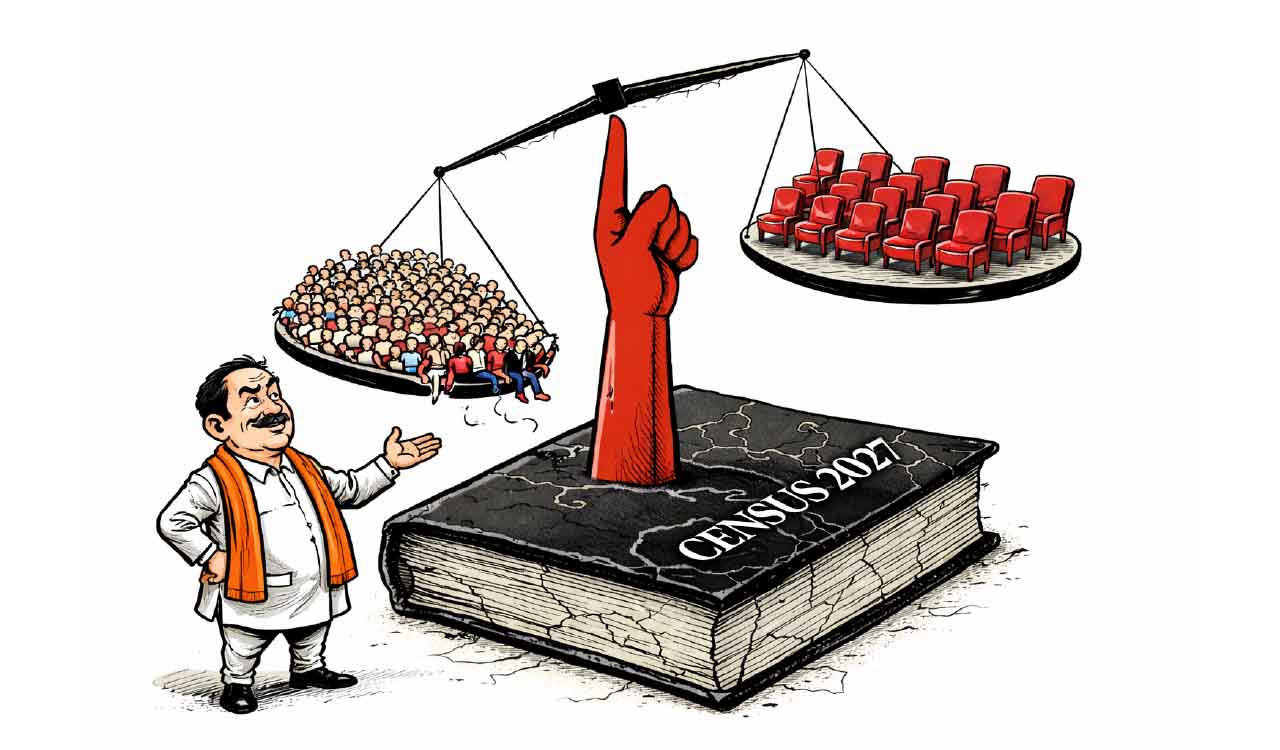
If the 131st Amendment Bill passes as is, it will redefine how half of India participates in its democracy — this is not regional, but a national crisis


By Nayini Anurag Reddy
Bill No. 107 of 2026, the Constitution (One Hundred and Thirty-First Amendment) Bill, has been presented to the nation as a vehicle for women’s empowerment. The government’s framing is that this is the enabling legislation required to operationalise the 2023 Women’s Reservation Act before the 2029 general elections, and that expanding the Lok Sabha from 543 to 850 seats is a necessary precondition for that goal. This framing is, at best, incomplete. At worst, it is a deliberate conflation designed to make opposition to the Bill appear as opposition to women’s representation.
Also Read
The 2023 Act could have been implemented with the existing strength of 543 seats without any delimitation exercise whatsoever. Multiple constitutional scholars and women’s rights advocates have made this argument. The government chose, instead, to bundle women’s reservation with a sweeping restructuring of India’s electoral architecture, one that will determine the political trajectory of every State in the Union for the next half-century.
The Bill amends Articles 55, 81, 82, 170, 330 and 332 of the Constitution. It raises the Lok Sabha’s maximum strength to 815 members from the States and 35 from Union Territories. It de-links delimitation from the upcoming 2027 census. And it does all of this during a special parliamentary session convened with barely days of notice, while Assembly election campaigns are underway in multiple States, with no prior all-party consultation, no expert committee, and no attempt at building the consensus that a constitutional amendment of this magnitude demands.
Clause that Controls Everything
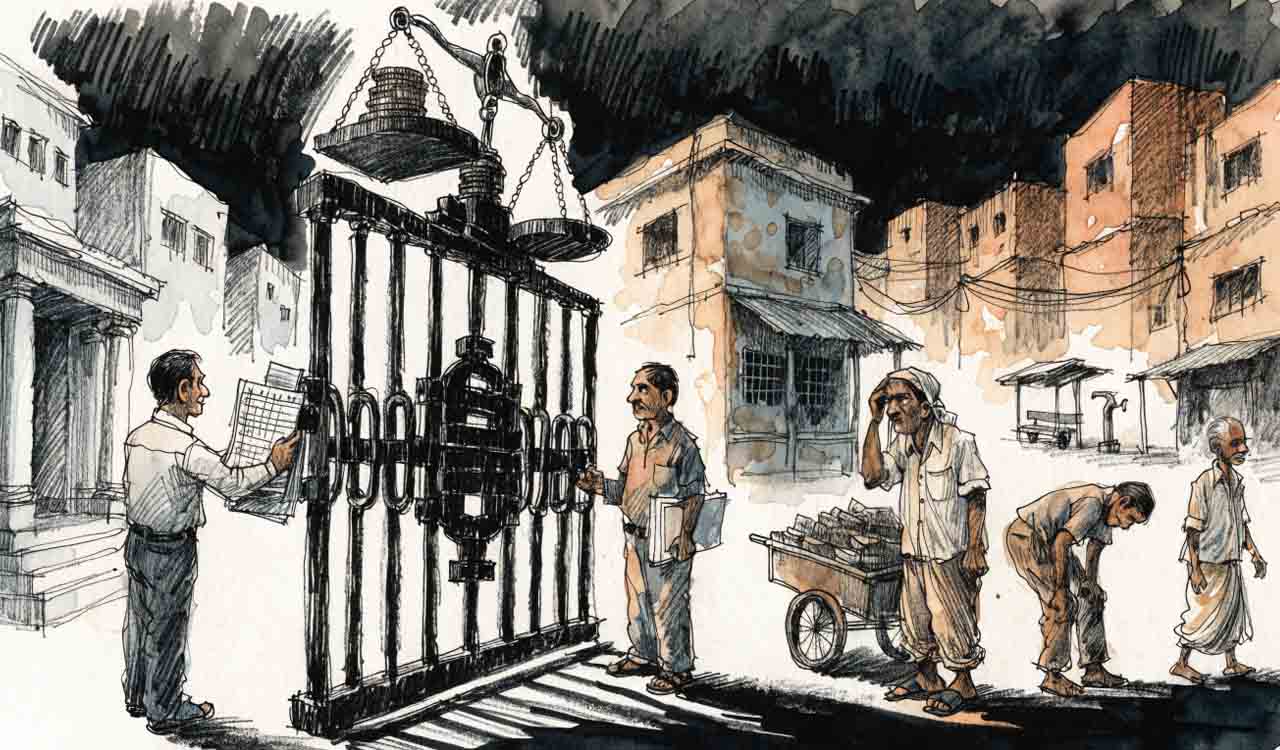
The real danger in this Bill is not the headline number of 850. It lies in a single phrase buried in every clause that redefines “population.” The new language reads: “the population as ascertained at such census, as Parliament may by law determine, of which the relevant figures have been published.” Those words, “as Parliament may by law determine,” accomplish something extraordinary. They transfer the authority to select which census will govern delimitation from the constitutional framework to the discretion of whichever party holds a simple majority in Parliament.
The 84th Amendment of 2001 froze seat allocation based on the 1971 Census specifically to protect States that had successfully implemented population control measures. This Bill lifts that freeze and replaces it with nothing. No minimum seat floor for any State. No cap on how many seats any single State can gain. No formula linking seat allocation to fiscal contribution, human development indices, or governance outcomes. No safeguard of any kind for Southern States.
The 131st Amendment Bill does not merely redraw India’s electoral map — it dismantles constitutional protections that shielded Southern states for five decades, and concentrates power to reshape India’s democracy in the hands of whichever party commands a parliamentary majority
Yet the same Bill demonstrates, in its own text, that the government knows precisely how to draft constitutional protection when the political will exists. Clause 7 inserts sub-clauses 3A and 3B into Article 332, establishing explicit mathematical floors for Scheduled Tribe seat protection in Arunachal Pradesh, Meghalaya, Mizoram, Nagaland and Tripura — a binding formula, embedded in constitutional text, enforceable by any court.
For Telangana, which currently holds 17 Lok Sabha seats: no such formula. For Tamil Nadu with 39, Kerala with 20, Karnataka with 28, Andhra Pradesh with 25: no such formula. The Bill protects where it chooses to protect and is silent where silence serves its purpose.
When Proportional is Partisan
The Government has communicated, off the record, that every State’s seats will increase by a uniform 50 per cent. But this assurance exists nowhere in the Bill’s text. There is no binding formula, no constitutional guarantee, and no enforceable mechanism to hold this promise in place once the legislation is enacted. The Delimitation Commission that will actually allocate these seats and redraw every constituency boundary operates under orders that cannot be challenged in any court of law.
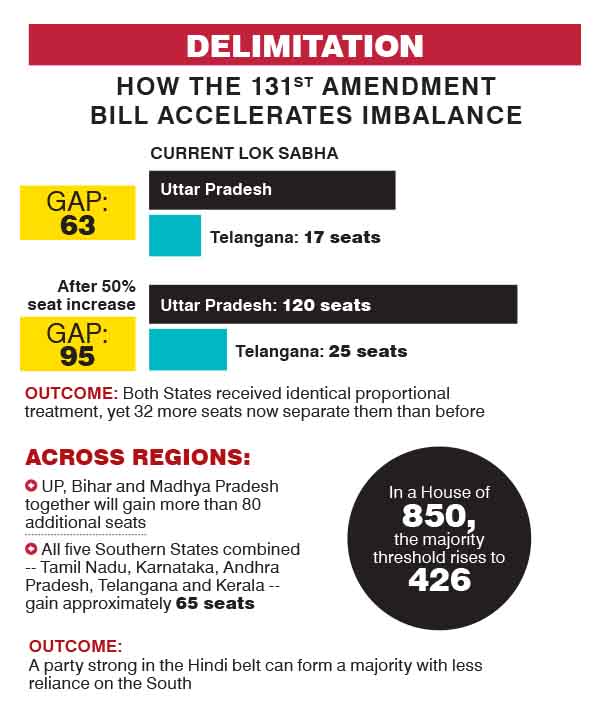
Even assuming the 50 per cent commitment is honoured, the arithmetic of a proportional increase on an unequal base does not preserve balance. It accelerates imbalance. In the current Lok Sabha, the gap between Uttar Pradesh’s 80 seats, and Telangana’s 17 is 63. After a uniform 50 per cent increase, UP holds 120, and Telangana holds roughly 25. The gap is now 95. Both States received identical proportional treatment, yet 32 more seats now separate them than before.
Scale this across regions: UP, Bihar and Madhya Pradesh together gain upwards of 80 additional seats under a pro-rata model. All five Southern States combined, Tamil Nadu, Karnataka, Andhra Pradesh, Telangana and Kerala, gain approximately 65. In a House of 850, the majority threshold rises to 426. The additional seats required to reach that threshold come overwhelmingly from the North.
A party dominant in the Hindi heartland can now construct a parliamentary majority with even less dependence on Southern mandates than before. That is not balance preserved. That is imbalance accelerated, with constitutional sanction.
The Double Punishment
What makes this Bill particularly dangerous is that it does not operate in isolation. It arrives at a moment when Southern States are already bearing the fiscal consequences of the same population control that is now being used to diminish their political voice.
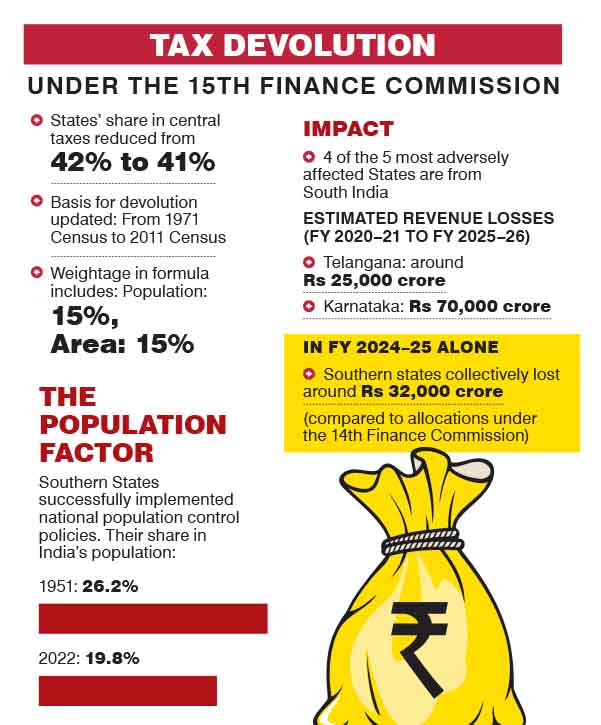
The 15th Finance Commission shifted the basis for tax devolution from 1971 population data to 2011 figures and reduced the States’ aggregate share of central taxes from 42 per cent to 41 per cent. The formula assigns 15 per cent weightage each to area and population. The result has been devastating for the South. Four of the five States that lost the most under the new formula are from South India. Telangana alone has lost an estimated Rs 25,000 crore in its share of Union taxes between FY 2020-21 and FY 2025-26.
Karnataka’s losses over the same period are estimated at Rs 70,000 crore. In FY 2024-25 alone, Southern States collectively lost an estimated Rs 32,000 crore compared to allocations under the 14th Finance Commission. The population share of Southern States has declined from 26.2 per cent in 1951 to 19.8 per cent in 2022, a trajectory that was a direct result of the national population policy that Southern States implemented faithfully.
That demographic achievement is now being used, simultaneously, to reduce the South’s share of central revenues through the Finance Commission and to reduce its share of parliamentary seats through delimitation. This is not two separate policy outcomes. This is a single, compounding structural disadvantage: less money and fewer seats, both flowing from the same cause.
The question before the nation is not whether delimitation should happen. It is whether a democratic republic can sustain a framework in which States that followed national policy, controlled their populations, educated their women, industrialised their economies, and contributed disproportionately to the national treasury are rewarded with diminishing political voice and shrinking fiscal allocations.
Southern States did precisely what the Union government asked them to do for five decades. Bill No 107 of 2026 is the answer they have received. This is no longer a matter for parliamentary debate alone. It is a question that demands the attention of every citizen, every State legislature, every Chief Minister, and every elected representative south of the Vindhyas. The time for polite concern has passed. What is required now is a unified, unambiguous, and sustained assertion of the South’s constitutional rights, not as a favour to be requested but as a principle to be defended.
If this Bill passes in its current form without safeguards, without floors, without any constitutional guarantee of equitable treatment, it will not merely alter seat numbers. It will redefine the terms on which half of India participates in its own democracy. That is not a regional grievance. That is a national crisis. And it must be treated as one.
(The author is an MBA graduate, public policy observer, and entrepreneur based in Hyderabad)

Related News