Opinion: India’s silent energy vulnerability—the looming LPG crisis
Expanding storage capacity and diversifying supply sources must become urgent national priorities


By Brig Advitya Madan
As tensions escalate in West Asia and the Strait of Hormuz remains precariously vulnerable, India faces an energy risk that receives far less attention than crude oil — the possibility of a Liquefied Petroleum Gas (LPG) supply shock. If the ongoing conflict extends into April and maritime routes remain disrupted, India could confront a serious LPG shortage that directly affects millions of households.
Also Read
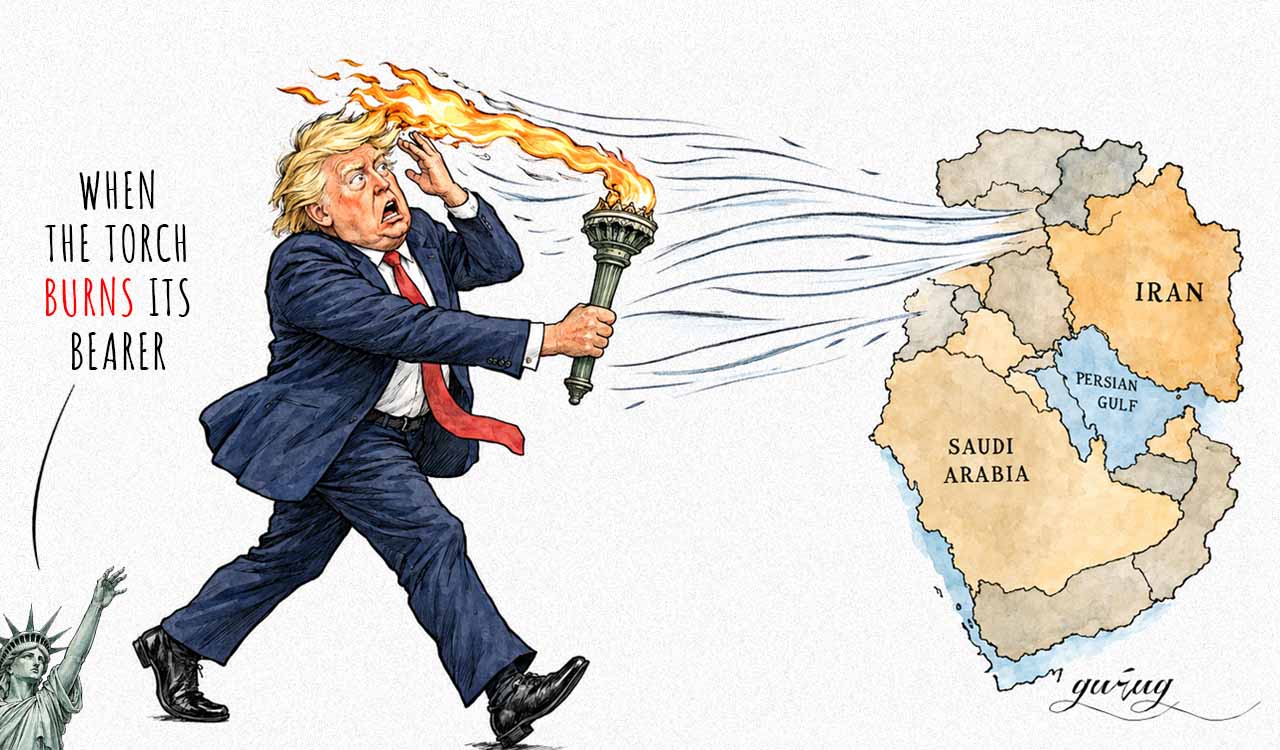
The Strait of Hormuz, through which a significant share of global energy shipments pass, continues to remain under threat amid persistent drone and missile exchanges between Iran, the United States and Israel. Meanwhile, Washington’s strategic messaging has been evolving. What initially began as negotiations over Iran’s ballistic missiles and regional proxies gradually shifted — after the outbreak of hostilities — to the destruction of Iran’s nuclear infrastructure, regime change, and even demands for unconditional surrender. The shifting goals indicate that the conflict may not end quickly.
India has only two underground LPG storage caverns —at Mangalore and Visakhapatnam, which together can store approximately 1.6 lakh tonnes of LPG, equivalent to just two days of national consumption
In such circumstances, it is plausible that the United States and Israel will continue military operations until Iran’s stockpile of missiles and drones is significantly degraded. For them, the confrontation has assumed a do-or-die character. However, for countries like India — geographically distant from the battlefield but deeply dependent on West Asian energy supplies — the consequences could be immediate and severe.
India’s Growing LPG Dependence
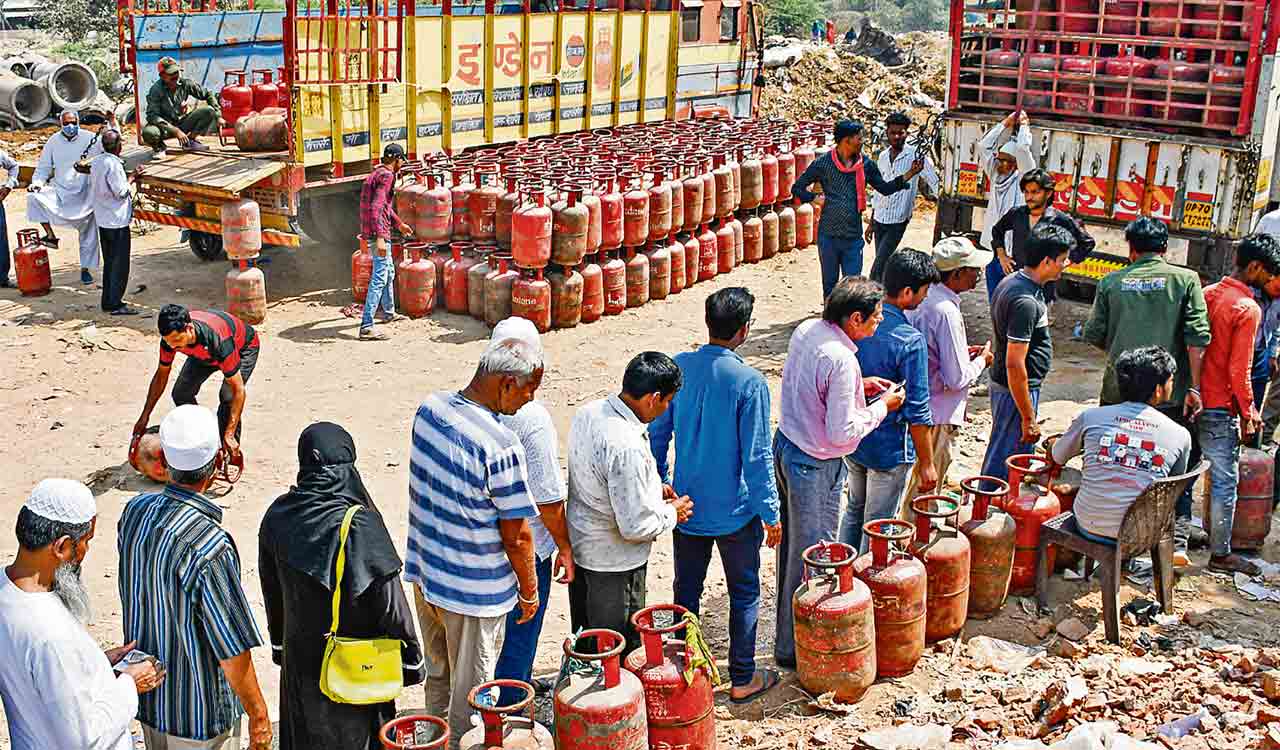
Unlike crude oil disruptions that typically influence transport and industry, LPG shortages directly affect households. Over the last decade, India’s dependence on LPG has expanded dramatically due to policy-driven social transformation.
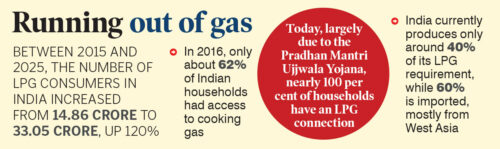
Between 2015 and 2025, the number of LPG consumers in India increased from 14.86 crore to 33.05 crore, representing a staggering 120 per cent rise. In 2016, only about 62 per cent of Indian households had access to cooking gas. Today, largely due to the Pradhan Mantri Ujjwala Yojana, nearly 100 per cent of households have an LPG connection.
While this expansion has been a major public health and welfare success, it has also sharply increased India’s demand for LPG cylinders. Unfortunately, infrastructure for strategic storage has not grown at the same pace. India currently produces only around 40 per cent of its LPG requirement, meaning 60 per cent must be imported, largely from West Asia. This structural dependence makes the country vulnerable to disruptions in maritime supply routes.
Strategic Storage: India’s Weak Link
Energy security is not just about production and imports; it is also about storage. In this regard, India’s LPG reserves remain extremely limited.
At present, India has only two underground LPG storage caverns — one at Mangalore and the other at Visakhapatnam. Together, they can store approximately 1.6 lakh tonnes of LPG, which is equivalent to just two days of national consumption.
The Visakhapatnam cavern was commissioned in 2007, while the Mangalore cavern became operational only recently in 2025. The latter alone holds about 80,000 tonnes, roughly equal to one day’s consumption.
To put this in perspective, India consumes roughly 80,000 tonnes of LPG every day, and 85 per cent of it is used by households. Any disruption lasting even a week could therefore create serious supply pressures.
Concerns about India’s limited LPG storage capacity have previously been flagged by the International Energy Agency, which recommended that India significantly expand its strategic reserves to match its growing demand.
Imports and Supply Routes
India today consumes roughly 31 million tonnes of LPG annually, but domestic production stands at only 13 million tonnes. The gap is met through imports.
Over the past decade, India’s LPG imports have risen sharply — from 13.5 million tonnes in 2011 to around 27 million tonnes in 2025. Consequently, the share of imports in India’s LPG consumption has increased from 47 per cent in 2014 to about 60 per cent today.
India is currently the second-largest LPG consumer in the world, with monthly consumption touching around 3 million tonnes. The country imports LPG from six major suppliers — Qatar, the United Arab Emirates, Kuwait, Saudi Arabia, Oman and the United States.
Among these, Qatar remains the largest supplier, accounting for 34 per cent of India’s LPG imports. The United Arab Emirates supplies about 26 per cent, while Kuwait contributes roughly 8.3 per cent. Smaller volumes also come from the United States, Saudi Arabia, and Oman.
Most shipments from West Asia reach Indian ports within six days, thanks to proximity through the Strait of Hormuz. However, imports from the United States take about 45 days to arrive.
India recently signed an agreement to import 2.2 million tonnes of LPG per annum from the United States, but the longer shipping time means these supplies cannot immediately compensate for disruptions in the Gulf.
Production Constraints at Home
Increasing domestic LPG production is not as simple as turning a switch. LPG is produced primarily during crude oil refining, especially through fluid catalytic cracking (FCC) units in refineries. These units break heavier hydrocarbon fractions into lighter products, including LPG. However, the same process also produces propylene, which is used to manufacture polypropylene, an essential raw material for plastics and synthetic rubber. Additionally, these units generate naphtha, which is further processed to produce petrol.
While catalysts in FCC units can be modified to increase LPG output, doing so may reduce propylene production and even affect petrol quality. In other words, refinery operations require a delicate balance between LPG output and other essential petrochemical products.
Recognising the current risks, the government has already directed refining companies not to divert propane and butane — key LPG components — for petrochemical manufacturing.
The Way Forward
The current geopolitical turbulence offers a sobering reminder that energy security must extend beyond crude oil. India urgently needs to expand its strategic LPG storage capacity.
One promising initiative is the proposed construction of salt caverns in the Bikaner–Barmer region of Rajasthan, where geological formations are suitable for underground storage. India has already entered into a partnership with a German company for the required salt cavern technology. Accelerating this project could significantly strengthen India’s ability to withstand supply disruptions.
In an era where energy supply chains are increasingly vulnerable to geopolitical shocks, strategic reserves act as an insurance policy. For a country with more than 33 crore LPG consumers, ensuring uninterrupted cooking fuel supply is not merely an economic necessity — it is a matter of social stability.
The lesson from the present crisis is clear: expanding storage capacity and diversifying supply sources must become urgent national priorities. Energy security, after all, begins in the kitchen.

(The author is a retired Army officer)

Related News