Opinion: KCR and the power of public trust
The deeper history of a government is written in the everyday lives of its people. KCR’s 24-hour free farm power became a defining policy that reshaped Telangana’s rural development narrative


By Chitikena Kiran Kumar
Electricity is not merely power flowing through wires; it is the energy that brings greenery to a farmer’s field, light to a home, productivity to an industry, and movement to rural life. The changes witnessed in Telangana after the formation of the State gave special significance to the decisions taken by the government led by K Chandrashekhar Rao.
Also Read
For farmers who once waited uncertainly for electricity, the availability of 24-hour free power for agriculture marked a significant change in their everyday lives. It was not merely an administrative decision but a policy that touched the roots of rural life. That is why many people continue to remember the KCR period not simply as a political chapter, but as a period associated with their own experience of development.
For a farmer, when the motor stops, the water supply stops. When water stops, the hope connected with the crop becomes uncertain. Recognising this ground reality, the KCR government gave importance to 24-hour free electricity for agriculture. Its objective was not limited to supplying electricity; considerable attention was given to strengthening generation, transmission and distribution infrastructure. The agricultural sector, in particular, gained a new sense of confidence because the farmer could plan cultivation with greater certainty.
Powering Development
During the TRS period, which later became the BRS, electricity was viewed not merely as one department of administration but as an important foundation connected with agriculture, irrigation, industries and the rural economy.
Schemes such as Rythu Bandhu and Rythu Bima formed part of a wider approach towards farmer welfare. Mission Kakatiya, Mission Bhagiratha, irrigation projects and reliable electricity were interconnected in the larger development journey of rural Telangana. The idea was clear: when the farmer receives water, electricity and financial support together, the foundation of rural economic life becomes stronger.
There was a time when power shortage was considered an unavoidable problem in Telangana. The transformation that followed was therefore significant. Electricity generation capacity, transmission networks, substations and distribution infrastructure received attention on a large scale. The increase in power demand also reflected the changing economic needs of the State. Agriculture expanded, industries grew and household consumption increased. Strengthening the power sector became an essential part of the development process.
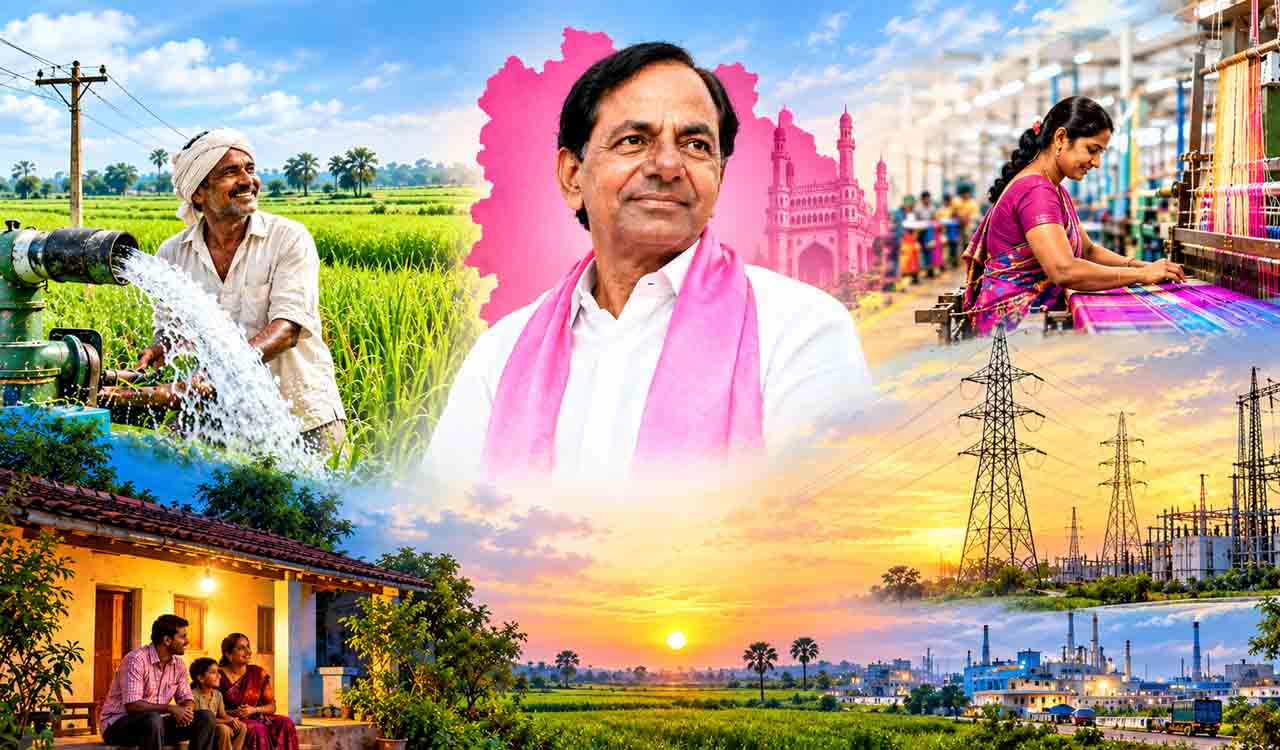
From farmers’ fields to Sircilla’s looms, reliable electricity became a symbol of development under KCR, shaping public memory and Telangana’s political debate
Electricity is not just an urban necessity; it is also the backbone of village life. From a farmer’s borewell motor to a small industrial machine, and from a school or hospital to a shop or household, every activity depends on a reliable power supply. During the KCR-led government, uninterrupted electricity gradually became an important public expectation. For many people, the change was not something they merely heard about; it was something they experienced in their daily lives.
The importance of electricity becomes even more visible in places such as Sircilla, where handloom, powerloom and textile activities are closely connected with the livelihood of thousands of families. For these communities, electricity is not simply a convenience. It is the force that keeps the looms running and the local economy active. When a machine stops, production is affected; when production suffers, family incomes are affected. Dependable electricity therefore has a direct bearing on the economic lives of local communities.
Preserving Foundation
The political significance of the KCR period is closely connected with such experiences. Political slogans may change, but the memory of development remains in the minds of people when they have personally experienced it. A farmer who could run his motor with greater confidence, a family that enjoyed a reliable power supply, and a small industrial unit that could operate its machinery without constant fear of interruptions naturally remembers the period in which these changes became visible.
At the same time, Telangana’s electricity requirements have been increasing rapidly. Industrial growth, expanding agricultural activity, urbanisation and rising household consumption are putting greater pressure on the power sector. The challenge before any government is not only to maintain the existing infrastructure but also to prepare the State for future demand. The foundations created in the past must be protected, strengthened and expanded to meet changing requirements.
Power-related political debates will naturally continue. Different political parties may present different interpretations of the situation. But electricity is ultimately a matter that touches ordinary life directly. The farmer wants dependable power for cultivation, the industrial worker wants uninterrupted production, the entrepreneur seeks stability, and a household expects reliable electricity. Beyond political arguments, these expectations remain at the heart of the issue.
Impact on Lives
In this context, it is natural for people to discuss the foundations laid during the KCR regime. Governments change, but the impact of their policies does not disappear immediately. When a policy continues to influence people’s lives even after a government leaves office, it becomes part of public memory. The 24-hour free electricity for agriculture is one such policy that continues to feature in discussions about the future of farming and rural development.
The KCR approach to development also extended beyond electricity. Farmer welfare programmes, irrigation initiatives, drinking-water projects, infrastructure development and support for rural livelihoods were presented as interconnected components of progress. Electricity provided the energy behind many of these activities. For this reason, the discussion on the power sector cannot be completely separated from the larger development experience associated with the TRS government and its subsequent BRS phase.
Politics may change with every election. Governments may change and new promises may enter the public arena. But people do not easily forget the changes that they have experienced in their fields, homes, workplaces and villages. This is particularly true in rural areas, where development is measured less by speeches and more by what reaches the ground. In that sense, the political journey of KCR and the BRS remains connected with the memories and experiences associated with their years in government.
Public trust is never built in a single day. It develops through years of administration, visible work and personal experiences. The emphasis on agriculture, 24-hour free power, farmer-oriented welfare measures and infrastructure development together shaped a distinct development narrative during the KCR period. Therefore, whenever the question of electricity and rural development becomes a subject of public debate, the contribution of the KCR-led government naturally forms an important part of the discussion.
The real strength of a political movement is ultimately reflected in people’s memories. In villages, in the fields, beside the looms of Sircilla and in the homes where the lights stayed on, development acquired a human face. For many, the KCR period continues to represent that experience of confidence. Political history may be written in election results, but the deeper history of a government is written in the everyday lives of its people. Memories of that development remain an important part of Telangana’s political and social history.
(The author is a poet, writer and columnist)

Related News